
Sheet Pile Contractor Miami: Deep Excavation Support in Water Bearing Ground
In Miami a sheet pile wall is a water control structure before it is an earth retention structure. The ground under this city holds water and moves it fast, the table sits close to the surface, and any deep cut here is a hole somebody is trying to keep dry inside an aquifer.
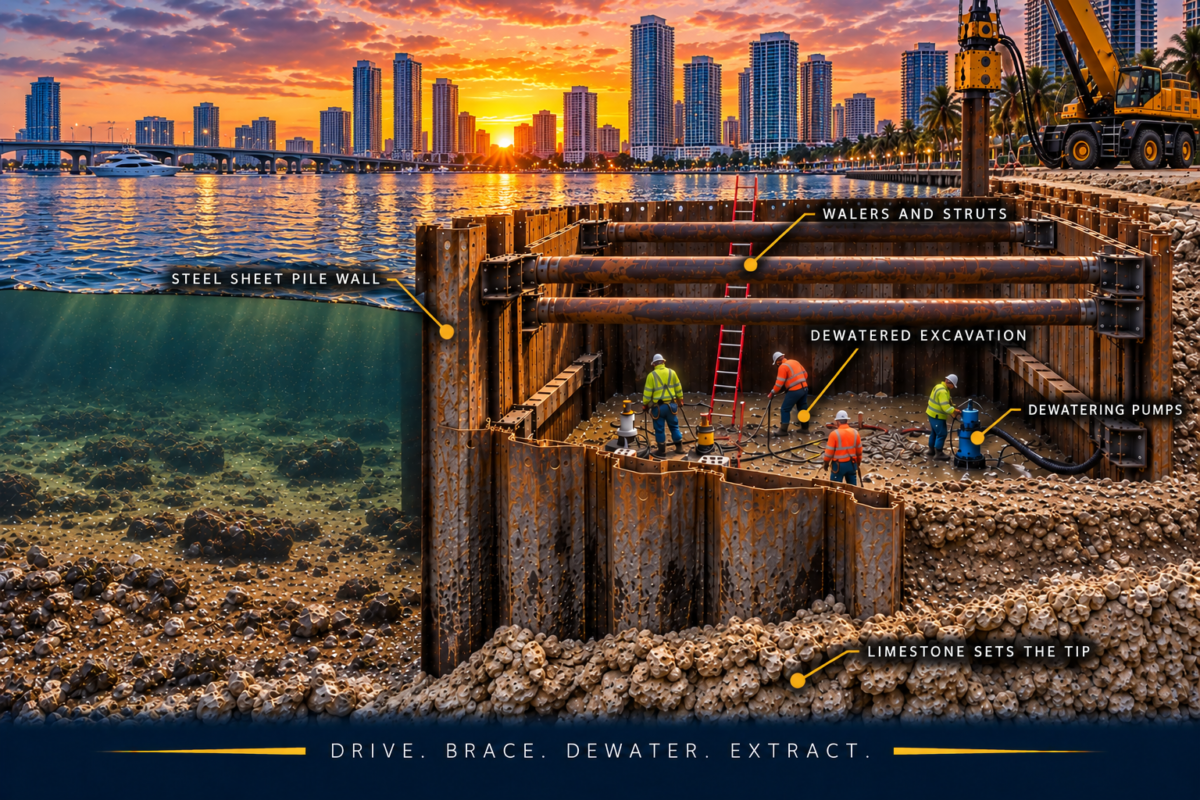
Which is why more pump is rarely the answer. Pumping harder in permeable ground pulls water from farther away, and what travels with that water is fines out of the ground under whatever is standing next door. The wall has to cut the water off, and how deep it goes to do that is set by the geology rather than by how deep you want to dig.

We engineer the wall, source or rent the steel, drive it with our own crews, and pull it back out. Four scopes that are normally split across four companies, which is where most sheet pile schedules come apart.
Miami Dade, Broward and Monroe counties, and statewide on larger jobs. Miami, Miami Beach, Coral Gables, Coconut Grove, Doral, Hialeah, Aventura, Key Biscayne, Homestead, Hollywood and Fort Lauderdale.
How far below the water table the cut goes, whether the wall can reach something tight enough to cut off against, and what is standing within a few feet of the excavation. Those three answers move a Miami number more than wall height does.
Sheet Pile Work Across Florida
Foundation Masters runs sheet pile work statewide, and the conditions change hard from one market to the next. Tampa Bay sits on shallow limestone and brackish water. Orlando is inland sand with vibration sensitive neighbors. Jacksonville is river and organics. Miami is deep excavation under a high water table. Each page covers what actually governs there.
The Water Is in the Rock, and You Do Not Out Pump Rock
Three conditions decide most sheet pile jobs here, and none of them are the ones that govern anywhere else in the state.
The first is that the water is in the formation rather than only in the soil, and the formation moves it readily. An open cut below the table is not draining down to a level and stopping. It is being fed, continuously, from every direction, for as long as the hole is open.
The second follows from it. Cutoff beats pumping. A wall that reaches something tight enough to seal against turns the problem into a manageable volume inside the box. A wall that stops short leaves a path underneath it, and the pumps then run against the whole aquifer instead of against the hole. Excavation support work of this kind also sits under the OSHA excavation standard at 29 CFR 1926 Subpart P, which is where the protective system requirements come from.
The third is proximity. Miami cuts happen on lots with no room around them, and the thing that usually moves a neighboring building here is not vibration. It is water leaving the ground and taking fines with it. That damage is quiet, it happens below everything, and it is almost entirely preventable by cutting the water off instead of chasing it with pumps.
What That Changes on Your Job
- Wall depth is set by where a cutoff is achievable, not by the excavation depth plus a rule of thumb
- If nothing tight is within reach, the design changes rather than the pump schedule
- Interlock tightness becomes a performance item, because a cutoff wall leaks at its joints first
- Deep cuts get internally braced, since there is rarely room behind the wall for a tieback
- Monitoring watches groundwater and settlement next door, not just the wall itself
- Near the bay a permanent wall is also a marine wall, which changes the steel and the coating
What We Actually Do With Sheet Pile
Four things, and most contractors in this market do one or two of them. Holding all four is what lets us solve a problem in the field instead of writing a letter about it.
Engineer the Wall
Our Florida licensed engineers produce signed and sealed sheet pile design, with the section, the cutoff, the bracing and the sequence worked out together. See structural engineering drawings.
Source the Material
We can get any section. PZ, PZC, NZ, AZ, flat web, cold formed, new or used. If it rolls or it exists in the secondary market, we can put it on your site.
Rent, Sell or Buy Back
Rent the sheets for a temporary wall, buy them outright, or sell us the ones you are finished with. See steel sheet piles for sale and sell your sheet piles.
Drive and Extract
Our own crews and rigs, from the first sheet to the last one pulled. Pile driving is our trade, not a subcontract we manage.
Brace the Cut
Walers, struts and corner bracing for deep excavations with no room behind the wall for an anchor, sequenced with the dig rather than after it.
Cutoff and Dewatering
Groundwater control designed with the wall instead of bid against it, so the pumps are handling a box rather than the whole formation.
Where Sheet Pile Earns Its Keep in South Florida
These are the scopes that come up repeatedly in this market, and each one puts a different demand on the wall.
Deep Excavation Support
The dominant scope here. A braced box holding a cut open below the water table while the permanent structure goes in, then taken back out.
Below Grade Structures
Basements, podium levels and below grade parking, where the wall has to hold the ground and the water for the whole build. See drainage and waterproofing in Miami.
Shoring Beside Existing Buildings
Cuts with a neighbor on the property line, where protecting the structure next door is the governing design condition rather than an afterthought.
Cofferdams
Pump stations, outfalls and structures in or beside the water, where the wall holds the ground and the water at once. See cofferdams in Florida.
Seawalls and Bulkheads
Permanent marine walls on the bay and the canals, where the steel and the coating decision carries the structure for decades. See seawall contractors.
Utility and Lift Station
Tight deep shafts for municipal work, usually on a live street with traffic on one side and a building on the other.
Sheet Pile Work We Have Done
Described by scope and county rather than by client, because most of this work sits under agreements we do not publish.
- A steel sheet pile retaining wall on a Pasco County development tract, designed and built as permanent grade separation
- Sheet pile walls and driven piles on a county bridge replacement program in Central Florida
- A sheet pile cofferdam for a Central Florida water authority pump station, with the dewatering in the same scope
- Temporary cofferdam and dewatering design for a state agency coastal impoundment project
- A sheet pile wall pursued for a Pinellas County school site, where we walked because the ground did not support what the budget assumed
The Order That Keeps It From Going Sideways
Front loading the subsurface is the whole trick, and here it decides the groundwater strategy before it decides anything else.
We start with what is under the site and what the water is doing in it, because that is what says whether a cutoff is reachable. If it is, the wall gets designed to reach it and the dewatering gets sized for a box. If it is not, we say so early and the approach changes, which is a conversation nobody enjoys and everybody would rather have at design than at forty feet.
Then the sequence. Drive, install each level of bracing as the dig comes down to it, dewater inside the box, build, backfill, remove the bracing in reverse, pull the sheets. Every brace level is a hold point, because a deep cut in this ground is only ever as safe as the support that is actually installed at that moment.
What We Need From You to Quote a Miami Sheet Pile Job
Nobody in this market publishes this, which is why the first week of a sheet pile job is usually spent trading emails. Send what you have and we can put a real number in front of you.
The first half of the list is the same anywhere. The second half is the Miami half, and it is the part that moves the price here, because the groundwater and the neighbors decide the method, the wall depth and the bracing far more than the cut depth does on its own.
Send Us Whatever You Have
- Site address and survey, so we can see the footprint and the access
- Geotechnical report or boring logs, or tell us there are none and we will run them
- Excavation depth, and the finished subgrade elevation
- Wall length and geometry, including corners and returns
- Temporary or permanent, and how long a temporary wall stays in the ground
- Groundwater depth and any permeability or pump test data, because that is what decides whether a cutoff is reachable
- What is standing next to the cut, how close it is, and what it is founded on
- Whether a dewatering permit exists, and where the discharge is allowed to go
- Whether there is any room behind the wall, which decides bracing against anchors
- Access, overhead clearance, laydown room and street or lane closures
Nearly Everything Here Comes Back Out, Which Makes Renting the Default
This market runs on support of excavation. The box goes in, the building goes up inside it, and the steel comes back out. On a wall with a known end date, renting wins outright and it is not close.
Buying earns its place in two cases. A permanent wall that stays in the ground as part of the structure, and a contractor who already knows the same sections are showing up on the next three jobs. Outside those, buying sections for a six month cut and then storing them is money left on the ground.
We rent, sell and buy back, and we will tell you which one is cheaper for your job even when it is not the one that bills highest. A contractor talked into buying sheets they never use again does not call back, and we would rather have the next job.
Sections We Work With
Any profile family in common use. These are the ones that come up most on South Florida work.
- PZ and PZC hot rolled Z sections, the workhorse for braced excavation support
- NZ and AZ Z sections, widely available new and used
- Heavier Z sections where a deep braced cut needs the section modulus
- Combination wall systems where a Z section alone will not carry it
- Flat web PS sections where a cellular structure is called for
- Cold formed sections for lighter and shallower utility work
Sheet Pile Contractor Miami: Frequently Asked Questions
What does a sheet pile contractor in Miami actually do?
Four things that are usually split across four companies. We engineer the wall, source or rent the steel, drive it with our own crews and rigs, and pull it back out when the temporary works are finished. On a deep braced cut that matters more than it sounds, because a problem in the field gets solved in the field rather than becoming a letter about whose scope it was.
Why can you not just pump a Miami excavation dry?
Because the water is in the formation and the formation moves it readily, so an open cut below the table is being fed continuously rather than draining to a level and stopping. Pumping harder pulls water from farther away and brings fines with it out of the ground under whatever is standing nearby. The wall has to cut the water off so the pumps are handling a defined box instead of the whole formation.
What decides how deep the sheet pile has to go?
Where a cutoff is achievable, not the excavation depth plus a rule of thumb. The wall needs to reach something tight enough to seal against, and that elevation comes out of the borings and the groundwater data rather than off a drawing. A wall that stops short leaves a path underneath it, which is the most expensive way to find out the data was thin.
What if there is nothing to cut off against?
Then the approach changes rather than the pump schedule. That is a design conversation, and it is one we would rather have early than at depth with a hole open. It is also the single most useful thing a geotechnical report can tell you on a South Florida job, and the one most often missing from the ones we are handed.
Can you excavate next to an existing building in Miami?
That is most of this market. What governs is usually not vibration. It is water leaving the ground and taking fines with it from under the neighbor, which is quiet, happens below everything and rarely gets blamed on the right cause. A preconstruction condition survey, groundwater and settlement monitoring, and a wall designed to cut off rather than to drain are what prevent it.
Do you brace the excavation, or only drive the wall?
We brace it. On a deep Miami cut there is usually no room behind the wall for a tieback, so the support goes inside the box as walers, struts and corner bracing, installed level by level as the dig comes down. Each brace level is a hold point, because the cut is only ever as safe as the support actually installed at that moment.
Do you design the wall, or do I need a separate engineer?
We design it. Our Florida licensed engineers produce signed and sealed sheet pile design, which is unusual among installers in this market. It also removes the most common failure point on these jobs, which is a wall designed by somebody who has never had to drive one, with a bracing scheme that cannot actually be installed in the sequence the dig requires.
Do you handle the dewatering as well?
Yes, and we scope it with the wall rather than after it. The wall and the groundwater control are one problem here, not two contracts. When the cutoff is designed by one party and the dewatering is bid by another, the pumps end up sized for an assumption nobody owns, and the cost of that shows up as standby and as damage next door.
Do you rent sheet pile, or only install it?
Both, and we sell it and buy it back. Nearly everything in this market is temporary and comes back out, which makes renting the right answer far more often than not. Buying earns its place on a permanent wall, or for a contractor who already knows the same sections are showing up on the next several jobs.
Does salt water matter on a Miami sheet pile wall?
On a permanent wall near the bay or on a canal, yes, and it drives the section and the coating rather than the installation. On a temporary braced cut that comes out in months, it does not. The question to settle at design is which of those two the wall actually is, because the answer changes what you should be buying.
What do you need from me to quote a sheet pile job?
Site address and survey, boring logs if they exist, excavation depth, wall length and geometry, and temporary or permanent. Then the Miami half: groundwater depth and any permeability or pump test data, what is standing next to the cut and what it is founded on, whether a dewatering permit exists and where discharge is allowed, and whether there is any room behind the wall for an anchor.
What areas around Miami do you cover?
Miami Dade, Broward and Monroe counties, and statewide on larger work. That includes Miami, Miami Beach, Coral Gables, Coconut Grove, Doral, Hialeah, Aventura, Key Biscayne, Homestead, Hollywood and Fort Lauderdale.
Engineering That Has Been in the Hole It Designed
Foundation Masters, LLC has been a licensed civil engineering company since 2004 and has worked in Florida since 2014 under Florida Certificate of Authorization CA number 30969.
Our team carries over 125 years of combined experience across structural, civil and geotechnical engineering, and the construction side runs under our own license rather than through a broker.
Related Miami Engineering
- Geotechnical engineering in Miami, where the borings and the groundwater picture come from
- Structural engineering in Miami for the permanent structure the wall supports
- Civil engineering in Miami for site, stormwater and permitting
- Soil borings, the step that decides whether a cutoff is reachable
- Drainage and waterproofing in Miami for the below grade structure that goes in the box
- Steel corrosion in Florida marine service
- Deep foundation systems when the wall is only part of the answer
Tell Us How Deep the Hole Goes and What the Water Is Doing
Foundation Masters, LLC engineers, supplies, rents, drives and extracts steel sheet pile across Miami and South Florida. One company from the boring log to the last sheet pulled.