
Bridge Contractor Alabama
Foundation Masters, LLC. Licensed Florida engineering firm, CA# 30969. Residential and light commercial bridge design and construction across Alabama, from the Tennessee Valley to Mobile Bay.

Alabama has more miles of navigable river than any other state in the country, and a great many more miles of creek that never show up on a navigation chart but still have to be crossed to get home. Foundation Masters designs and builds those crossings: private drives, development entrances, farm and timber access, and the replacement of spans that have quietly stopped being safe.
We are a design build firm, which means the investigation, the drawing and the structure all come out of one shop instead of three. Jeff Earl founded Foundation Masters after two decades in deep foundations, earth retention and structural repair, and a licensed professional engineer seals the plan set before anything gets driven.
Alabama sits inside a Southeast footprint that also covers Florida, Georgia, Mississippi, Tennessee, South Carolina and North Carolina. Everything is indexed on the bridge contractor hub.
The Fall Line Decides What Your Foundation Can Reach
There is a line that runs diagonally across Alabama, roughly through Phenix City, Montgomery and Tuscaloosa, where the hard rock of the interior disappears under the sand and clay of the coastal plain. North of it, a pile is looking for rock and will usually find it. South of it, there is no rock within practical reach and capacity has to be built a completely different way. Everything about how a bridge foundation gets designed here follows from which side of that line the crossing sits on.
Plateau and Valley and Ridge
Huntsville, Birmingham, Gadsden, Anniston and Jasper. Sandstone and shale on the plateau, folded limestone and dolomite in the valleys. Rock can be shallow and then drop away over a short distance, so depth to bearing is rarely uniform across one crossing.
The Birmingham valley also has genuine solution activity in its limestone. That is covered below.
The Piedmont
Auburn, Opelika, Alexander City, Sylacauga and Talladega. Gneiss and schist under a blanket of saprolite, which is rock that has weathered in place into something that handles like stiff soil.
Saprolite depth can swing many feet between two points a short distance apart. A single boring is not a survey here.
Upper Coastal Plain and the Black Belt
Montgomery, Tuscaloosa, Selma, Demopolis and Marion. Sand and clay over chalk, including the high plasticity clay prairie that gives the Black Belt its name and its reputation.
No rock to drive to. Capacity comes from friction and from getting the abutment loads spread properly.
The Gulf Coast
Mobile, Daphne, Fairhope, Foley and the beach communities. Soft deltaic and bay deposits, a water table that is frequently within a few feet of grade, and storm surge as a design event rather than a hypothetical.
Deep piles, scour protection and uplift on the superstructure all matter more down here than span length does.
Black Belt Clay and Why It Moves Abutments
The Black Belt prairie is some of the most productive farm ground in Alabama and some of the least forgiving ground to put a concentrated load on. The clay there has high plasticity, which in plain terms means it swells when it takes on water and shrinks when it gives it back, and it does that seasonally, year after year.
A bridge abutment founded in that zone does not fail all at once. It heaves in the wet season, settles in the dry one, and after enough cycles the bearing seats are no longer where the drawing put them. You see it as a bump at the approach, then as cracking in the abutment face, then as a deck that no longer sits flat.
The design answer is to get the load below the active zone rather than to make the footing bigger inside it, and to keep water from pooling against the abutment in the first place. That is a soil boring question before it is a structural one, which is why we take borings at the abutment locations on this side of the state rather than working from a regional assumption.
This page covers Alabama. The rest of the bridge practice is below.
The FM-H20 Fire Truck Rated Bridge
A loaded pumper weighs somewhere north of fifteen tons. The pickup that has been crossing your bridge for years weighs three. Those are not the same question, and on a long private drive in Alabama there is usually no second way in. The FM-H20 is the bridge we build so that the answer is yes before anybody has to ask.
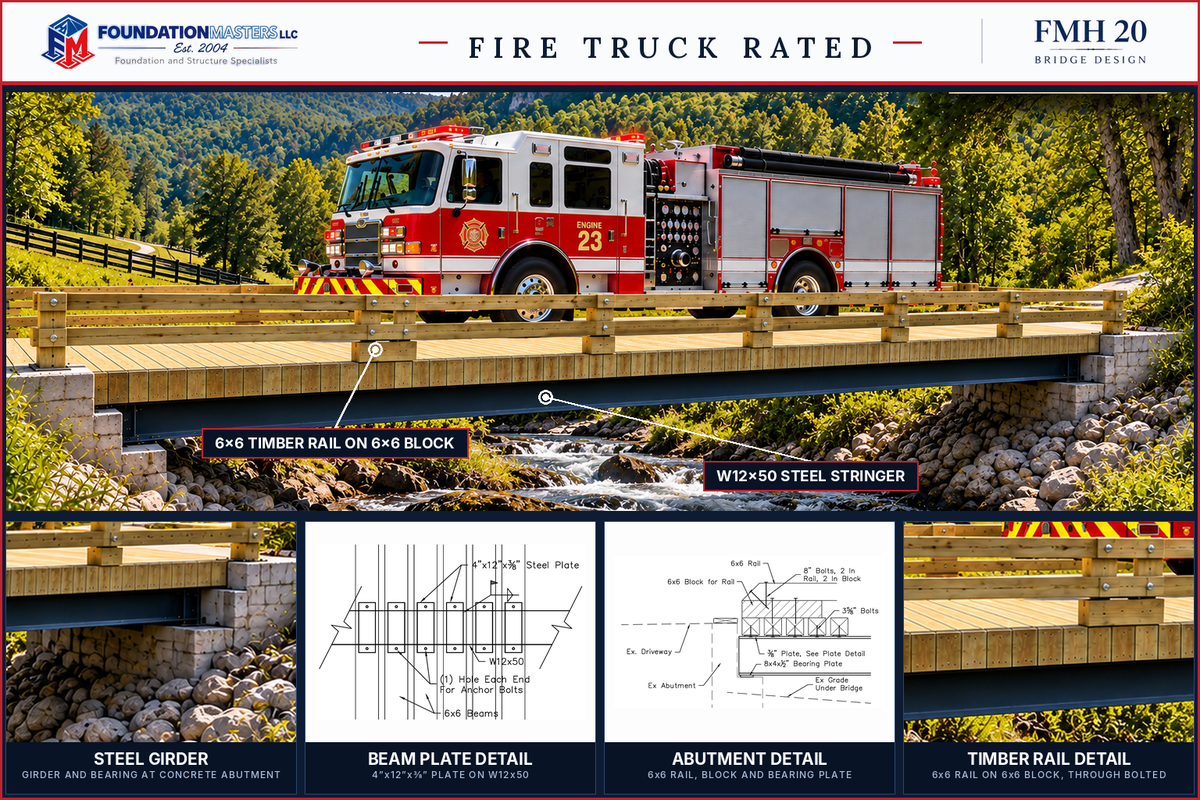
FM-H20 Specification
- Steel girder superstructure with timber deck
- Fire truck H-20 loading, 20 ton deck capacity
- Maximum span up to 60 feet
- Abutments rated to 80 tons at a 2 to 1 safety factor
- Vinyl sheet piling at the abutments, driven 60 inches below the mud line
- Lifetime warranty
Why the Sheet Pile Is Not Optional
Erosion is the leading reason private bridges fail, and Alabama gives it plenty of opportunity. A plateau branch can come up several feet in an afternoon, and the first thing fast water finds is the loose fill packed in behind an abutment.
Vinyl sheet pile driven below the mud line puts a wall between the stream and that fill. Embedment gets set by the crossing and the soil, not by a catalog default.
Full detail on the FM-H20 fire truck rated residential bridge page. Starting price is around 3,300 dollars per linear foot.
Foundations: The FM-PP30 Driven Pipe Pile
Four FM-PP30 piles carry each abutment. Three inch schedule 40 pipe, thirty tons apiece, driven with a pneumatic hammer by our own crews. Driven rather than hydraulically pressed matters on a tight bank, because a pressed pile has to react against structure that is not there yet and a driven one does not.
What the pile is hunting for depends entirely on where you are. In the valleys around Birmingham and Gadsden it is driven to refusal on limestone or dolomite, and it often gets there quickly. In the Piedmont it has to get through the saprolite and into sound rock, which is deeper and far less predictable than the surface suggests. Below the Fall Line, through the Black Belt and down to Mobile Bay, there is nothing hard to reach at all, so the pile is driven until it develops capacity in the sand and clay, and that means a substantially longer pile. One system, three different jobs.
This is also where the pipe pile approach earns its place over a drilled shaft on a residential job. The rig is small enough to work on a creek bank, and driving to refusal tells you what you have as you go instead of after the concrete cures.
Solution Features in the Birmingham Valley
The limestone and dolomite under Jefferson and Shelby Counties is soluble, and water has been working on it for a very long time. What that leaves is solution channels, soft seams and occasional open voids underneath ground that reads as perfectly sound from the surface.
A bridge abutment is a heavy load in a small footprint, which is precisely the case a shallow void does not survive. Where the geology says solution activity is likely, we take borings at the abutment locations and design from measured refusal rather than from a regional average. Foundation Masters does sinkhole and void work as a core part of the practice, not as something we take on occasionally, and on an Alabama valley crossing that is the difference between a foundation seated on rock and one seated on the roof of something.
Timber Traffic Is a Different Loading Problem
Roughly two thirds of Alabama is forest, and a lot of private crossings in this state exist so that something heavy can get out of the woods. That changes the design question from what is the heaviest vehicle to how many heavy passes does this deck see in a year.
Tell Us About the Trucks Before We Draw It
A loaded log truck, a chip van, a loaded hay trailer or a tracked machine on a lowboy each put a different footprint on a deck, and repeated passes fatigue connections in a way a single crossing never does. A deck sized for a fire engine once a decade is not automatically a deck sized for a harvest season.
Approaches Matter as Much as the Span
Heavy repeat traffic breaks down the approach fill long before it bothers the steel. Where that traffic is expected we detail the approaches and the drainage behind the abutments for it rather than treating them as an afterthought at the end of the job.
What We Build in Alabama
Private Drive Crossings
The one span standing between your house and the county road. Built so that emergency apparatus can use it, not just the vehicles already parked on your side of it.
Farm and Timber Access
Tractors, loaded trailers, grain trucks and log trucks crossing repeatedly rather than once. Different loading, different deck, different approach detail.
Development Entrances
The first structure anyone sees coming into a subdivision or a gated community, and the one that has to survive a full construction cycle before a single resident uses it.
Greenway and Trail
Foot and cart crossings over branches, ravines and boggy ground. Light loads, but the same scour and foundation questions as anything else in a creek.
Custom and Architectural
Signature spans and replica designs at estate and development entrances, where the look is part of the brief and gets engineered alongside the structure rather than bolted on afterward.
Repair and Replacement
Spans that have begun to sag, scour out at the banks or rot at the deck. We look at it and write up what we find before anyone proposes a scope.
Alabama Service Areas
Birmingham Metro
Birmingham, Hoover, Vestavia Hills, Mountain Brook, Trussville, Alabaster, Pelham and Chelsea. Valley limestone, where borings earn their cost.
Huntsville and the Tennessee Valley
Huntsville, Madison, Decatur, Athens, Florence, Muscle Shoals, Scottsboro and Guntersville. Plateau and valley crossings with flashy streams.
Montgomery and the River Region
Montgomery, Prattville, Wetumpka and Millbrook. Right at the Fall Line, where rock runs out and the foundation approach changes.
Tuscaloosa and West Alabama
Tuscaloosa, Northport, Jasper, Demopolis, Selma and Marion. Black Belt clay and chalk, with shrink and swell as the governing concern.
East Alabama and the Piedmont
Auburn, Opelika, Anniston, Oxford, Alexander City, Sylacauga and Talladega. Saprolite over rock at unpredictable depth.
Mobile and Baldwin County
Mobile, Daphne, Fairhope, Spanish Fort, Foley, Gulf Shores and Orange Beach. Soft soils, high water table and surge exposure.
Already have a builder lined up? We will do the investigation, the design and the sealed set and hand it to them.
Alabama Bridge FAQs
What does a residential bridge cost in Alabama?
The FM-H20 starts around 3,300 dollars per linear foot. Span, bank condition, how far the piles have to go and how hard the crossing is to reach are what move it from there. We put a real number on it after we have stood on the bank.
My property is in the Black Belt. Does that rule out a bridge?
Not at all. It changes the foundation, not the feasibility. Expansive clay is well understood and designed around every day. The part that is not negotiable is getting borings at the abutments so the load can be carried below the zone that moves seasonally.
How deep do the piles go?
It depends which side of the Fall Line you are on. North of it the pile is driven to refusal on limestone, dolomite or sound rock and can stop relatively shallow. South of it there is no rock to reach, so the pile is driven until it develops capacity in the sand and clay, which means a considerably longer pile.
Do I need a permit to build over a creek?
In most cases yes, and the number of desks it crosses surprises people. A span over a stream generally needs the county building permit plus a state review of any work inside the waterway, and depending on the water body a federal authorization on top of that. Those reviews, not the construction, are normally what sets the schedule. We prepare and file the package rather than handing you a drawing and wishing you luck.
Will a fire truck really cross it?
Yes, and that is the whole reason the rating exists. H-20 means the deck is sized for apparatus loading at 20 tons rather than for passenger vehicles. Where the bridge is part of a required fire department access road, the local fire code official sets the load it has to carry, and some codes call for 75,000 pound apparatus, so we confirm the requirement with the fire marshal before the design is set. It is worth asking your local department what they actually run, because a rural tanker carrying several thousand gallons of water can be heavier than the engine everyone pictures.
How long does the job take once it is permitted?
For a typical single span private crossing, the field work is measured in weeks rather than months once the permits are in hand. Driving the piles and setting the abutments is the slow part. Setting steel and building the deck goes quickly after that. The honest answer is that the paperwork ahead of it usually takes longer than the bridge does.
What about storm surge on the coast?
On a crossing in Mobile or Baldwin County the governing event is frequently not the truck on the deck, it is the water. Scour at the supports and uplift on the superstructure both get designed for, and the foundation goes deeper than an inland crossing of the same span would need.
Should I repair my existing crossing or replace it?
That depends on what is actually wrong, and the honest answer is not always the more expensive one. Scoured abutments and rotted timber on an otherwise sound steel frame are repairable. A structure that was never rated for the loads crossing it now, or one whose foundations have moved, is a replacement. We look at it and put the finding in writing before anybody talks about price.
Talk About Your Alabama Crossing
New bridge, development entrance, timber access, or a crossing that has started to move. Tell us where it is and what has to get across it.
Call 656-233-7089Or send it in writing through the contact page. Include the property address, the span and a photo of the crossing.