
Bridge Contractor Georgia
Foundation Masters, LLC. Licensed Florida engineering firm, CA# 30969. Residential and light commercial bridge design and construction across Georgia, from the north Georgia mountains to the coastal plain.

Foundation Masters, LLC designs and builds bridges in Georgia. Jeff Earl, founder, has spent more than twenty years in structural construction, foundation work and specialty access structures, and the firm has built bridge work into a practice that runs across the Southeast.
The focus here is residential and light commercial: private driveway crossings, development entrances, ranch and farm access, subdivision roads, golf course and plaza crossings. Plans are prepared and sealed by a licensed professional engineer before anything is built.
We also work in Florida, Alabama, Mississippi, South Carolina, North Carolina and Tennessee. The full practice sits on the bridge contractor hub.
There Are Two Georgias Under a Bridge
Georgia is not one foundation problem. The Fall Line runs roughly through Columbus, Macon and Augusta, and what sits under a crossing changes completely depending on which side of it you are on. A bridge designed for one half of the state and dropped onto the other half is how you end up with an abutment that moves.
Above the Fall Line: Piedmont and Mountains
Atlanta, Athens, Gainesville, Rome and the north. Residual soil weathered down from the parent rock, sitting over partially weathered rock and then hard rock. Depth to competent bearing can change by many feet across a single crossing, so two abutments on the same bridge often need different pile lengths.
Streams run with grade behind them. Velocity, not standing water, is what works on the banks and the supports here, so scour protection and bank treatment carry more of the design than they do further south.
Below the Fall Line: Coastal Plain
Macon south through Albany, Valdosta, Brunswick and Savannah. Sand, silt and clay layers, softer near surface ground, and a water table that sits closer to grade. Bearing is often found by driving deeper rather than by finding rock.
Streams are flatter and slower, with blackwater creeks, swamp margins and tidal influence near the coast. The failure mode shifts from velocity scour toward soft ground settlement, bank slumping and long term abutment movement.
What That Means on Your Project
We do not quote a bridge off a span length and a photo. Where the bearing depth, a soft layer or a rock surface is in question, we take soil borings and design from measured data. On a north Georgia crossing the question is usually how deep the rock is and how fast the water moves. On a south Georgia crossing it is usually how thick the soft ground is and where the water table sits. Both answers come out of the ground, not out of a catalog.
This page covers Georgia. Everything else in the bridge practice is one click away.
The FM-H20 Fire Truck Rated Bridge
FM-H20 is the Foundation Masters residential bridge: a steel girder and timber deck system rated to carry a fire truck. Most homeowner insurance carriers want to know a fire apparatus can reach the house, and on a property behind a creek the bridge is the only thing standing between the engine and your front door.
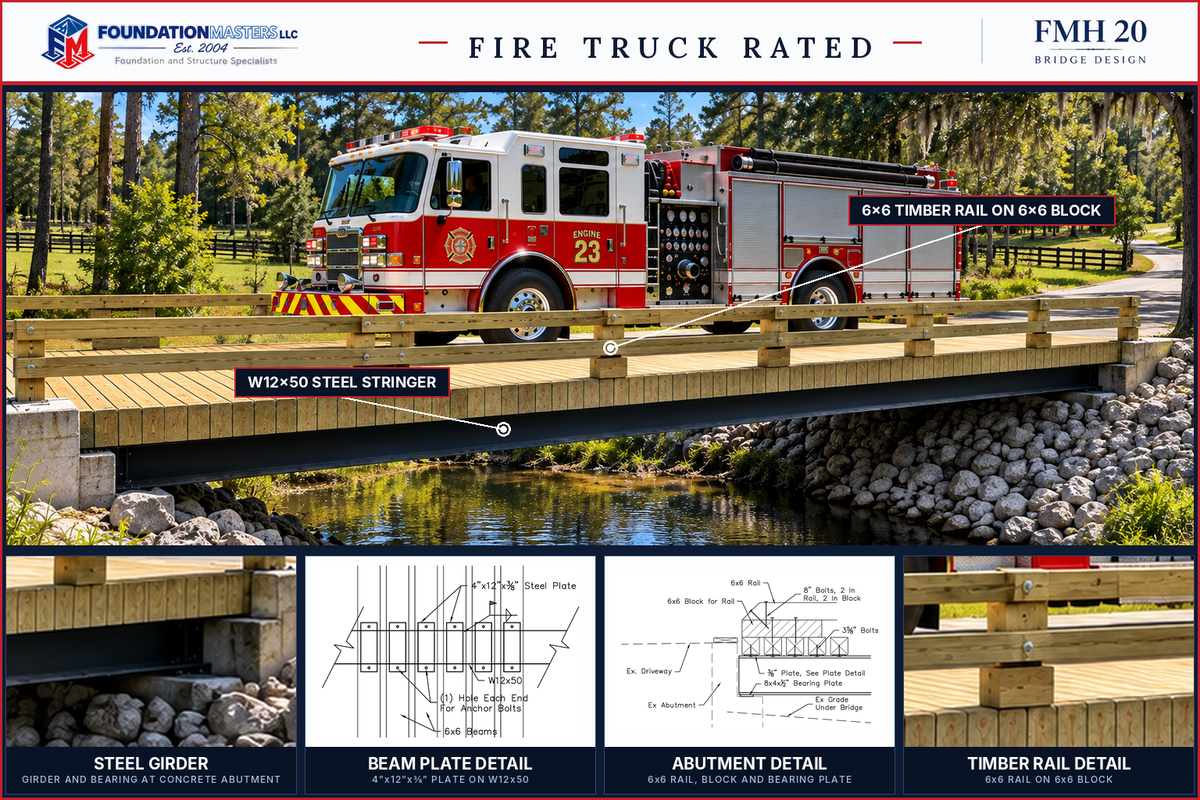
FM-H20 Specification
- Steel girder superstructure with timber deck
- Fire truck H-20 loading, 20 ton deck capacity
- Maximum span up to 60 feet
- Abutments rated to 80 tons at a 2 to 1 safety factor
- Vinyl sheet piling at the abutments, driven 60 inches below the mud line
- Lifetime warranty
Why the Sheet Pile Matters
Erosion at the abutment is one of the most common ways a private bridge is lost. The structure stands and the ground beside it leaves. Driving vinyl sheet piling well below the mud line puts a cutoff between the moving water and the soil the abutment is sitting on.
On a north Georgia stream with grade behind it, that cutoff is doing real work. We still size it to the crossing rather than installing the same depth everywhere.
Full detail on the FM-H20 fire truck rated residential bridge page.
Foundations: The FM-PP30 Driven Pipe Pile
The bridge is only as good as what carries it. Our standard abutment foundation is the FM-PP30, a 3 inch schedule 40 driven pipe pile rated at 30 tons, installed four to an abutment by our own pile driving crews.
The FM-PP30 is driven with a pneumatic hammer rather than pressed, so it puts no installation load into anything nearby and causes no vibration damage to existing structures. Above the Fall Line the piles are driven to refusal on weathered or competent rock. Below it they are driven to the depth that develops capacity in the sand and dense layers, which usually means a longer pile. Same system, two different answers, decided by the ground.
Development and Estate Bridges
For land developers, property investors, civil and geotechnical and structural engineers, architects and builders, particularly on upper bracket developments, subdivisions, shopping plazas, golf courses and private drives, the bridge at the entrance is the first thing anyone sees. It is doing more than carrying a car.
Foundation Masters builds custom bridges and architectural bridge replicas for residential and light commercial work. If you want the entrance to your development to be the thing people describe when they give directions, that is a conversation worth having early, while the structural approach and the look can still be designed together rather than bolted onto each other.
Private Driveway Crossings
Single residence access over a creek, branch, drainage way or ravine, rated for the vehicles that actually need to get in.
Development Entrances
Shared access for subdivisions, gated communities and multi parcel private roads, designed for construction traffic as well as residents.
Ranch and Farm Access
Working crossings for equipment, trailers and loaded trucks, where the bridge has to take more than a pickup.
Golf Course and Plaza
Cart crossings, maintenance access and light commercial spans where appearance is part of the specification.
Pedestrian and Trail
Walkways, nature trail crossings and boardwalk systems over wet ground, creeks and uneven terrain.
Repair and Replacement
Inspection, structural reinforcement, deck replacement, abutment stabilization or full reconstruction of an existing crossing.
Georgia Service Areas
Atlanta Metro
Atlanta, Marietta, Alpharetta, Roswell, Lawrenceville, Newnan and the surrounding counties. Residual soil over weathered rock, with rock depth changing across a single site.
North Georgia
Gainesville, Dahlonega, Blue Ridge, Ellijay, Rome and the mountain counties. Steeper streams, higher velocity and scour as the governing concern.
Piedmont and Fall Line
Athens, Madison, Macon, Columbus and Augusta, where the geology changes over short distances and the design has to follow it.
South Georgia
Albany, Tifton, Valdosta, Waycross and the farm country. Sand and soft near surface ground, deeper piles, flatter water.
The Coast
Savannah, Brunswick, St. Simons and the Golden Isles. Tidal creeks, marsh margins and a salt air corrosion environment.
Design Only Work
Where a Georgia builder is already engaged, we can provide the bridge design and the sealed plan set and stay out of the construction.
Georgia Bridge FAQs
What does a residential bridge cost in Georgia?
FM-H20 pricing starts at about 3,300 dollars per linear foot. The real number depends on span, abutment work, access for equipment, how far the piles have to go and what the approaches need. We price it after we have looked at the crossing, not before.
Why does my insurance company care about the bridge?
Because a fire engine weighs a great deal more than a car. If apparatus cannot cross to reach the house, some carriers treat the property differently. A fire truck rated crossing like the FM-H20 is built to answer that question. Where the bridge is part of a required fire department access road, the local fire code official sets the load it has to carry, and some codes call for 75,000 pound apparatus, so we confirm the requirement with the fire marshal before the design is set.
How deep do the piles go in Georgia?
It depends entirely on where you are. Above the Fall Line the piles are driven to refusal on weathered or competent rock, which can be shallow or can surprise you. Below it there is often no rock to hit and the pile is driven until it develops capacity in the sand. That is why we take borings where the answer is not obvious.
What usually destroys a private bridge?
Water, not weight. Scour at the supports, a washed out approach and a bank eroding back toward an abutment account for most of the private crossings we are called out to look at. That is why the abutment protection is part of the design rather than an upgrade.
Can you repair my existing bridge instead of replacing it?
Often yes. It turns on the condition of the girders, the abutments and the foundations rather than the deck, which is the part owners notice first. We inspect it and give you a written opinion either way. See bridge repair.
Who seals the drawings?
A licensed professional engineer. Foundation Masters prepares the design and the plan set in house and the structure is not built off an unsealed drawing.
How long does a Georgia bridge project take?
The construction is usually the short part. Site evaluation, design, permitting and any agency review take longer than setting steel and laying deck, and the timeline moves depending on the county and on whether the crossing affects a regulated stream or wetland.
Talk About Your Georgia Crossing
New bridge, development entrance, a crossing that has started to move, or a replacement. Tell us where it is and what has to get across it.
Call 656-233-7089Or send it in writing through the contact page. Include the property address, the span and a photo of the crossing.