
Bridge Contractor Tennessee
Foundation Masters, LLC. Licensed Florida engineering firm, CA# 30969. Residential and light commercial bridge design and construction across Tennessee, from the Appalachian valleys to the Mississippi bottomland.

A private bridge in Tennessee is almost never a simple span. It is a span plus whatever the water is doing to the banks, plus whatever the rock is or is not doing underneath, plus the question of how you get a pile driver to it in the first place. Foundation Masters handles all three.
We are a design build outfit, so the drawing and the structure come out of the same shop. Jeff Earl founded the firm after two decades in structural repair, deep foundations and earth retention, and a licensed professional engineer seals the plan set before a pile goes in the ground.
Tennessee sits inside a Southeast footprint that also covers Florida, Georgia, Alabama, Mississippi, South Carolina and North Carolina. Everything is indexed on the bridge contractor hub.
Tennessee Is Three States Under a Bridge
Drive Tennessee end to end and the ground changes under you three times. A foundation approach that works in Knoxville is the wrong answer in Memphis, and the crossing in Murfreesboro has a problem neither of the other two has. This is the single most important thing to understand before anybody quotes you a bridge here.
East Tennessee
Knoxville, Chattanooga, the Tri-Cities and the Blue Ridge. Folded and faulted rock, limestone and dolomite ridges with shale in the valleys between them. Rock can be close to the surface and then drop away sharply.
Streams run with real grade behind them. Velocity and scour at the supports govern more of the design than settlement does.
Middle Tennessee
Nashville, Murfreesboro, Franklin, Columbia and the Central Basin and Highland Rim. Limestone with mature karst: sinkholes, solution channels, caves and voids. Rock is often shallow, which sounds like good news until you find out what is in it.
This is the half of the state where what you cannot see matters most.
West Tennessee
Memphis, Jackson and the Mississippi embayment. Loess over deep sand and clay, with no rock within practical reach. Bearing comes from driving deeper, not from hitting something hard.
West Tennessee also sits in the New Madrid seismic zone, which is a real design consideration and not a historical footnote.
Karst, Sinkholes and What Is Actually Under the Abutment
Middle Tennessee limestone is soluble. Water has been working on it for a very long time, and what it leaves behind is solution channels, soft seams and open voids, sometimes directly under ground that looks perfectly sound from the top.
A bridge abutment is a concentrated load in a small footprint. That is exactly the loading case a shallow void does not survive. Where the geology says karst is possible, the only honest way to design is to find out what is down there first. We take soil borings and design from measured data rather than from an assumption about how deep the rock is.
Foundation Masters does sinkhole and void work as a core part of the practice, not as an occasional sideline. On a Tennessee crossing that experience is the difference between a foundation that is seated on rock and one that is seated on the roof of something.
This page covers Tennessee. The rest of the bridge practice is below.
The FM-H20 Fire Truck Rated Bridge
A fire engine runs somewhere north of fifteen tons loaded. A pickup runs three. If the crossing to your house was built for the pickup, the engine is not coming across it, and on a hollow road in Tennessee there is no second way in. FM-H20 is the bridge we build so that question has a yes attached to it.
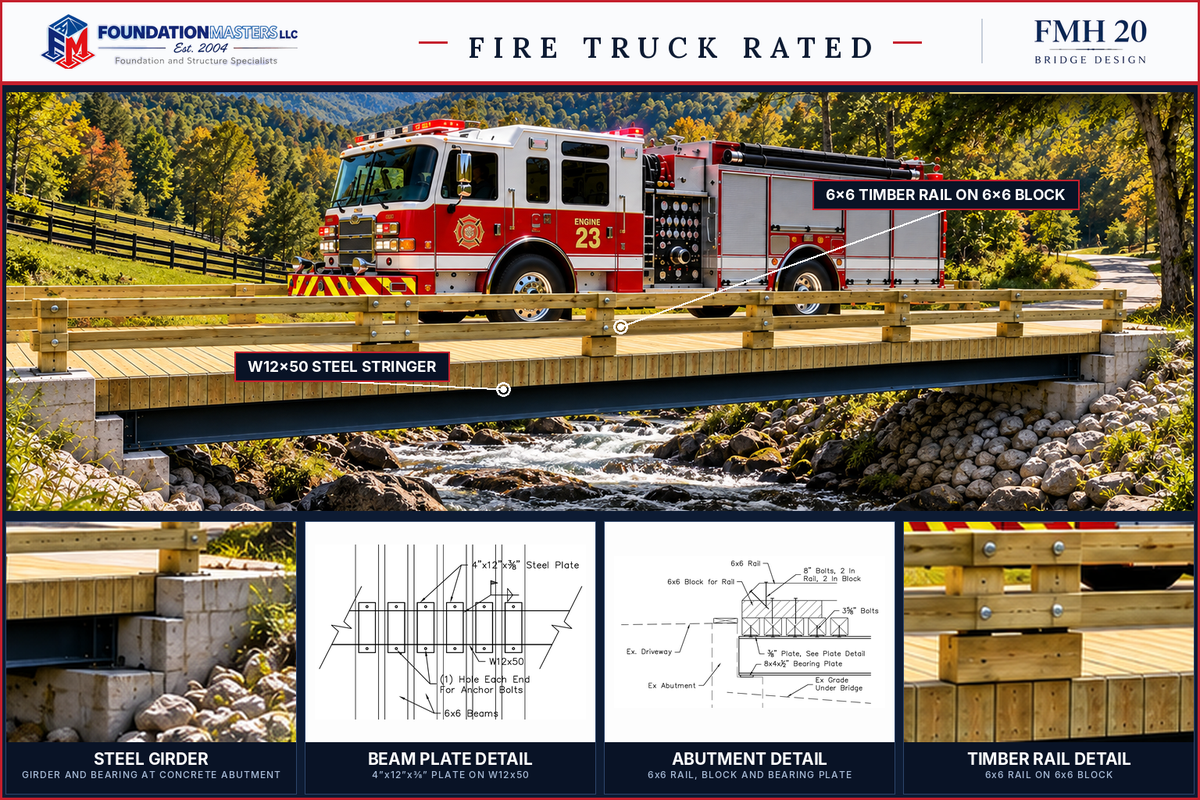
FM-H20 Specification
- Steel girder superstructure with timber deck
- Fire truck H-20 loading, 20 ton deck capacity
- Maximum span up to 60 feet
- Abutments rated to 80 tons at a 2 to 1 safety factor
- Vinyl sheet piling at the abutments, driven 60 inches below the mud line
- Lifetime warranty
Where the Sheet Pile Earns Its Keep
Tennessee creeks move. A storm cell parks over a ridge, the branch comes up four feet in an hour, and it goes looking for the softest thing it can find. That is almost always the fill behind an abutment.
Vinyl sheet pile driven below the mud line is a wall between that water and the soil your bridge is standing on. Depth gets set by the crossing, not by a default.
Full detail on the FM-H20 fire truck rated residential bridge page.
Foundations: The FM-PP30 Driven Pipe Pile
Four FM-PP30 piles carry each abutment. Three inch schedule 40 pipe, thirty tons apiece, driven with a pneumatic hammer by our own crews. Hammer driven rather than hydraulically pressed matters on a tight site, because a pressed pile has to react against something and a driven one does not.
What the pile is looking for changes as you move across the state. East of Nashville it is looking for limestone or sound rock and it usually finds it. In karst country it is looking for rock that is actually solid, which is a different question and the reason borings come first. Out past Jackson there is nothing hard to find at all, and capacity comes from skin friction over a much longer pile. One pile system, three jobs.
Getting the Equipment to the Crossing
On a flat Florida lot nobody thinks about this. In Tennessee it is frequently the hardest part of the job. The bridge sits at the bottom of the property, the drive down to it is steep, narrow, switchbacked and soft, and a pile rig plus a crane plus concrete trucks have to get down there and back out.
We Walk It Before We Price It
Grade, turning radius, overhead limbs, culvert capacity on the existing drive, where a truck can turn around and where the ground will carry the load. If the access needs temporary matting or a widened turn, that belongs in the number up front rather than as a surprise in week three.
Sometimes the Answer Changes the Design
If the site genuinely cannot take a large rig, that pushes the design toward smaller equipment and a different foundation sequence. Better to find that out standing on the bank than after mobilization.
What We Build in Tennessee
Hollow and Holler Crossings
The single drive over a creek that is the only way to the house. Rated for the ambulance and the engine, not just the family car.
Farm and Equipment Access
Tractors, loaded hay trailers, grain trucks and skidders, crossing repeatedly rather than once. Different loading question, different deck.
Development Entrances
Subdivision and gated community access, specified for the construction traffic that comes first and the residents who come after.
Greenway and Trail
Walkways and trail crossings over creeks and wet ground, where the load is light and the setting does most of the work.
Custom and Architectural
Bridges built to be looked at as well as driven over, where the structure and the appearance get designed together rather than one after the other.
Repair and Replacement
A crossing that has started to settle, scour out or rot. Inspection first, written opinion second, work third.
Tennessee Service Areas
Nashville and Middle Tennessee
Nashville, Franklin, Brentwood, Murfreesboro, Columbia and Lebanon. Shallow limestone and karst, where borings earn their cost.
Knoxville and East Tennessee
Knoxville, Maryville, Sevierville and the Smokies foothills. Ridge and valley rock, steep streams and scour as the governing concern.
Chattanooga
Chattanooga, Cleveland and the Sequatchie Valley. Rock close to surface in places, deep soft fill in others, often on the same property.
Memphis and West Tennessee
Memphis, Germantown, Collierville and Jackson. Loess over deep sand, longer piles and seismic considerations on the design.
The Tri-Cities and the Plateau
Johnson City, Kingsport, Bristol, Cookeville and Crossville. Mountain and plateau crossings where access for equipment is half the problem.
Plans Without the Crew
Already have a builder lined up? We will do the investigation, the design and the sealed set and hand it to them.
Tennessee Bridge FAQs
What does a residential bridge cost in Tennessee?
The FM-H20 starts around 3,300 dollars per linear foot. What moves it from there is span, how much abutment work the banks need, how far the piles have to be driven and whether equipment can actually reach the crossing. We put a number on it after we have walked it.
My property is in sinkhole country. Is that a problem?
It is a reason to investigate, not a reason to walk away. Middle Tennessee karst is well understood and engineers design around it every day. What is not acceptable is guessing. Where the geology says voids are possible we take borings at the abutment locations before anybody draws a foundation.
Can you get equipment down my driveway?
That is one of the first things we check, and occasionally the answer is no without some work first. Grade, width, turning room, overhead clearance and whether the existing drive will carry a loaded truck all get looked at on the site visit. If access needs matting or a widened turn, it goes in the price up front.
Does the New Madrid zone change anything in West Tennessee?
It is a real seismic zone and it is accounted for in the design of structures out there. For a short span private crossing it mostly shows up in how the superstructure is tied to the abutments and in the foundation detailing rather than in the span itself.
Do I need a permit to build over a creek?
Usually. A crossing over a stream typically brings a state level review of the work in the waterway on top of the county building permit, and that review is normally the longest item on the schedule. We handle the submittal rather than leaving you to chase it.
How deep do the piles go?
In East and Middle Tennessee they are driven to refusal on limestone or sound rock, which can be shallow. In West Tennessee there is generally no rock to reach and the pile is driven until it develops capacity in the sand, which means a considerably longer pile.
Will a fire truck really cross it?
That is the whole point of the H-20 rating: a 20 ton deck capacity, sized for apparatus rather than passenger vehicles. Where the bridge is part of a required fire department access road, the local fire code official sets the load it has to carry, and some codes call for 75,000 pound apparatus, so we confirm the requirement with the fire marshal before the design is set. Some insurance carriers ask the question directly before they write the policy on a property behind a private crossing.
Can you build through the winter?
Mostly yes. Driving pile and setting steel are not weather sensitive the way concrete flatwork is. Wet ground and access are the real constraints in winter, which loops back to the driveway question above.
Talk About Your Tennessee Crossing
New bridge, development entrance, a crossing that has started to move, or a replacement. Tell us where it is and what has to get across it.
Call 656-233-7089Or send it in writing through the contact page. Include the property address, the span and a photo of the crossing.