
FMPP30-FS Pipe Pile System
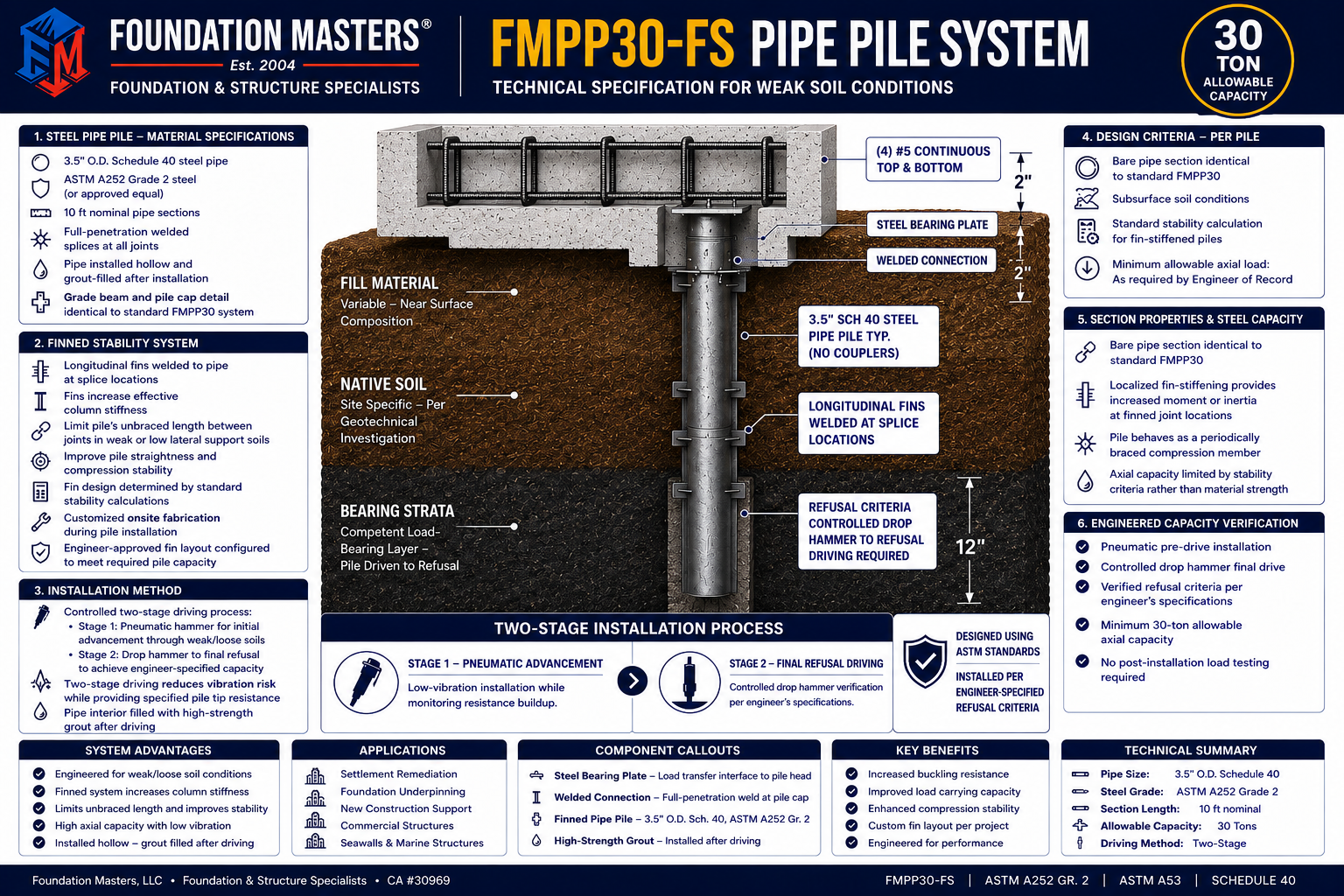
The FMPP30-FS is an engineered deep foundation solution designed for projects encountering weak, loose, or variable soil conditions where traditional driven piles or shallow foundations are impractical. This system is based on the proven FMPP30 pipe pile design, enhanced with a field-fabricated fin system to increase axial capacity, lateral stability, and overall performance in low-strength soils.
Engineering Contact: 813-614-1718 • Request Consultation
Florida’s Longest-Running Foundation Repair & Structural Engineering Firm
For more than 25 years, Foundation Masters has designed, engineered, and installed foundation repair, underpinning, deep foundation, waterproofing, and structural stabilization systems. As Florida’s longest-running foundation repair company under continuous ownership, Foundation Masters continues to provide engineered solutions backed by decades of field experience, documented project performance, and proprietary foundation systems developed specifically for Florida conditions.
Engineer Design Reference
Select a pile system to review specifications, installation criteria, and engineered acceptance guidance. Use this index to compare options and keep design decisions consistent across projects.
Best Option for Long Piles in Weak Soil
For long pile lengths and weak/loose/variable soils, FMPP30-FS is typically the best-performing option before stepping up to a larger-capacity pile such as FM-PP45. The fin-stabilized configuration increases confinement and effective bearing interaction where standard pipe piles struggle to develop resistance.
*System selection should follow project-specific geotechnical recommendations and engineering criteria.
System Overview
Core Components
- 3.5″ O.D. Schedule 40 steel pipe pile
- ASTM A252 Grade 2 steel (or approved equal)
- Internal mechanical couplers or welded splices
- Four (4) steel fins welded over each pipe joint
- Fin dimensions and spacing determined by Engineer of Record (EOR)
What “FS” Changes
The FS configuration uses welded steel plate fins at joints to increase bearing surface and confinement in low-strength soils. Fin layout, length, and thickness are engineered to meet required axial load and refusal criteria.
Field-Fabricated & Adjustable
Fins are custom fabricated onsite during installation, allowing real-time adjustment based on subsurface conditions encountered in the field, especially valuable in variable fill, soft clays, and loose sands.
Fin-Stabilized Design
Design Basis
Fin bearing calculations are used to determine allowable pile capacity. The fin system increases soil interaction and confinement, improving performance where standard pipe piles cannot develop sufficient resistance.
Engineering Control
Fin dimensions and spacing are established by the EOR, and can be refined during installation as subsurface conditions are verified.
Installation Method
Controlled Driving
- Two-stage controlled driving process
- Initial advancement using low-vibration pneumatic hammer
- Final seating via controlled drop hammer to engineer-specified refusal
Low-Vibration Advantage
Installation is designed to limit vibration impacts to adjacent structures while still achieving refusal criteria for acceptance.
Engineering & Performance
The FMPP30-FS system can achieve required tonnage per pile without post-installation load testing when installed to verified refusal criteria (as permitted by project requirements and the EOR).
Particularly Effective For
- New construction foundations
- Grade beam supported structures
- Soft clays, loose sands, and variable fill soils
- Sites requiring low-vibration installation methods
Engineering Support
We can assist with preliminary pile layouts, fin configuration guidance, and installation criteria coordination based on structural demands and geotechnical recommendations.
Phone: 813-614-1718
Request Consultation
Contact Foundation Masters
For engineering review, pile layout assistance, or project-specific consultation:
Foundation Masters, LLC
Phone: 813-614-1718
Request a Foundation Review
*Final system selection and acceptance criteria should be determined by project-specific engineering and geotechnical recommendations.
Related Systems & Resources
Explore the full pipe pile lineup and our other deep foundation systems.