
Geotechnical Engineering Miami for Coastal Soils, Limestone and Foundation Design
Miami sits on porous Miami Oolite and Anastasia limestone with a high water table, loose sands, organics and shoreline erosion, so tidal uplift, saltwater intrusion and corrosion all factor into durable foundation design.
It also sits directly on top of its own drinking water. That changes what an excavation is here. In most of Florida, pumping the hole dry is a construction method. In Miami-Dade it is a regulated discharge, and what the borings find decides which permit the job needs.
We help Miami area clients with:
- Subsurface exploration: SPT borings, CPT soundings, rotary wash
- Foundation and coastal engineering design
- Sinkhole and void assessment where applicable
- Ground improvement and soil stabilization
- Seawall and shoreline stabilization
- Dewatering and groundwater control design
- Forensic geotechnical investigations

South Florida, from one firm
- Florida Certificate of Authorization CA 30969
- Investigation, design and installation under one roof
- Miami-Dade, Broward and the Keys
What we establish before a foundation is named
- Depth at which competent rock actually starts
- Seasonal high groundwater in a tidal setting
- Organics and fill under anything carrying load
- The dewatering approach and the county permit path
- Chloride exposure and what it does to the detailing
Talk to us before design
Send the address and the site history. We will tell you what the investigation needs to cover before anyone spends money designing to the wrong assumption.
Office 813-614-1718
You Are Digging Into the Drinking Water, and the Regulator Knows It
The Biscayne aquifer is unusually shallow and unusually permeable, and it is the water supply. The United States Environmental Protection Agency has designated it a sole source aquifer, which the agency defines as an underground water source that supplies at least 50 percent of the drinking water consumed in the area overlying the aquifer. The designated area includes all of Dade County and parts of Broward, Monroe and Palm Beach counties.
Which Means Dewatering Is a Permitted Discharge
Miami-Dade County describes its Class V permit as the one needed for temporary dewatering or whenever water is removed from an excavation, from the ground or existing structure, to ensure that sediment, turbidity and contaminants are removed before it is later discharged.
Read that once more with a contractor hat on. It is not a form about how much water you move. It is about what is in the water you move, and where it goes afterward. On a South Florida site with a shallow water table, that is most excavations of any depth.
And the Borings Decide Which Permit You Are In
This is where the geotechnical scope stops being a formality. Miami-Dade describes its Class VI permit as the one needed for the installation of a drainage system for any project that has known soil or groundwater contamination, or that uses, generates, handles, disposes of, discharges or stores hazardous materials.
So the phrase that changes the permitting path is known soil or groundwater contamination. On a redevelopment parcel in a county this old and this industrial in places, that is not a rare finding. It is something the exploration either establishes early, while the schedule can absorb it, or something the project discovers at the worst possible moment.
The practical consequence for a Miami budget is simple. Two numbers price the earthwork on most South Florida jobs, and neither of them is the foundation type. They are the depth to competent rock and the seasonal high groundwater. Get those wrong and the excavation method, the dewatering plan and the permit class all move together, in the same direction, after the contract is already signed.
Built for Miami Limestone, High Groundwater and Coastal Exposure
Services
We provide geotechnical engineering and construction management for subsurface exploration, foundation and coastal design, ground improvement, dewatering and forensic investigation across Miami and South Florida.
Clients
We work with homeowners, developers, contractors, attorneys, associations, and commercial and municipal owners on high rise, coastal and difficult soil projects across Miami-Dade County.
Approach
We focus on verified subsurface data and durable, corrosion aware foundation design so the solution holds up in Miami coastal, tidal and high groundwater conditions.
Why Miami Clients Choose Us
We do not treat a soil report as a box to check. We connect subsurface data to the foundation, the groundwater, the coastal exposure and the long term durability of the structure.
- Identify subsurface risk early, including cavities, organics, seasonal high groundwater and corrosion
- Recommend durable, cost effective foundations and ground improvement
- Prevent water intrusion, settlement and construction delays
- Establish the two numbers that price the earthwork before the contract is signed
Miami Geotechnical Engineering Services
We handle exploration, foundation and coastal engineering, ground improvement, groundwater control and forensic investigation throughout Miami and South Florida.
Site Feasibility and Due Diligence
Early evaluation of subsurface risk, groundwater, coastal exposure and development constraints, while the deal can still be priced around what is in the ground.
Subsurface Exploration
SPT borings, CPT soundings and rotary wash to characterize limestone, sands, organics and groundwater conditions.
Rock Depth and Excavatability
Establishing where competent rock actually starts and what it will take to get through it, because on a Miami site that answer moves the budget more than the foundation type does.
Foundation and Coastal Engineering
Foundation and coastal design matched to Miami soils, tidal uplift and chloride exposure.
Ground Improvement
Vibro replacement stone columns, soil mixing and pressure grouting for weak or organic ground.
Seawall and Shoreline Stabilization
Geotechnical support for seawall and shoreline stabilization with corrosion aware detailing.
Dewatering and Groundwater Control
Temporary and permanent dewatering, cutoff barriers, and uplift and inflow management below the water table, scoped with the county permit path in view.
Deep Foundations and Underpinning
Design support for pipe pile, pile driving, helical piers and drilled shafts.
Uplift and Load Checks
Uplift and load review for high rise and coastal structures where the soils and the water table govern rather than the superstructure.
Corrosion Aware Detailing
Material and protection decisions for structural steel and connections in a chloride environment, made at design rather than at the first inspection.
Construction Phase Support
Earthwork observation, fill evaluation, compaction review, pile monitoring and the field calls that have to be made while the excavation is open.
Forensic Geotechnical Engineering
Investigation of settlement, coastal distress, failed foundations and disputed subsurface conditions, with a written opinion on cause.
Why Geotechnical Engineering Matters Early
Miami subsurface conditions, porous Miami Oolite and Anastasia limestone, high groundwater, loose sands and organics, mean uplift, corrosion and settlement all have to be planned for. For regional geologic reference, see the United States Geological Survey.
- Identify subsurface risks early, including cavities, organics, high groundwater and corrosion
- Recommend durable, coastal appropriate foundations and ground improvement
- Prevent water intrusion, settlement and construction delays
- Establish the dewatering and permitting path before the excavation is open
Designed for Miami Geology, Groundwater and Coastal Performance
We routinely deliver projects in Brickell, Coral Gables, Miami Beach, Doral, Wynwood and along Biscayne Bay. Each location presents distinct geologic and coastal constraints.
Designs account for tidal uplift, dewatering constraints, organic settlement and chloride exposure that influence foundation selection and long term durability.
A great deal of Miami-Dade is also redevelopment on parcels that carried a previous use. What that use left behind is a geotechnical finding with a permitting consequence, which is a good reason to look before the schedule is committed.

SPT and CPT Exploration · Subsurface Data · Miami Geotechnical Conditions
Coastal Stabilization and Durable Foundation Support
Along the Miami shoreline, verified data and corrosion aware construction matter more than assumptions.
- Vibro compaction and vibro replacement using stone columns
- Soil mixing and cement stabilization of organics
- Seawall stabilization and corrosion aware detailing
- Dewatering systems and cutoff barriers
- Underpinning and retrofits for existing coastal structures
- Driven sheet piling for retention, cofferdams and shoreline work
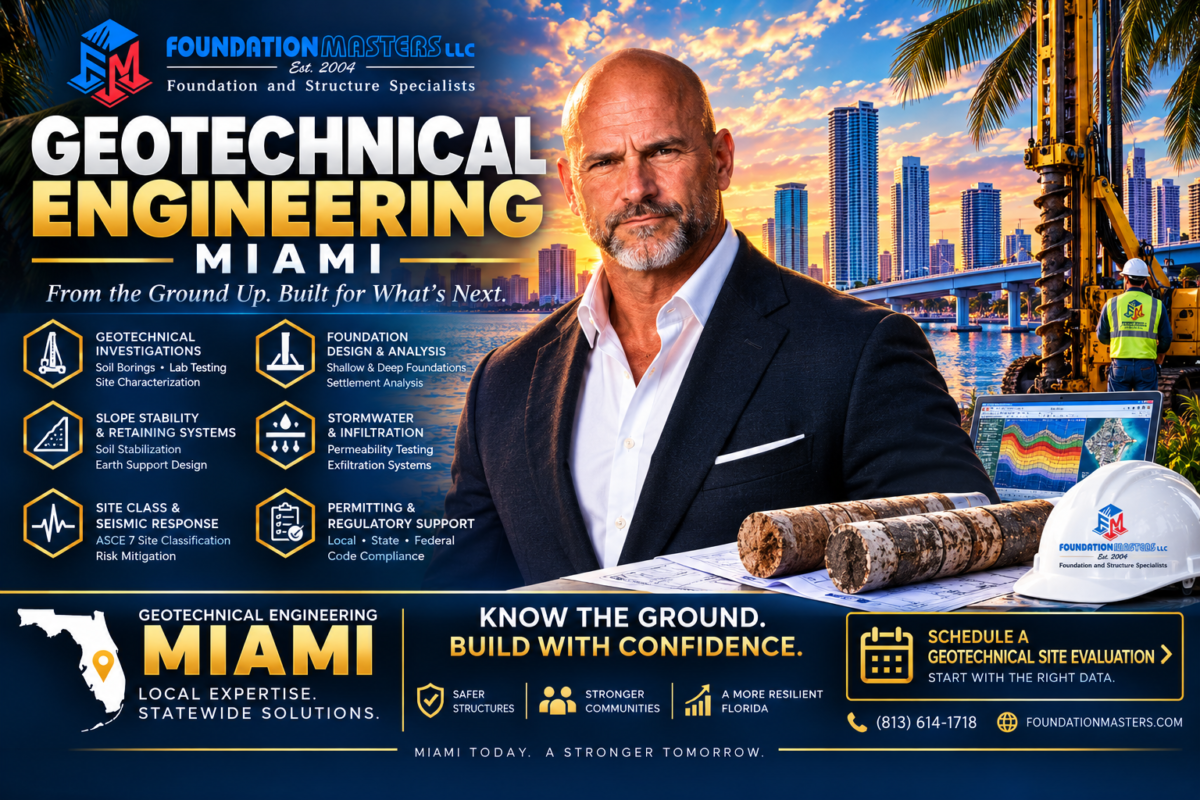
Testing, Surveying and Subsurface Characterization
We maintain regionwide soil, rock and groundwater data to speed planning and budgeting. Our exploration and subsurface support include:
- SPT borings, CPT soundings and rotary wash
- Boundary and topographic surveys
- ALTA and NSPS land title surveys
- GPS and high definition 3D laser scanning
- Construction layout and as built quality control
- Wetland delineation and hydrographic mapping
- Geophysical surveys, including ground penetrating radar, electrical resistivity and seismic testing
Matching the Foundation to Miami Ground
Depending on the soils, groundwater and loads, we evaluate and support a range of foundation systems:
- Shallow foundations on improved ground for light structures
- Helical piers, micropiles and drilled shafts for heavier loads or void risk
- Pipe pile and driven pile deep foundations
- Stone columns and ground improvement to enable shallow foundations
- Corrosion protection near saltwater
- Dewatering and groundwater control for construction
A Miami Geotechnical Report Is Written Once and Read by Several Audiences
Most of the pressure on a geotechnical report does not come from the person who commissioned it. It comes from everyone who reads it later, usually under circumstances nobody planned for.
- The structural engineer, who designs to the bearing values and will ask what happens at the edge of the footprint where there was no boring
- The contractor, who prices the excavation and the dewatering from it and finds out on day one whether the rock depth and the water were right
- The county reviewer, whose permit path depends in part on what the report says is in the soil and the groundwater
- The building official, checking that the foundation design rests on something and not on an assumption
- The next engineer, years later, when something has moved and somebody wants to know what was known at the time
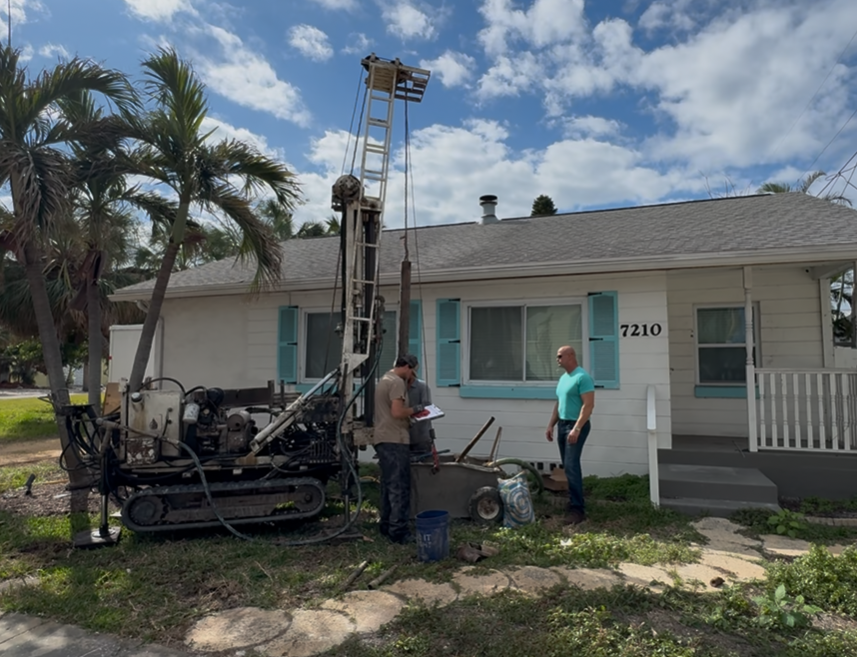
Field Work · Subsurface Support · Miami Geotechnical Projects
What the Investigation Has to Establish on a Miami-Dade Parcel
The methods travel. The question the investigation is trying to settle does not. A scope written for one South Florida site and reused on the next usually collects the right data about the wrong risk, which is the most expensive kind of complete report. These are the answers a Miami project generally needs before a foundation type is named or an excavation is priced.
The Ground and the Water
- Depth at which competent rock actually starts, and whether it is continuous across the footprint rather than present at one boring
- What it will take to get through that rock, which is an excavation method question and therefore a price question
- Seasonal high groundwater in a tidal setting, where the number moves and the design needs the envelope rather than a single reading
- Depth and variability of organics under anything carrying load, which is a settlement question before it is a bearing question
- Fill history and previous use, because both change what is down there and what the county will ask about it
- Chloride exposure and what it means for material selection and protection detailing
- Whether excavated material can be reused on site, which is a budget question answered by a laboratory
Why This Order Saves Money Here Specifically
In most markets a surprise in the ground is a design problem. In Miami-Dade it is a design problem and a permitting problem at the same time, because the dewatering plan and the drainage system both have to answer to the county, and what the report says about the soil and the groundwater is part of what they answer with.
That means the sequence matters more than it does elsewhere. Establish the subsurface conditions, then set the dewatering approach, then commit the schedule. Reversing any two of those is how a project ends up holding a crew while a permit path gets sorted out.
It is also why recording uncertainty honestly is worth more than a confident number. If the data is ambiguous, saying so, with what would resolve it, is more useful to every downstream reader than a figure nobody can trace back to a hole.
Serving Geotechnical Projects Across Miami and South Florida
Foundation Masters delivers geotechnical engineering throughout Miami-Dade County and South Florida. Each area presents distinct soils, groundwater and coastal conditions that shape foundation and site decisions.
Brickell and Downtown
High loads on tight sites with neighbors close enough that the excavation support question arrives at the same time as the foundation question, and the dewatering plan has to answer to both.
Miami Beach and the Barrier Islands
Tidal groundwater, fill of varying age and quality, and chloride exposure that moves the material decision as much as the load does.
Coral Gables and Coconut Grove
Established neighborhoods where additions and renovations sit on structures that have already found their level, so the question is often whether the existing foundation can take the new load.
Doral and West Dade
Former agricultural and industrial ground, where what a previous use left behind is a geotechnical finding with a permitting consequence.
Along Biscayne Bay
Shoreline work adds scour, tidal groundwater and salt exposure, and usually adds a seawall or earth retention question to the foundation question.
Former Wetland and Filled Ground
Organics under anything carrying load are a settlement question before they are a bearing question, and their depth and variability are two separate answers.
Geotechnical Engineering Miami: Frequently Asked Questions
What is the typical subsurface profile in Miami?
Shallow sands over porous limestone with high groundwater. Organics and solution cavities occur locally, especially along the coast and in former wetlands. The two numbers that matter most on a given parcel are the depth at which competent rock actually starts and the seasonal high groundwater.
Which foundations work best in Miami?
Shallow foundations on improved ground for light structures, and deep foundations such as helical piers, micropiles or drilled shafts, or stone columns, for heavier loads or void risk, with corrosion protection near saltwater. Which one suits your site is a question the borings answer, not a question the market answers.
Do I need dewatering?
Often yes, for excavations below the seasonal high water table, which in much of Miami-Dade is most excavations of any depth. We design temporary and permanent groundwater control to manage uplift and inflow, and we scope it knowing the county treats the water you remove as a discharge rather than as a nuisance.
Is dewatering in Miami-Dade actually permitted, or is that just good practice?
It is permitted. Miami-Dade County describes its Class V permit as the one needed for temporary dewatering or whenever water is removed from an excavation, from the ground or existing structure, to ensure that sediment, turbidity and contaminants are removed before it is later discharged. Confirm the current requirements with the county for your specific project, because programs are revised.
Why does Miami regulate this more tightly than other Florida markets?
Because the aquifer under the site is the water supply. The United States Environmental Protection Agency has designated the Biscayne aquifer a sole source aquifer, which it defines as an underground water source that supplies at least 50 percent of the drinking water consumed in the area overlying the aquifer. The designated area includes all of Dade County and parts of Broward, Monroe and Palm Beach counties.
Can what my borings find change which permit my project needs?
Yes, and this is the part worth knowing early. Miami-Dade describes its Class VI permit as the one needed for the installation of a drainage system for any project that has known soil or groundwater contamination, or that uses, generates, handles, disposes of, discharges or stores hazardous materials. On a redevelopment parcel, whether that phrase applies to you is frequently established by the subsurface investigation.
When should I hire a geotechnical engineering firm?
Before design and permitting for new builds, additions, coastal or seawall work, or any site where poor soils, voids or high groundwater are suspected. The work earns its money during due diligence and design. A correction made in the field happens at the contractor rate, after the schedule is already committed.
Do you handle coastal and seawall projects?
Yes. We support seawall and shoreline stabilization, coastal foundation design and corrosion aware detailing for waterfront structures, and we install sheet piling and deep foundations with our own crews.
How deep is the rock, and can you tell me before you drill?
Not honestly. Regional mapping and nearby records give a range and a reasonable expectation, and that expectation can be wrong by enough to change the excavation method across a single footprint. We will tell you what the regional data suggests and then go find out.
How many borings does my Miami project need?
There is no fixed number, and anyone who quotes one before seeing the site is pricing a package rather than answering a question. The layout is driven by the structure, the footprint, the loads, the known geology and what the historical review turns up. Placement usually matters more than count.
Does corrosion really change the foundation decision?
In a chloride environment near the coast it changes the material and the protection detail, and sometimes the system. Those decisions are cheap at design and expensive at the first inspection cycle, which is the argument for making them while the drawings are still open.
Can you coordinate geotechnical work with structural design and repair?
Yes. We integrate subsurface data with structural design, deep foundations and repair so the solution matches both the soils and the structure. That is the reason a soil problem and a foundation problem do not have to be investigated by two different companies here.
Do you provide forensic geotechnical engineering in South Florida?
Yes. We investigate settlement, coastal distress, failed foundations and disputed subsurface conditions, and we provide a written engineering opinion on cause rather than a list of observations.
Will a geotechnical report help resale value?
Documented subsurface data and foundation recommendations reduce risk for owners, buyers and lenders by improving confidence in the foundation conditions at the property. On a coastal parcel it is frequently the document the transaction turns on.
How do I start a project with Foundation Masters?
Send the address, the survey, any plans, permits or photographs you have, the known site history and what you are trying to achieve. We will tell you what the investigation actually needs to cover before anyone spends money designing to the wrong assumption.
Related Florida Engineering and Foundation Services
This page connects to related services involving soils, foundations, deep foundation systems, structure and coastal work.
Geotechnical Engineering Florida
The statewide geotechnical hub for subsurface exploration, foundation design and ground improvement.
Foundation Repair Miami
Miami foundation repair for settlement, cracking and structural movement, engineered from the cause.
Structural Engineering Miami
Structural engineering coordinated with subsurface data for repair, retrofit and coastal construction.
Civil Engineering Miami
Drainage, stormwater, site development and permitting support for Miami properties.
Seawall Contractor
Seawall and marine support for shoreline stabilization and waterfront structures.
Pipe Pile
Driven pipe pile deep foundations for heavy loads, poor soils and coastal conditions.
Pile Driving Contractors
In house pile driving for residential, commercial and industrial deep foundations statewide.
Sheet Piling Contractors
Driven sheet piling for retention, cofferdams and shoreline work, installed with our own equipment.
High Rise Building Inspectors
Threshold and structural inspection for Miami high rise and essential structures.
Steel Corrosion
Corrosion evaluation for coastal and marine exposed structural steel and connections.
Foundation Inspection Miami
Evaluations for settlement, cracking and pre purchase questions across Miami-Dade.
Luxury New Construction Miami
Engineer built luxury new construction in Miami, designed from soil and structure outward.
Sources and Agency References
The primary sources behind the aquifer and permitting statements on this page. Worth reading directly rather than taking any summary of them on trust, this one included.
- Miami-Dade County one time environmental permits, including the Class II, Class V and Class VI descriptions quoted above
- United States Environmental Protection Agency, Sole Source Aquifer program, for the designation and what it means
- Florida Geological Survey, for the geological context behind South Florida limestone
- South Florida Water Management District, the permitting district for Miami-Dade
- United States Geological Survey, for regional geologic and groundwater reference
- Foundation Masters Research Center, our own technical investigations on South Florida geology and long term building performance
Leadership and Delivery
Our work is supported by leadership and a technical team with experience in geotechnical, structural, civil, forensic and construction facing disciplines, backed by in house deep foundation and ground improvement capability.
- Geotechnical engineering statewide in Florida
- Geotechnical engineering in Tampa
- Geotechnical engineering in Orlando
- Geotechnical engineering in Jacksonville
Jeff Earl, CEO
Foundation Masters, LLC · Construction and Engineering Management
Florida CA: 30969
Office: 813-614-1718 · Direct: 656-233-7089
Email: [email protected]
Start Your Miami Geotechnical Engineering Project
Planning a new build, addition or remediation in Miami-Dade? Foundation Masters provides exploration, foundation and coastal design, ground improvement, dewatering and forensic geotechnical support for demanding South Florida projects.
Foundation Masters, LLC
Geotechnical, civil and structural engineering, and deep foundation installation, throughout South Florida and the State of Florida.
Phone: 813-614-1718
Service area: Miami-Dade, Broward and the Keys, and statewide.