
FM-H20 Fire Truck Rated Residential Bridge
Foundation Masters, LLC. Licensed Florida engineering firm, CA# 30969. Steel girder and timber deck bridge engineered for H-20 apparatus loading, with a 20 ton deck capacity and spans to 60 feet.

Most private bridges were built for the vehicle that lives on the far side of them. A pickup runs about three tons. A loaded engine runs north of fifteen, a ladder truck more than that, and a rural tanker carrying several thousand gallons of water can be heavier than either. If the only crossing to a property was never rated for that, the apparatus stops at the near bank, and there is no second way in.
The FM-H20 exists so that question has a documented answer. It is a steel girder bridge with a timber deck on driven pipe pile foundations, designed by Foundation Masters, sealed by a licensed professional engineer, and built by our own crews. It is the standard crossing we put on residential and light commercial sites across Florida and the Southeast.
What the H-20 Rating Actually Means
H-20 is a highway loading designation. In plain terms it describes a two axle truck with a 20 ton gross load, and it is the figure most fire marshals and insurance carriers reach for when they ask whether apparatus can reach a structure behind a private crossing. The FM-H20 is named for it because that is the load case the deck is sized to carry.
The Insurance Question
Carriers writing a policy on a property behind a private bridge frequently ask what the crossing is rated for and who rated it. A sealed drawing set answers both at once.
The Fire Marshal Question
Access requirements are set locally and vary. Confirm with the authority having jurisdiction what apparatus they run and what they require, because the answer drives the rating before anything gets drawn.
The Resale Question
A crossing with an engineered rating and an as built record is a documented asset. One without is a question a buyer inspector will raise and nobody on site can answer.
Ratings and load combinations are finalized by project specific engineering. Confirm local authority requirements for fire apparatus access before relying on a figure on any page.
How the Bridge Is Put Together
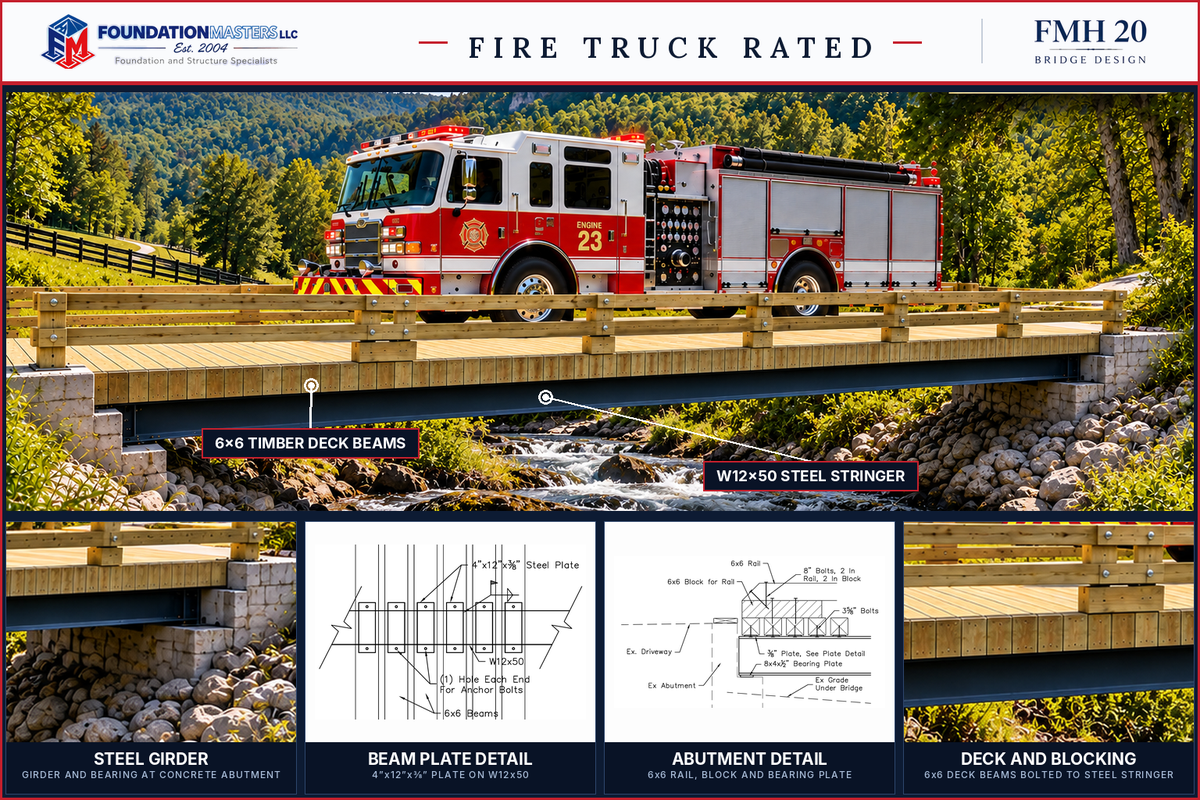
Superstructure
- W12x50 structural steel stringers, ASTM A992 Grade 50
- 4 in by 12 in by 3/8 in steel beam plates, one hole each end for anchor bolts
- 8 in by 4 in by 1/2 in bearing plates at the abutments
- Shop primed as standard, hot dip galvanizing available where the setting calls for it
- Welding conforms to AWS D1.1 Structural Welding Code for Steel
Deck and Guardrail
- 6 by 6 pressure treated Southern Yellow Pine, Number 2 or better, deck and rail
- Deck beams run across the span with the ends exposed at the fascia
- 6 by 6 rail on a 6 by 6 block for rail, through bolted with 8 in bolts, two in the rail and two in the block
- LedgerLOK hex head structural screws at the deck fastening
- Composite decking and architectural rail treatments available as an upgrade
Foundations: FM-PP30 Driven Pipe Piles
Each abutment is carried on four FM-PP30 piles. Three inch schedule 40 pipe, 3.500 in outside diameter, 0.216 in wall, ASTM A252 Grade 2, rated at thirty tons apiece and driven to bearing with a pneumatic hammer.
Driven rather than hydraulically pressed is a deliberate choice on this structure. A pressed pile develops its installation force by reacting against something already built, which is fine under an existing footing and useless on an open creek bank where there is nothing to push against yet. A hammer driven pile needs no reaction and tells you what you have as it goes, because refusal is measured rather than assumed.
What the pile reaches depends on the site. In much of Florida and across the limestone belt it is driven to refusal on rock. In deep sand and clay there is nothing hard to find, so capacity is developed in friction over a considerably longer pile. That is settled by soil borings at the abutment locations, not by a regional assumption. Batter piles are used where lateral loads call for them.
Abutments, Scour and the Thing That Actually Fails
Residential bridges rarely fail in the span. They fail at the bank. Water finds the loose fill packed in behind an abutment, takes it a little at a time, and one day the approach drops and the bearing seat is no longer where the drawing put it. Erosion is the leading cause of failure on private crossings, which is why the FM-H20 treats the abutment as the main event rather than as the thing holding up the interesting part.
Abutment Capacity
Engineered to 80 tons at a 2 to 1 safety factor. Concrete is 5,000 psi minimum with Grade 40 reinforcing or better, and the design is checked against 1,500 psf assumed soil bearing unless borings say otherwise.
Scour Protection
Vinyl sheet piling driven 60 inches below the mud line at the abutments, with riprap and grading where the hydraulics call for it. Embedment is set by the crossing and the soil rather than by a default.
Hydrologic modeling is available where flood flows govern the design. Related: geotechnical engineering and pipe pile.
This page covers the FM-H20 itself. The state pages cover the ground it goes into.
FM-H20 Technical Specification
Design Loading
H-20 apparatus loading, 20 ton deck capacity. Project specific analysis per applicable codes.
Span
Standard spans to 60 feet. Longer spans by project specific design.
Superstructure
W12x50 steel stringers, A992 Grade 50, with 3/8 in beam plates and 1/2 in bearing plates.
Deck
6 by 6 pressure treated Southern Yellow Pine, Number 2 or better. Composite decking available.
Guardrail
6 by 6 timber rail on 6 by 6 blocking at the deck edges, through bolted. Architectural options available.
Abutments
80 ton capacity at a 2 to 1 safety factor. 5,000 psi concrete, Grade 40 reinforcing or better.
Foundations
FM-PP30 driven pipe piles, four per abutment, 30 ton working load each, pneumatically driven to bearing.
Scour Protection
Vinyl sheet piling 60 inches below the mud line, with riprap and grading as the site requires.
Warranty
Lifetime warranty on bridges designed and installed by Foundation Masters.
Starting price is 3,300 dollars per linear foot for a typical turn key residential configuration. Span, bank condition, pile depth and site access are what move it from there.
Installation and Record Keeping
Sequence
- Borings and survey, then the sealed design
- Piles driven with a pneumatic hammer to verified bearing resistance
- Abutments formed and poured, sheet pile driven at the banks
- Girders set on bearing plates with the anchor details made up
- Deck beams laid and fastened, rail and blocking set
What You Get at the End
- Sealed drawings and calculations
- Pile driving logs with recorded refusal
- Mill certifications and material test reports on request
- Inspection records for piles, bearings, connections and deck fastening
- As built elevations and photographic documentation
Vibration monitoring and static load testing are available as contract add ons where the site or the neighbors warrant it.
FM-H20 FAQs
What does an FM-H20 cost?
It starts around 3,300 dollars per linear foot for a typical residential crossing, turn key. What moves it is the span, how much abutment and bank work the site needs, how deep the piles have to go and whether a pile rig can physically reach the crossing.
Will a fire truck really cross it?
That is what the H-20 rating is for: a 20 ton deck capacity sized for apparatus rather than passenger vehicles. Ask your local department what they actually run, because a tanker carrying several thousand gallons can outweigh the engine most people picture, and that answer should be settled before the design is finalized.
How long does it take?
Once permits are in hand the field work on a single span crossing is measured in weeks rather than months. Driving pile and building the abutments is the slow part. The permitting ahead of it usually takes longer than the bridge does.
Why timber deck instead of concrete?
Weight and cost. A timber deck on steel girders carries apparatus loading at a fraction of the dead load of a concrete deck, which means lighter girders, smaller abutments and fewer piles underneath. On a private crossing that is the difference between a sensible number and a public works number.
How long does a pressure treated deck last?
Deck boards are the wearing part of the structure and are meant to be replaceable. The steel, the piles and the abutments are the permanent elements and the warranty follows them. Composite decking is available where somebody wants to take future deck replacement off the table.
Can it be built on a site with no rock?
Yes. The piles are driven until they develop capacity rather than until they hit something hard, which simply means a longer pile in deep sand and clay. The borings tell us which situation we are in before anybody prices it.
What about a coastal or brackish setting?
Hot dip galvanizing on the superstructure is the usual answer where salt is in play, and the vinyl sheet piling at the abutments does not corrode at all. Those get specified at design rather than added later.
Can you design it and let my builder build it?
Yes. We will do the borings, the design and the sealed set and hand it over. The lifetime warranty applies to bridges we build, so that is the trade to weigh.
Price an FM-H20 for Your Crossing
Tell us the span, what has to get across it and where the property is. We will tell you what it takes.
Call 656-233-7089Or send it in writing through the contact page. Include the property address, the span and a photo of the crossing.