
Residential Bridge Construction
Foundation Masters, LLC. Licensed Florida engineering firm, CA# 30969. Driveway, estate and entrance bridges for homes across Florida and the Southeast, designed so the way in stays open in a flood and a fire engine can reach the house.

For a lot of homes the driveway is the only way in, and the driveway crosses water. A creek, a canal, a drainage ditch or a wetland sits between the house and the road. Whatever is carrying the driveway over it decides whether you can get out in a storm, whether a fire engine can get in, and whether the next owner sees an asset or a problem.
Foundation Masters designs and builds residential bridges: private driveway crossings, estate and gated community entrances, culvert replacements and second access routes. We are a design build firm. Our crews survey the site, a licensed professional engineer designs and seals the bridge and its foundations, and our own crews drive the piles and build it.
We build across Florida, Georgia, Alabama, Mississippi, Tennessee, South Carolina and North Carolina. Everything is indexed on the bridge contractor hub.
Culvert or Bridge? Why Pipes Under Fill Wash Out
The most common private crossing is a pipe laid in the creek with fill piled on top. It is cheap and it works on an ordinary day. The trouble is the day that is not ordinary. A flood carries branches, leaves and trash, and the inlet of the pipe is the first thing that catches them. Once the opening clogs, the water backs up behind the fill, rises over the top, and cuts the driveway away from the downstream side. The pipe is often still there afterward. The road on top of it is gone.
A bridge takes the pipe out of the problem. A single clear span lets the creek pass under it at full width, with the supports set back on the banks where the water does not reach them, so there is nothing in the channel to clog and no fill to wash away.
When a Culvert Is Enough
A small, steady drainage swale with little debris, plenty of room for the water to back up harmlessly, and a second way out if it ever does wash. The pipe still has to be sized for the storm, not the average day.
When It Should Be a Bridge
A real creek that rises fast, carries debris or has already washed out a crossing, a driveway that is the only way to the house, or a crossing a fire engine has to use. In those cases a clear span is the crossing that stays open.
This page covers residential bridges. The rest of the bridge practice is below.
Can a Fire Engine Reach Your House?
This is the question that matters most and gets asked least. A bridge that has carried cars and pickups for years can still be the wrong bridge for a fire engine, which weighs many times more than a pickup and puts that weight on a short wheelbase. If the driveway bridge is the only way to the house, the fire department either crosses it or stops at it.
Our standard residential bridge is the FM-H20: steel girders under a timber deck, rated for H-20 fire truck loading with a 20 ton deck capacity and spans up to 60 feet. Where the bridge is part of a required fire department access road, the local fire code official sets the load it has to carry, and some fire codes call for 75,000 pound apparatus with the load limit posted at both ends. We confirm the requirement with the fire marshal before the design is set, and size the bridge to what they require.
It is also worth asking your local department what they actually run. A rural tanker carrying several thousand gallons of water can be heavier than the engine everyone pictures.
Residential Bridges We Build
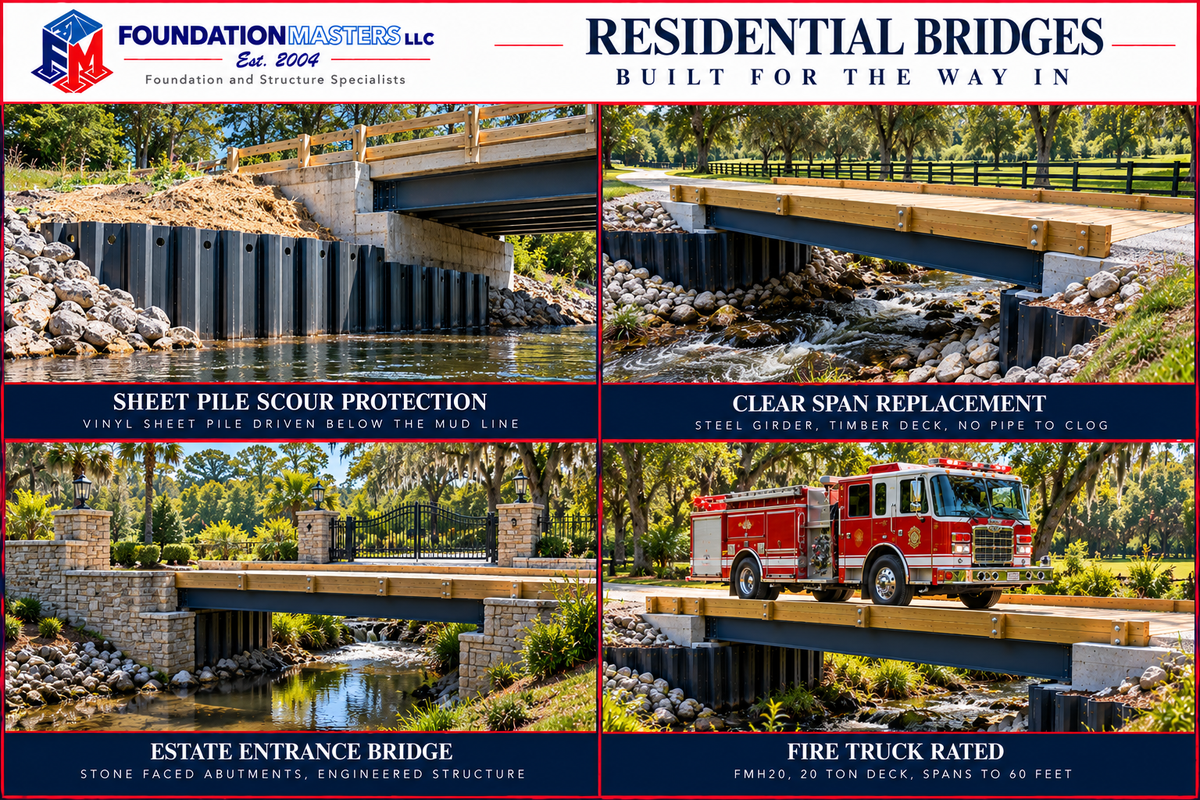
Private Driveway Bridges
The single crossing between the house and the road. Steel girders under a timber deck, 6×6 timber wheel guard along both edges, and foundations set back from the creek.
Culvert Replacements
Washed out or undersized pipe crossings replaced with a clear span, so there is nothing in the channel to clog and nothing on top to wash away.
Estate and Entrance Bridges
Signature crossings at the front of an estate or a gated community, with stone or stucco faced abutments and the appearance engineered alongside the structure.
Second Access Routes
A second way out for a property that has only one, so a washed out road or a blocked drive does not trap the household or keep emergency crews out.
Farm and Acreage Crossings
Bridges on larger residential properties that carry tractors, trailers and delivery trucks as well as the family cars.
Custom and Replica Bridges
Covered bridges, arched looks and replicas of historic designs, built over a modern engineered structure so the look does not come at the cost of the load rating.
Foundations and Scour Protection
Residential bridges rarely fail in the steel. They fail at the banks, when floodwater digs out the fill behind an abutment or the ground under a shallow footing. Every FM-H20 sits on four FM-PP30 driven steel pipe piles at each abutment, with vinyl sheet piling driven 60 inches below the mud line between the stream and the approach fill.
What the piles have to reach depends on where you live. In Florida and the coastal plain there is usually no rock in reach, so the pile builds its capacity in the sand and clay. In the Piedmont and the mountains it may be driven to refusal on rock. The state pages linked above explain what the ground does in each part of our footprint, and on any job where the soil is in question, soil borings come first.
How a Residential Bridge Project Runs
1. Site Visit
We stand on the bank, measure the crossing, look at what the creek does in a storm and talk through what has to cross the bridge, including the fire department.
2. Sealed Design
A licensed professional engineer designs and seals the bridge, the foundations and the scour protection. That set is what the permit office reviews and what our crews build from.
3. Permits
The county building permit, and for most creek crossings a state review of work in the waterway and sometimes a federal authorization. We prepare and file the package.
4. Build and Record
Our own crews drive the piles, set the abutments and steel and build the deck. You get a closeout record of what was built, which your insurer and your future buyer will both want.
Residential Bridge FAQs
What does a residential driveway bridge cost?
The FM-H20 starts around 3,300 dollars per linear foot. Span, bank condition, how far the piles have to go and how hard the crossing is to reach are what move it from there. We put a real number on it after we have stood on the bank.
Should I replace my culvert with a bridge?
If the creek rises fast, carries debris, has already washed out the crossing, or the driveway is the only way to the house, a clear span is usually the better answer. A culvert clogs at the inlet in a flood and the water then cuts away the fill on top. A bridge leaves nothing in the channel to clog.
Will a fire truck be able to cross it?
The FM-H20 is rated for H-20 fire truck loading with a 20 ton deck capacity. Where the bridge is part of a required fire department access road, the local fire code official sets the load, and some codes call for 75,000 pound apparatus. We confirm the requirement with the fire marshal before design and size the bridge to it.
How long a span can you build?
The FM-H20 spans up to 60 feet in a single clear span. Most private driveway crossings are well inside that. Longer crossings are designed individually.
Do I need a permit for a driveway bridge?
In most cases yes. A bridge over a stream generally needs the county building permit plus a state review of work in the waterway, and depending on the water body a federal authorization. Those reviews usually take longer than the construction. We prepare and file the package.
Can the bridge match the look of my home?
Yes. Abutments can be faced in stone or stucco, and covered, arched and replica designs can be built over the same engineered structure. The look is designed with the bridge, not added afterward, so it does not cost you load rating.
How long does construction take?
For a typical single span driveway bridge, the field work is measured in weeks once the permits are in hand. Driving the piles and setting the abutments is the slow part. The steel and deck go quickly after that.
My existing bridge is in bad shape. Repair or replace?
It depends on what is actually wrong. Scoured abutments and a rotted deck on a sound steel frame are often repairable. A bridge that was never rated for the loads crossing it now is usually a replacement. Our bridge repair process starts with a survey and an engineering evaluation before anyone talks about price.
Talk About Your Driveway Bridge
New bridge, culvert replacement, estate entrance or a second way in. Tell us where it is, how wide the crossing is and what has to get across it.
Call 656-233-7089Or send it in writing through the contact page. Include the property address, the span and a photo of the crossing.