
Sheet Pile Contractor Jacksonville: Bulkheads, Cofferdams and Marine Walls
Jacksonville is a river town, and that makes most of the sheet pile work here permanent marine wall rather than temporary shoring. A bulkhead holds a bank in place for decades, in moving water, with fill behind it and something built on top of that fill. It is a structure, not temporary works, and it almost never fails the way people expect it to.
The sheet rarely gives up first. The anchorage does. Tiebacks, walers and the soil the anchors are developed in carry the load, and when a wall on this river goes bad it usually went bad behind the steel, out of sight, long before anything showed at the face.

We engineer the wall, source or rent the steel, drive it with our own crews, and pull it back out. Four scopes that are normally split across four companies, which is where most sheet pile schedules come apart.
Duval, Clay, St Johns and Nassau counties, and statewide on larger jobs. Jacksonville, Jacksonville Beach, Atlantic Beach, Neptune Beach, Mayport, Orange Park, Fleming Island, Green Cove Springs, St Augustine and Fernandina Beach.
Where on the river the wall sits, whether it has to be anchored, and whether the work happens from land or off the water. Those three answers move a Jacksonville number more than wall height does.
Sheet Pile Work Across Florida
Foundation Masters runs sheet pile work statewide, and the conditions change hard from one market to the next. Tampa Bay sits on shallow limestone and brackish water. Orlando is inland sand with vibration sensitive neighbors. Jacksonville is river and organics. Miami is deep excavation under a high water table. Each page covers what actually governs there.
Soft Ground, a River That Changes Chemistry, and a Wall That Lives or Dies on Its Anchors
Three conditions decide most sheet pile jobs in this market, and none of them are the conditions that govern elsewhere in Florida.
The first is soft ground. The river valley and the marsh carry soft clays and organic layers, and the problem here is the opposite of the one in Tampa. Nothing stops the sheets. What is hard to find is competent material deep enough to develop the embedment and the anchor capacity the wall actually needs. Drive easy and anchor badly and you have built a hinge.
The second is the water itself. The St Johns is tidal a long way inland, and it runs full marine near the mouth, brackish through the middle and fresh upriver. That means two permanent walls in the same city, a few miles apart, can justify different steel and a different coating. A regional default does not survive that, and steel corrosion is where the design life is won or lost.
The third is anchorage. Most permanent walls here are anchored rather than cantilevered, which puts the load into tiebacks, walers and the soil behind the wall. Anchored wall design is treated formally in the US Army Corps of Engineers engineer manual on the design of sheet pile walls, and it is the half of the structure nobody can see once the job is done.
What That Changes on Your Job
- Embedment is governed by where competent material actually starts, not by a round number below dredge line
- The tieback and waler system gets designed as a structure rather than detailed as an afterthought
- Where the wall sits on the river drives the steel, the coating and the design life
- Fill behind a bulkhead has to be specified and placed, because the fill is part of the wall
- Settlement of soft layers behind the wall shows up as a sunken slab on top, years later
- Marine access, tide and current decide the rig and the production rate before anything else does
What We Actually Do With Sheet Pile
Four things, and most contractors in this market do one or two of them. Holding all four is what lets us solve a problem in the field instead of writing a letter about it.
Engineer the Wall
Our Florida licensed engineers produce signed and sealed sheet pile design, including the tieback and waler system rather than just the sheet. See structural engineering drawings.
Source the Material
We can get any section. PZ, PZC, NZ, AZ, flat web, cold formed, new or used. If it rolls or it exists in the secondary market, we can put it on your site.
Rent, Sell or Buy Back
Rent the sheets for a temporary wall, buy them outright, or sell us the ones you are finished with. See steel sheet piles for sale and sell your sheet piles.
Drive and Extract
Our own crews and rigs, from the first sheet to the last one pulled. Pile driving is our trade, not a subcontract we manage.
Tiebacks and Anchorage
The part that carries an anchored bulkhead. Rods, walers, deadmen and anchors developed in soil that was actually tested rather than assumed.
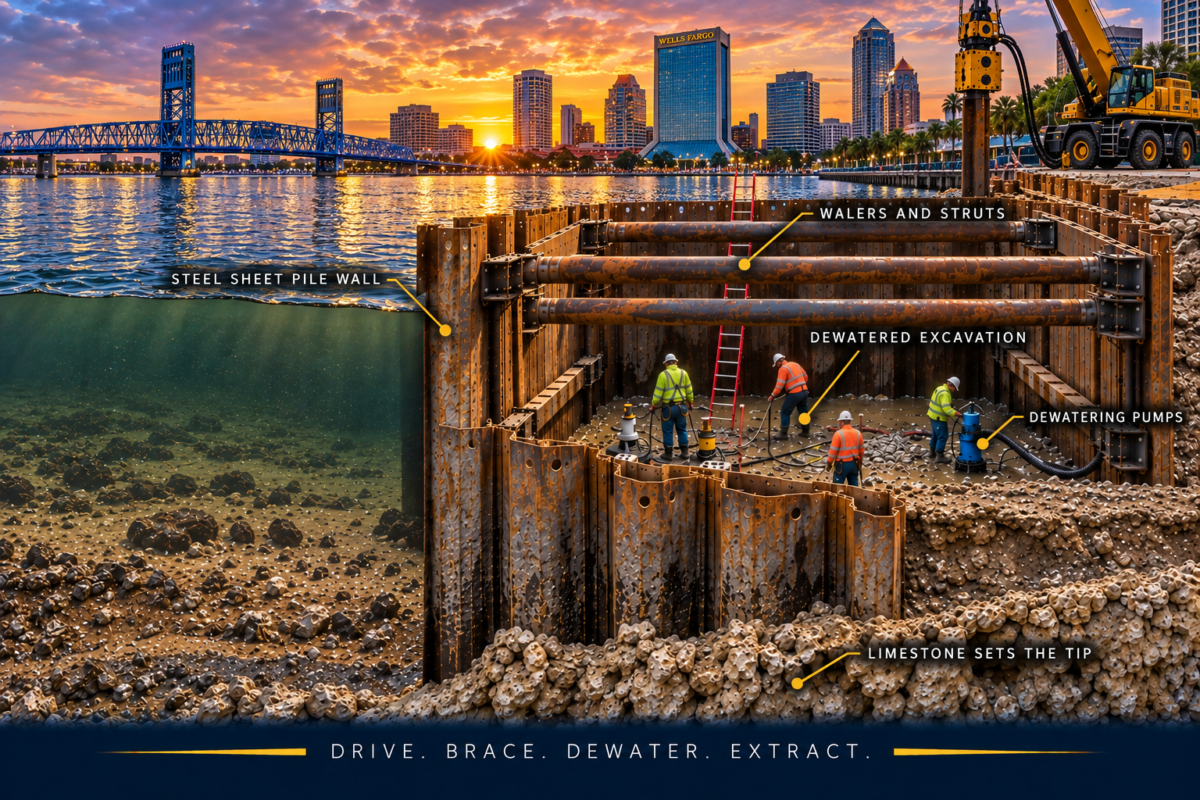
Brace and Dewater
Walers, struts and the groundwater control that has to happen in the same sequence. A braced wall and a dry hole are one problem, not two.
Where Sheet Pile Earns Its Keep on the First Coast
These are the scopes that come up repeatedly in this market, and each one puts a different demand on the wall.
Bulkheads and Seawalls
The signature scope here. Permanent anchored walls holding a bank, with fill and usually a structure behind them. See seawall contractors.
Bulkhead Replacement
Replacing a wall that has lost its anchors or is bleeding fill through the joints, often with a structure sitting close behind it that cannot be disturbed.
Port and Terminal
Slip walls, dock structures and quay work where the steel lives in moving salt water and the schedule follows the tide and the vessel traffic.
Cofferdams
Pump stations, outfalls and bridge piers below the water table, where the wall holds the ground and the water at once. See cofferdams in Florida.
Bridge and Scour
Abutment protection and scour countermeasures on river and creek crossings for county and municipal structures. See bridge construction.
Timber Wall Replacement
A great deal of older waterfront here is timber that is at the end of its service life. See timber pilings.
Sheet Pile Work We Have Done
Described by scope and county rather than by client, because most of this work sits under agreements we do not publish.
- A steel sheet pile retaining wall on a Pasco County development tract, designed and built as permanent grade separation
- Sheet pile walls and driven piles on a county bridge replacement program in Central Florida
- A sheet pile cofferdam for a Central Florida water authority pump station, with the dewatering in the same scope
- Temporary cofferdam and dewatering design for a state agency coastal impoundment project
- A sheet pile wall pursued for a Pinellas County school site, where we walked because the ground did not support what the budget assumed
The Order That Keeps It From Going Sideways
Front loading the subsurface is the whole trick, and on a river wall it decides the anchors as much as the sheets.
We start under the site, because where competent material begins sets the embedment, the anchor type and whether a tieback is even viable. From there the wall and its anchorage get designed and sealed together, the section gets selected against the water it will sit in, and the material gets sourced or pulled from rental.
Then the sequence. Drive, install the walers and tiebacks, dewater if the work is in the dry, excavate or dredge to line, place and compact the fill in lifts, and tie the top into whatever goes on it. Backfill is a hold point here rather than cleanup, because fill dumped in one pass behind a finished wall is how a good bulkhead gets ruined in an afternoon.
What We Need From You to Quote a Jacksonville Sheet Pile Job
Nobody in this market publishes this, which is why the first week of a sheet pile job is usually spent trading emails. Send what you have and we can put a real number in front of you.
The first half of the list is the same anywhere. The second half is the Jacksonville half, and it is the part that moves the price here, because the water and the anchorage decide the method, the steel and the production rate more than the wall height does.
Send Us Whatever You Have
- Site address and survey, so we can see the footprint and the access
- Geotechnical report or boring logs, or tell us there are none and we will run them
- Exposed wall height, and the dredge or mudline elevation in front of it
- Wall length and geometry, including corners and returns
- Temporary or permanent, and the design life you expect out of it
- Where on the river or creek it sits, because the water chemistry changes between the mouth and upriver
- Whether the wall needs to be anchored, and whether there is room behind it for a tieback and a deadman
- Land or marine access, meaning whether a rig can reach it or the work goes off a barge
- What sits behind the wall, how close it is, and what the fill is carrying
- Any existing wall, its condition, and whether the anchors are still doing anything
On a Permanent River Wall, Buying the Right Steel Beats Saving Money on It
This market splits cleanly. A cofferdam or a shored cut is temporary and the steel comes back out, so renting usually wins outright. A bulkhead is permanent and stays in salt or brackish water for decades, and that is a different decision entirely.
On a permanent wall the section, the steel and the coating are a design life calculation rather than a price comparison. Saving money on the steel in a marine wall buys a wall that needs replacing years sooner than anybody planned for, and by then it is somebody else holding the bill.
We rent, sell and buy back, and we will tell you which one is cheaper for your job even when it is not the one that bills highest. A contractor talked into buying sheets they never use again does not call back, and we would rather have the next job.
Sections We Work With
Any profile family in common use. These are the ones that come up most on First Coast work.
- PZ and PZC hot rolled Z sections, the workhorse for bulkhead and retaining walls
- NZ and AZ Z sections, widely available new and used
- Heavier Z sections where an anchored marine wall needs the section modulus
- Flat web PS sections where a cellular structure is called for
- Combination wall systems where a Z section alone will not carry it
- Cold formed sections for lighter and shorter walls on upland work
Sheet Pile Contractor Jacksonville: Frequently Asked Questions
What does a sheet pile contractor in Jacksonville actually do?
Four things that are usually split across four companies. We engineer the wall and its anchorage, source or rent the steel, drive it with our own crews and rigs, and pull it back out when the work is temporary. On a river wall that matters more than it sounds, because a problem in the field gets solved in the field rather than becoming a letter about whose scope it was.
What usually fails first on a bulkhead on the St Johns River?
Not the sheet. On an anchored wall the load goes into the tiebacks, the walers and the soil the anchors are developed in, and that is where the trouble starts. The other common failure is fill escaping through the joints over years, which empties the ground behind the wall and shows up on the surface as a sunken slab or a dropped seawall cap long before the steel looks like the problem.
Why does the steel decision change depending on where on the river the wall sits?
Because the water changes. The St Johns is tidal a long way inland and runs full marine near the mouth, brackish through the middle and fresh upriver. Two permanent walls in the same city, a few miles apart, can justify a different section and a different coating. A regional default does not survive that, which is why we ask where on the river the job is before quoting a permanent wall.
Can a sheet pile bulkhead be built where the ground is soft?
Yes, and soft ground is normal here. The river valley and the marsh carry soft clays and organic layers, and the difficulty is the opposite of the one in Tampa Bay. Nothing stops the sheets. What is hard is finding competent material deep enough to develop the embedment and the anchor capacity the wall needs. Driving easy and anchoring badly produces a hinge rather than a wall.
Do you install the tiebacks and anchors, or just the wall?
We design and install the whole system. Rods, walers, deadmen and anchors, developed in soil that has actually been tested rather than assumed. That matters because the anchorage is the half of an anchored bulkhead nobody can inspect once the job is finished, and it is the half that decides how long the wall lasts.
Can you work from the water?
Yes. A good deal of waterfront work here cannot be reached with a land rig, and marine access changes the equipment, the sheet lengths and the production rate before anything else does. Tide and current set the working window. We would rather know at bid whether the job is land based or marine than find out at mobilization.
Do you design the wall, or do I need a separate engineer?
We design it. Our Florida licensed engineers produce signed and sealed sheet pile design, including the tieback and waler system rather than only the sheet, which is unusual among installers in this market. It also removes the most common failure point on these jobs, which is a wall designed by somebody who has never had to drive one or anchor one.
Can you replace an existing bulkhead without disturbing what is behind it?
Often yes, and the planning is the job rather than the driving. What governs is how close the structure behind the wall sits, what the fill is carrying, and whether the old anchors are still doing anything. A new wall driven just outside the failing one is frequently the cleaner answer, because it avoids opening up ground that is currently holding something up.
Do you rent sheet pile, or only install it?
Both, and we sell it and buy it back. The decision splits by scope here. A cofferdam or a shored cut is temporary and the steel comes back out, so renting usually wins. A permanent bulkhead is a design life question rather than a price comparison, and that is a case for buying the right section instead of the cheapest one.
What do you need from me to quote a sheet pile job?
Site address and survey, boring logs if they exist, exposed wall height, the dredge or mudline elevation, wall length and geometry, temporary or permanent, and the design life. Then the Jacksonville half: where on the river it sits, whether it has to be anchored, whether there is room behind it for a tieback and a deadman, whether access is land or marine, and the condition of any existing wall.
Why does the backfill behind a bulkhead matter so much?
Because on a bulkhead the fill is a structural component rather than cleanup. It has to be specified and placed in lifts, and it has to be material that will not wash out through the joints. Fill dumped in one pass behind a finished wall is how a good bulkhead gets ruined in an afternoon, and the damage does not appear until the surface above it starts to drop.
What areas around Jacksonville do you cover?
Duval, Clay, St Johns and Nassau counties, and statewide on larger work. That includes Jacksonville, Jacksonville Beach, Atlantic Beach, Neptune Beach, Mayport, Orange Park, Fleming Island, Green Cove Springs, St Augustine and Fernandina Beach.
Engineering That Has Been in the Hole It Designed
Foundation Masters, LLC has been a licensed civil engineering company since 2004 and has worked in Florida since 2014 under Florida Certificate of Authorization CA number 30969.
Our team carries over 125 years of combined experience across structural, civil and geotechnical engineering, and the construction side runs under our own license rather than through a broker.
Related Jacksonville Engineering
- Geotechnical engineering in Jacksonville, where the borings and the anchor capacity come from
- Structural engineering in Jacksonville for the structure the wall and the fill support
- Civil engineering in Jacksonville for site, stormwater and permitting
- Soil borings, the step that decides the embedment and the anchors
- Steel corrosion in Florida marine service
- Timber pilings on older waterfront at the end of its service life
- Deep foundation systems when the wall is only part of the answer
Tell Us Where on the River It Is
Foundation Masters, LLC engineers, supplies, rents, drives and extracts steel sheet pile across Jacksonville and the First Coast. One company from the boring log to the last sheet pulled.