
Drilled Shafts
Drilled shafts are large-diameter, cast-in-place concrete deep foundations built by drilling a hole, placing a steel reinforcing cage, and filling it with concrete. Also called caissons or bored piles, they carry very high axial and lateral loads in a single element, which makes them a first choice for bridges, high-rise buildings, and heavy structures across Florida.
Florida’s Longest-Running Foundation Repair & Structural Engineering Firm
For more than 25 years, Foundation Masters has designed, engineered, and installed foundation repair, underpinning, deep foundation, waterproofing, and structural stabilization systems. As Florida’s longest-running foundation repair company under continuous ownership, Foundation Masters continues to provide engineered solutions backed by decades of field experience, documented project performance, and proprietary foundation systems developed specifically for Florida conditions.
Deep Foundation Methods
Compare Foundation Masters’ deep foundation and pile systems. Each method suits different soils, loads, access, and structures, coordinated so design decisions stay consistent across the project.
Engineering Research & Technical Publications
Drilled shaft performance depends on the shaft diameter and depth, the steel reinforcing cage, concrete placement, the way the hole is kept open and clean, and the ground itself. Getting those right, and proving them by load and integrity testing, is what makes a drilled shaft a dependable high-capacity foundation.
The Foundation Masters Research Center contains engineering research, technical articles, Florida geology and karst studies, pile-system comparisons, and field case studies to help engineers, contractors, property owners, and associations understand modern deep foundation technology.
What Drilled Shafts Are
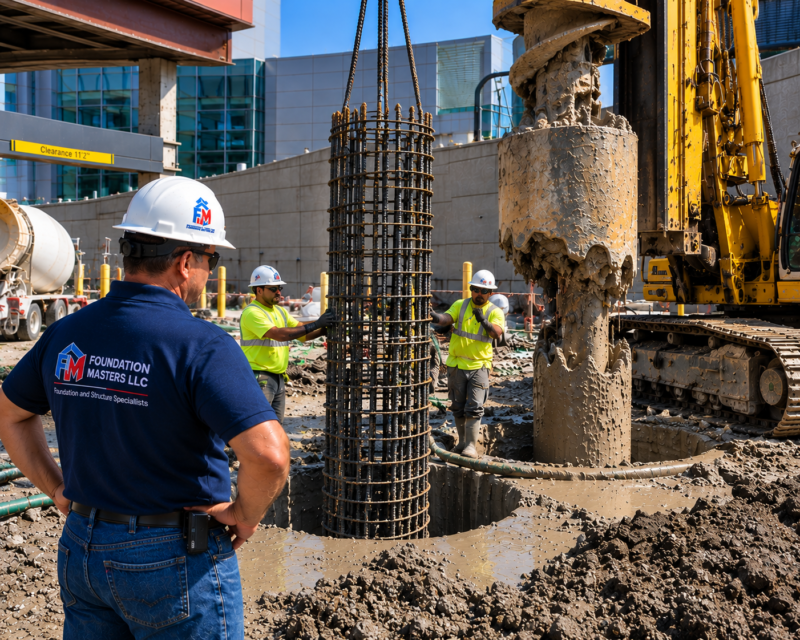
A drilled shaft is a large-diameter (typically 18 inches to 10 feet or more) cast-in-place concrete deep foundation. A rotary rig drills the hole to design depth, a steel reinforcing cage is lowered in, and the shaft is filled with concrete. The shaft carries load through end bearing on firm soil or rock at the tip and through side friction (skin friction) along its length. Because a single large shaft can replace a whole group of smaller piles and its cap, drilled shafts are efficient for concentrated, heavy loads.
How Capacity Develops
Drilled shafts develop capacity through end bearing at the tip and side friction along the shaft. In Florida, tipping into or socketing a shaft into limestone can add very high end-bearing capacity.
One Big Element
A single drilled shaft can carry the load of a full pile group, often with no pile cap, and provides excellent resistance to lateral loads and overturning, which matters for bridges, towers, and tall buildings.
Why Drilled Shafts Fit Florida
Florida’s sands over limestone are well suited to drilled shafts, which can be socketed into rock for high end bearing. Where holes are below the water table or in caving soils, the shaft is drilled under casing or drilling slurry to hold the hole open, then concreted, making drilled shafts a core part of our deep foundation systems.
How Drilled Shafts Are Installed
Drill
A rotary drill rig with an auger or bucket advances the shaft to design depth. Temporary casing or drilling slurry holds the hole open in loose soils or below the water table.
Clean & Inspect
The bottom of the shaft is cleaned of loose spoil and inspected so the shaft bears on firm soil or rock, a step that is critical to end-bearing performance.
Place Cage
A prefabricated steel reinforcing cage is lifted and lowered into the open shaft to carry structural, bending, and uplift loads and to connect to the structure above.
Concrete
Concrete is placed continuously, by tremie under slurry or water where required, filling the shaft from the bottom up. Casing is withdrawn as concrete rises, then the shaft is tested before acceptance.
Drilled Shaft Load Testing & Integrity Verification
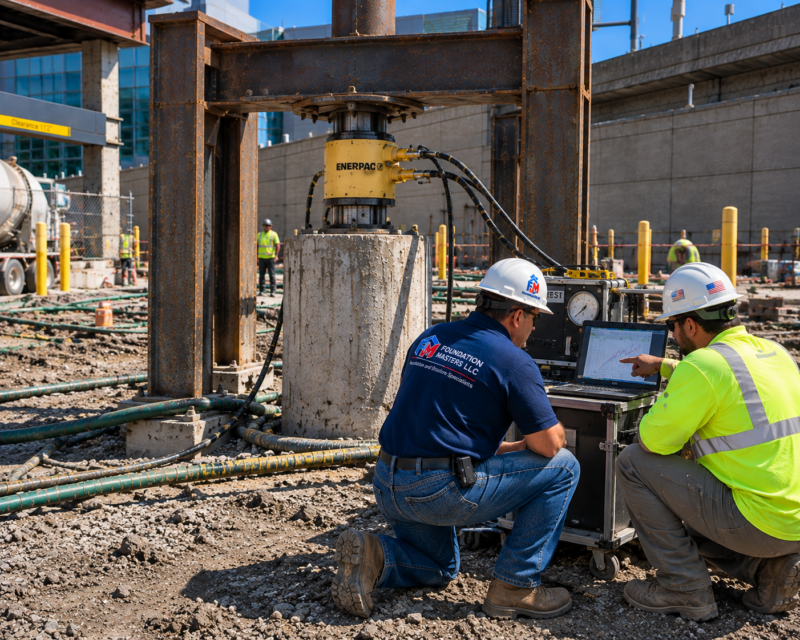
Capacity is proven, not assumed. Because drilled shafts carry such high loads, they are commonly verified by both load testing and integrity testing. Static or bi-directional (Osterberg cell) load tests confirm capacity, while integrity methods such as Crosshole Sonic Logging and Thermal Integrity Profiling confirm the concrete is sound along the full shaft. Results are documented in a signed and sealed engineering report before the shafts are accepted.
Drilled Shaft Applications
- Bridge foundations, piers, and abutments, including work alongside our bridge construction projects
- High-rise and mid-rise buildings with heavy, concentrated column loads
- Sound walls, sign structures, high-mast lighting, and towers with large lateral and overturning loads
- Heavy industrial and commercial structures needing large single-element capacity
- Sites where a shaft can be socketed into Florida limestone for high end bearing
- Foundations that must resist significant lateral load, scour, or uplift
Drilled Shafts vs. Driven Piles and Micropiles
A general comparison of deep foundation options. Values are typical/representative and vary with size, soil, and design.
*Representative comparison for planning only. Pile type, size, and capacity are always confirmed by project-specific geotechnical and structural engineering.
Drilled Shaft Standards & References
- FHWA Drilled Shafts: Construction Procedures and LRFD Design Methods (FHWA-NHI-10-016), via the Federal Highway Administration.
- ACI 336.3R Design and Construction of Drilled Piers and structural design under ACI 318, via the American Concrete Institute.
- Drilled shaft construction guidance from the ADSC: The International Association of Foundation Drilling and the Deep Foundations Institute.
- Deep foundation design under AASHTO LRFD Bridge Design Specifications and the Florida Building Code, coordinated with FDOT standards on transportation work.
Drilled Shaft FAQs
What is a drilled shaft?
A drilled shaft is a large-diameter (typically 18 inches to 10 feet or more) cast-in-place concrete deep foundation. A hole is drilled, a steel reinforcing cage is placed, and the shaft is filled with concrete, carrying load through end bearing and side friction. Drilled shafts are also called caissons or bored piles.
When are drilled shafts used?
Drilled shafts are used for bridges, high-rise buildings, towers, sound walls, sign structures, and heavy industrial foundations, wherever very high axial and lateral loads must be carried in a single element, often with no pile cap.
What is the difference between a drilled shaft and a driven pile?
A driven pile is a prefabricated element hammered into the ground. A drilled shaft is cast in place in a drilled hole. Drilled shafts offer higher single-element and lateral capacity with low vibration, while driven piles are efficient for new construction on open sites.
Are drilled shafts good for Florida soils and limestone?
Yes. Florida’s sands over limestone suit drilled shafts well, because a shaft can be socketed into rock for very high end bearing. In caving soils or below the water table, the hole is drilled under casing or slurry, then concreted.
How is drilled shaft capacity and quality verified?
By load testing and integrity testing. Static or bi-directional (Osterberg cell) load tests confirm capacity, and methods such as Crosshole Sonic Logging and Thermal Integrity Profiling confirm the concrete is sound, all documented in a signed and sealed engineering report.
Do you design and install drilled shafts?
Yes. Foundation Masters is a design-build firm that engineers and installs drilled shafts and other deep foundation systems, coordinated with our pile driving and foundation repair work. Request an engineering review to get started.