
Micropiles
Micropiles are small-diameter, drilled and grouted, high-strength steel-reinforced deep foundations that deliver large load capacity from a very small footprint. Foundation Masters designs and installs micropiles for underpinning, restricted-access and low-headroom sites, and Florida’s karst and limestone conditions, where minimal vibration and precise, verified capacity matter most.
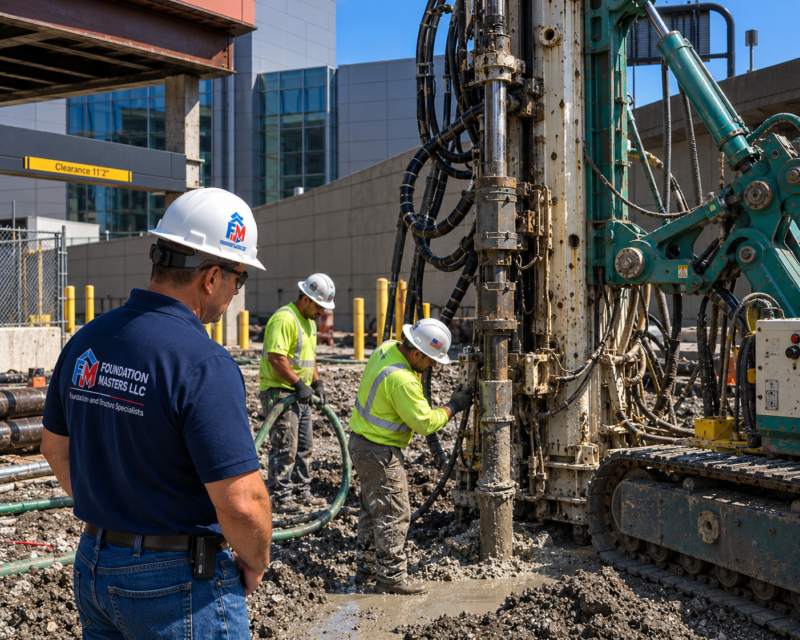
Florida’s Longest-Running Foundation Repair & Structural Engineering Firm
For more than 25 years, Foundation Masters has designed, engineered, and installed foundation repair, underpinning, deep foundation, waterproofing, and structural stabilization systems. As Florida’s longest-running foundation repair company under continuous ownership, Foundation Masters continues to provide engineered solutions backed by decades of field experience, documented project performance, and proprietary foundation systems developed specifically for Florida conditions.
Deep Foundation Methods
Compare Foundation Masters’ deep foundation and pile systems. Each method suits different soils, loads, access, and structures, coordinated so design decisions stay consistent across the project.
Engineering Research & Technical Publications
Micropile performance depends on the grout-to-ground bond, the steel reinforcement, the drilling and grouting method, and the ground itself. Getting those right, and proving them by testing, is what makes a micropile a dependable deep foundation.
The Foundation Masters Research Center contains engineering research, technical articles, Florida geology and karst studies, pile-system comparisons, and field case studies to help engineers, contractors, property owners, and associations understand modern deep foundation technology.
What Micropiles Are
A micropile is a small-diameter (typically 5 to 12 inch) drilled, grouted, and steel-reinforced deep foundation element. The load is carried by the bond between the grout and the surrounding ground, and by high-strength steel reinforcement (a threaded bar, casing, or both) inside the grout column. Because they are drilled rather than driven, micropiles install with minimal vibration, fit into tight and low-headroom spaces, and can be advanced through fill, boulders, rubble, and karst where driven piles struggle.
How Capacity Develops
Most micropile capacity comes from grout-to-ground bond along the bonded length, with the steel reinforcement carrying the structural load. This makes micropiles strong in both compression and tension (uplift and tie-down).
Drilled, Not Driven
Micropiles are drilled and grouted, so they generate little vibration and can work inside buildings, in basements, under low overhead, and beside sensitive structures where driving is not an option.
Why Micropiles Fit Florida
Florida’s karst limestone, variable fill, and high water tables create voids and hard/soft transitions that are difficult for some pile types. Micropiles drill through these conditions and are ideal for underpinning existing structures and adding capacity in restricted access, which is why they are a core part of our deep foundation systems.
How Micropiles Are Installed
Drill
A small, maneuverable drill rig advances the hole to design depth, using temporary casing or drilling techniques suited to the ground, including voids and limestone.
Reinforce
High-strength steel reinforcement (threaded bar and/or permanent casing) is placed in the hole to carry the structural load and connect to the structure.
Grout
Cement grout is placed and, where specified, pressure-grouted to improve the grout-to-ground bond. Grouting method (FHWA types A through D) is selected for the ground and target capacity.
Connect
The micropile head is connected to the structure, a new pile cap, or an underpinning bracket to transfer load, then verified by testing before acceptance.
Micropile Load Testing & Verification
Capacity is proven, not assumed. Micropiles are well suited to load testing, and both compression and tension (uplift) tests are common because micropiles perform strongly in both directions. We confirm performance with the appropriate verification and proof load tests, then document the results in a signed and sealed engineering report before the piles are accepted.
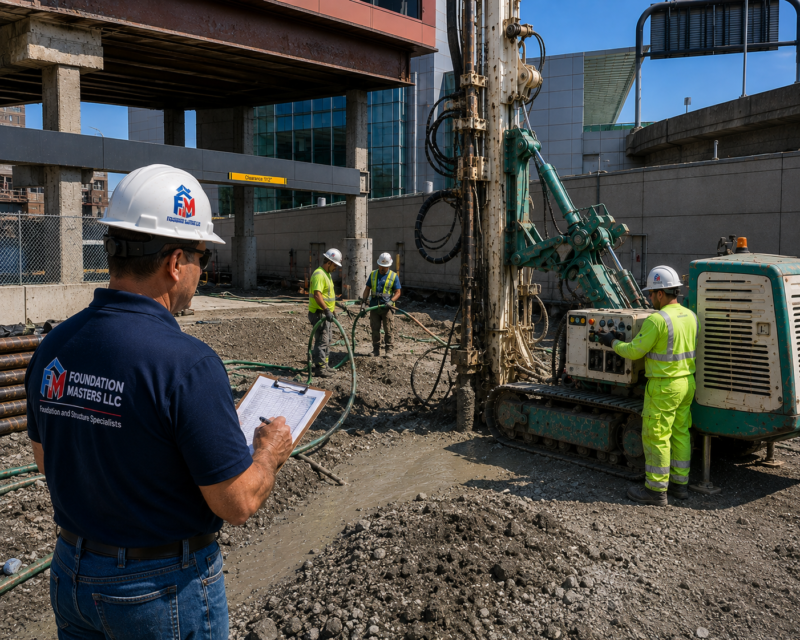
Micropile Applications
- Underpinning and adding capacity to existing buildings, including foundation repair and settlement stabilization
- Restricted-access and low-headroom work: interiors, basements, additions, and sites beside existing structures
- Karst, limestone, fill, boulders, and rubble where drilling is required
- High-capacity support in a small footprint for heavy or concentrated loads
- Tie-downs and resistance to uplift and overturning
- Vibration-sensitive sites and structures
Micropiles vs. Helical Piers and Driven Piles
A general comparison of deep foundation options. Values are typical/representative and vary with size, soil, and design.
*Representative comparison for planning only. Pile type, size, and capacity are always confirmed by project-specific geotechnical and structural engineering.
Micropile Standards & References
- FHWA Micropile Design and Construction Reference Manual (FHWA-NHI-05-039), via the Federal Highway Administration.
- Deep Foundations Institute (DFI) guidance on micropiles, via the Deep Foundations Institute.
- Structural design under the International Building Code and ACI 318, via the American Concrete Institute.
- Deep foundation and pile design under the Florida Building Code.
Micropile FAQs
What is a micropile?
A micropile is a small-diameter (typically 5 to 12 inch) drilled, grouted, and steel-reinforced deep foundation element. Capacity comes from the grout-to-ground bond and high-strength steel reinforcement, giving large load capacity from a small footprint.
When are micropiles used?
Micropiles are ideal for underpinning existing structures, restricted-access and low-headroom sites, karst and limestone conditions, vibration-sensitive areas, and high-capacity support where space is limited.
How much load can a micropile carry?
Micropiles can carry high loads for their size in both compression and tension. Actual capacity depends on diameter, bonded length, reinforcement, and ground conditions, and is confirmed by load testing and documented in a sealed engineering report.
Are micropiles good for Florida karst and limestone?
Yes. Because micropiles are drilled and grouted, they advance through limestone, voids, fill, and rubble that can stop driven piles, making them well suited to Central Florida’s karst geology.
Can micropiles underpin a building with limited access?
Yes. Compact drill rigs let micropiles be installed inside buildings, in basements, under low overhead, and beside existing structures with minimal vibration, which is a signature micropile use.
How is micropile capacity verified?
By load testing. Compression and tension (uplift) tests, and lateral tests where required, confirm performance under ASTM procedures, with results documented in a signed and sealed engineering report before acceptance.
Do you design and install micropiles?
Yes. Foundation Masters is a design-build firm that engineers and installs micropiles and other deep foundation systems, coordinated with our pile driving and foundation repair work. Request an engineering review to get started.