
Bridge Repair
Foundation Masters, LLC. Licensed Florida engineering firm, CA# 30969. Repair, strengthening and rehabilitation of private and light commercial bridges across Florida and the Southeast, built from a sealed engineering design instead of a guess.

Most bridges do not fail all at once. A bank washes out a little more each storm, a girder end starts to spall, a timber deck softens, the approach develops a bump, and one day the crossing is carrying a load it can no longer carry. Foundation Masters repairs those bridges: private drives, estate and development entrances, farm and timber crossings, golf course and pedestrian spans, and light commercial structures.
We are a design build firm. Our crews document the bridge, a licensed professional engineer evaluates it and seals the repair design, and our own crews build the repair. One shop from the first site visit to the final record, which is how the repair ends up fixing the cause and not just the symptom.
The bridge practice covers Florida, Georgia, Alabama, Mississippi, Tennessee, South Carolina and North Carolina. Everything is indexed on the bridge contractor hub.
Nobody Inspects a Private Bridge
Bridges on public roads are covered by the federal National Bridge Inspection Standards. A qualified inspector looks at them on a set cycle, generally every 24 months and more often when a part of the bridge is in poor condition, and the findings go into a national inventory.
A bridge on a private driveway, a farm road or inside a gated community usually falls outside that program. No one is required to look at it, so in practice no one does. The first sign of trouble is often a homeowner noticing that the deck bounces more than it used to, or that the creek bank has moved closer to the abutment than it was last year.
That is why a lot of the repair work we see could have been a much smaller job a few years earlier. If you have not had your crossing looked at, a field survey is the cheapest thing you can do for it.
Warning Signs Worth a Call
Scour at the Supports
The bank or streambed has eroded at an abutment or pier, fill is missing behind a wall, or you can see under a footing. Scour is one of the most common reasons bridges fail, and it happens out of sight.
A Bump at the Approach
The road drops where it meets the deck, or the approach slab has cracked. The fill behind the abutment is settling or washing out.
Cracking and Spalling
Concrete breaking off at girder ends, edges or corners, rust stains bleeding through cracks, or exposed reinforcing steel. Water and salt are getting to the steel.
A Deck That Moves
Noticeable bounce, sag or rattle when a vehicle crosses, loose planks or fasteners, or a deck that no longer sits level end to end.
Rot and Section Loss
Soft or split timber, rot at the bearing ends of stringers, or steel members and connections with heavy rust and thinning.
Heavier Traffic Than Before
The bridge was built for a car and now carries delivery trucks, equipment or a fire engine. A sound bridge can still be the wrong bridge for the load.
If you see active movement, a new crack that is growing, or open scour under a support, keep heavy vehicles off the bridge until it has been looked at.
This page covers bridge repair. The rest of the bridge practice is below.
How a Repair Gets Decided
A bridge repair is a structural decision, so it is made the way structural decisions should be made: from measured conditions, by an engineer, in writing. Nobody should be pricing a fix before anyone knows what is wrong.
1. Field Survey
Our crew documents the bridge as it actually is, which is often not how the original drawings show it. Photographs, measurements, deck and member condition, bearing seats, approach fill, and probing at the supports to find out how much ground has been lost to scour.
2. Engineering Evaluation
A licensed professional engineer reviews the survey, identifies the cause of the distress and decides what the bridge can safely carry in the meantime. Where the soil matters, that includes soil borings at the supports.
3. Sealed Repair Design
The engineer prepares and seals the repair drawings: what gets underpinned, what gets strengthened, what gets replaced and how it is protected. That set is what goes to the permit office and what our crews build from.
4. Repair and Record
Our own crews drive the piles, set the sheet pile, restore the concrete and replace what needs replacing. You get a closeout record of what was built, which matters when you sell the property or when an insurer asks.
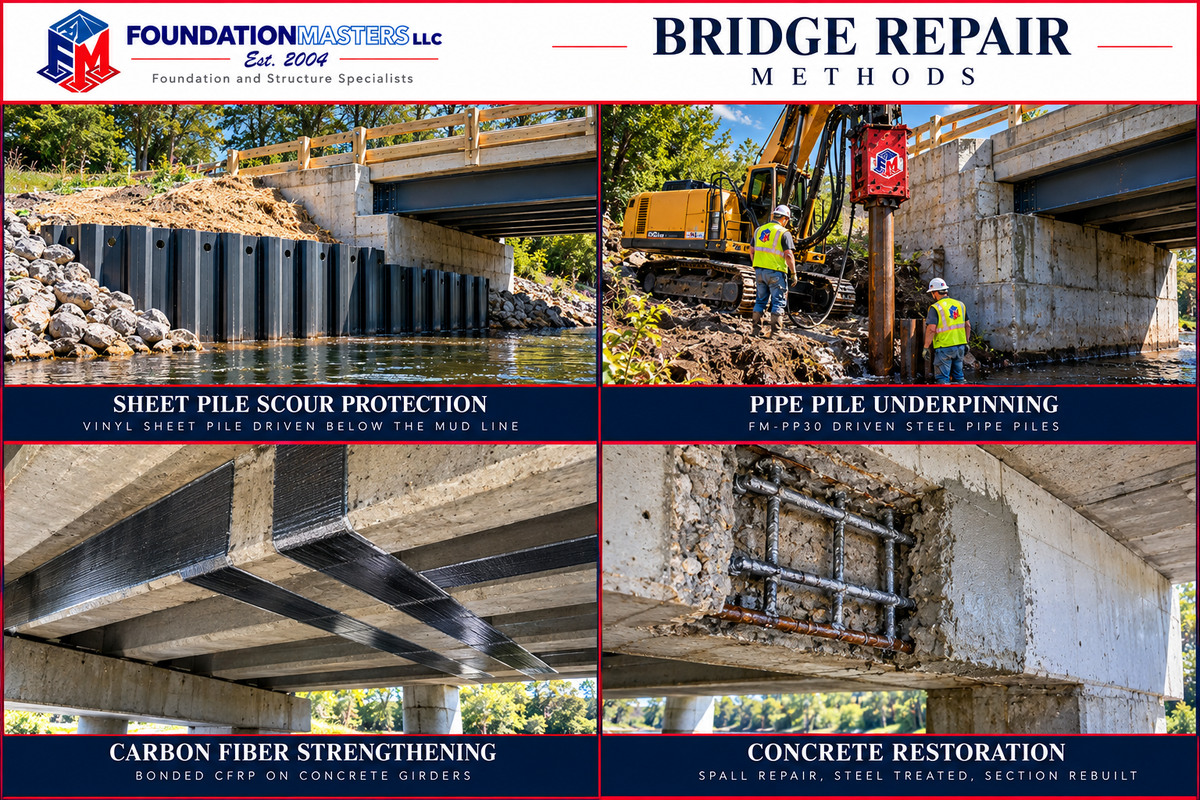
Repair Methods
Scour Protection and Sheet Pile
Vinyl or steel sheet piling driven below the mud line in front of an abutment, with the lost fill replaced behind it, so the stream cannot keep digging out the support.
Underpinning the Abutments
When an abutment has settled or been undermined, FM-PP30 driven pipe piles carry it down to ground that holds. On a heavier bridge with enough weight to push against, FM-PP25 push piers are hydraulically pressed beneath the existing abutment instead, so the support stops moving.
Carbon Fiber Strengthening
Bonded carbon fiber reinforcement on concrete girders, beams, columns and slabs, to restore or add capacity without replacing the member.
Concrete Restoration
Spalled and cracked concrete removed back to sound material, the reinforcing steel cleaned and treated, the section rebuilt and the surface protected so water and salt stay out.
Steel and Connection Repair
Corroded girders, plates and bolts cleaned, repaired or replaced, bearing seats rebuilt, and steel coated against the next twenty years of weather.
Deck Replacement and Load Upgrade
Rotted timber decks replaced, and bridges that need to carry more brought up to the FM-H20 fire truck rating where the substructure allows it.
Repair or Replace?
The honest answer is not always the more expensive one. A steel frame in good shape with scoured abutments and a rotten deck is a repair: protect the supports, underpin if needed, put a new deck on it. Corner spalling on a concrete girder is routine maintenance, not a reason to tear a bridge out.
It is a replacement when the structure was never built for the loads now crossing it, when the main members have lost too much section to be worth saving, or when the foundations have moved so far that underpinning would cost more than new. In that case we design and build a new crossing, usually the FM-H20, and we tell you which situation you are in before anybody talks about price.
Bridges We Repair
Private Drive Bridges
The single crossing between a house and the road, where losing the bridge means losing access to the home.
Community and HOA Bridges
Entrance and interior bridges in gated communities, where the association owns the structure and nobody has inspected it since the developer left.
Farm, Ranch and Timber Crossings
Bridges that carry repeated heavy loads, where approaches and connections wear out long before the steel does.
Pedestrian and Cart Bridges
Golf course, park, trail and campus spans, where rot, loose railings and scoured footings are the usual problems.
Light Commercial Bridges
Private access bridges serving businesses, industrial yards and storage sites, including concrete girder structures that need restoration or strengthening.
Storm and Flood Damage
Crossings damaged by hurricanes, surge and flash floods, where the first job is making the bridge safe and the second is making sure it does not happen again.
Bridge Repair FAQs
Who inspects a private bridge?
Usually nobody. The federal inspection program covers bridges on public roads, and a bridge on a private driveway, farm road or inside a gated community generally falls outside it. Unless the owner arranges an inspection, problems tend to be found when they are already obvious.
What does a bridge repair cost?
It depends entirely on what is wrong. Concrete patching and a deck replacement are a very different job from underpinning two abutments. That is why the field survey and engineering evaluation come first. Once we know the cause, we can put a real number on the repair.
Is my bridge safe to drive on right now?
If you can see open scour under a support, a crack that is growing, a deck that has started to sag or a girder end breaking apart, keep heavy vehicles off it until it has been looked at. Call us and we will tell you what to do in the meantime.
Who designs the repair?
A licensed professional engineer evaluates the bridge and seals the repair drawings. Our crews do the field survey and build the repair from that sealed design. The engineering decision is never left to whoever happens to be holding the tools.
Can carbon fiber fix a cracked concrete girder?
Often, yes. Bonded carbon fiber can restore or add strength to concrete beams, girders, columns and slabs without replacing them. The engineer decides whether it fits the damage, because carbon fiber strengthens a member but does not fix a foundation that is still moving.
Do I need a permit to repair a bridge?
In most cases yes, and if the work touches the stream or the banks there may be state and federal water permits on top of the local building permit. The sealed repair design is what those offices review. We prepare and file the package.
Can you upgrade my bridge to carry a fire truck?
Sometimes. If the abutments and foundations can carry the extra load, or can be underpinned to carry it, the superstructure and deck can often be brought up to the FM-H20 rating. If not, a new FM-H20 crossing is usually the better value.
How long does a bridge repair take?
The field work for most private bridge repairs is measured in weeks, not months. The survey, the sealed design and the permits usually take longer than the repair itself, which is one more reason to start before the bridge gets worse.
Talk About Your Bridge
Scour, cracking, a sagging deck, a bump at the approach, or a bridge that now has to carry more than it was built for. Tell us where it is and what you are seeing.
Call 656-233-7089Or send it in writing through the contact page. Include the property address, the span and photos of the problem areas.