
Pedestrian Bridge Construction
Foundation Masters, LLC. Licensed Florida engineering firm, CA# 30969. Design build pedestrian, golf cart and boardwalk bridges across Florida and the Southeast, engineered for the crowd, the cart and the maintenance truck that will actually use them.

A pedestrian bridge looks like the easy job. No trucks, no fire engines, just people walking across. In practice it carries crowds standing shoulder to shoulder, golf carts, bicycles, and the maintenance vehicle somebody will eventually drive across it whether anyone planned for that or not. It sits over water, it has to meet accessibility rules, and the railing has to stop a child from slipping through.
Foundation Masters designs and builds pedestrian bridges for golf courses, parks and greenways, gated communities, campuses, marinas and waterfront developments. We are a design build firm: our crews survey the site, a licensed professional engineer designs and seals the bridge and its foundations, and our own crews drive the piles and build it.
The work covers Florida and the rest of the Southeast, including Georgia, Alabama, Mississippi, Tennessee, South Carolina and North Carolina. Everything is indexed on the bridge contractor hub.
What a Pedestrian Bridge Is Really Designed to Carry
The national design guide for pedestrian bridges uses a crowd load of 90 pounds per square foot across the whole deck. That is people packed tight, the way they stand on a bridge to watch a fireworks show or a tournament finish. It is a heavier load than most owners picture when they hear the word footbridge.
The width of the deck decides the next question. Under the same guide, a bridge with a clear width between 7 and 10 feet is also checked for a 10,000 pound maintenance vehicle, and one wider than 10 feet for a 20,000 pound vehicle. A deck narrower than 7 feet is not expected to see one. Make the bridge wide enough for a mower, a utility vehicle or a golf cart, and it needs to be designed for one.
Under 7 Feet Wide
A walking bridge. Designed for the full crowd load. Good for trails, garden crossings and narrow creeks where nothing with wheels is expected.
7 to 10 Feet Wide
The usual golf cart and greenway width. Designed for the crowd load and a 10,000 pound maintenance vehicle, which covers carts and light utility vehicles.
Over 10 Feet Wide
Wide enough that a pickup or a mower will cross it. Designed for a 20,000 pound vehicle. If emergency apparatus needs to cross, that is a vehicle bridge, and we build it as an FM-H20.
Railings and Access Are Part of the Structure
A Real Railing, Not a Curb
On our vehicle bridges, the 6×6 timber along the deck edge is a wheel guard. A pedestrian bridge needs a true safety railing. Federal highway policy calls for pedestrian railing at least 42 inches tall, with openings small enough that a 6 inch sphere cannot pass through the lower 27 inches and an 8 inch sphere cannot pass through above that.
That is a child safety rule. We detail the posts, rails and through bolted connections to meet it and to take a crowd leaning on the rail.
Approaches Everyone Can Use
A bridge that sits up out of the flood is no good if the approach is a step or a steep ramp. Under the ADA standards a ramp run can be no steeper than 1 in 12, can rise no more than 30 inches before a landing, and needs handrails once it rises more than 6 inches.
We lay out the approaches with the bridge rather than after it, so the deck height and the accessible route work together.
This page covers pedestrian bridges. The rest of the bridge practice is below.
What We Build
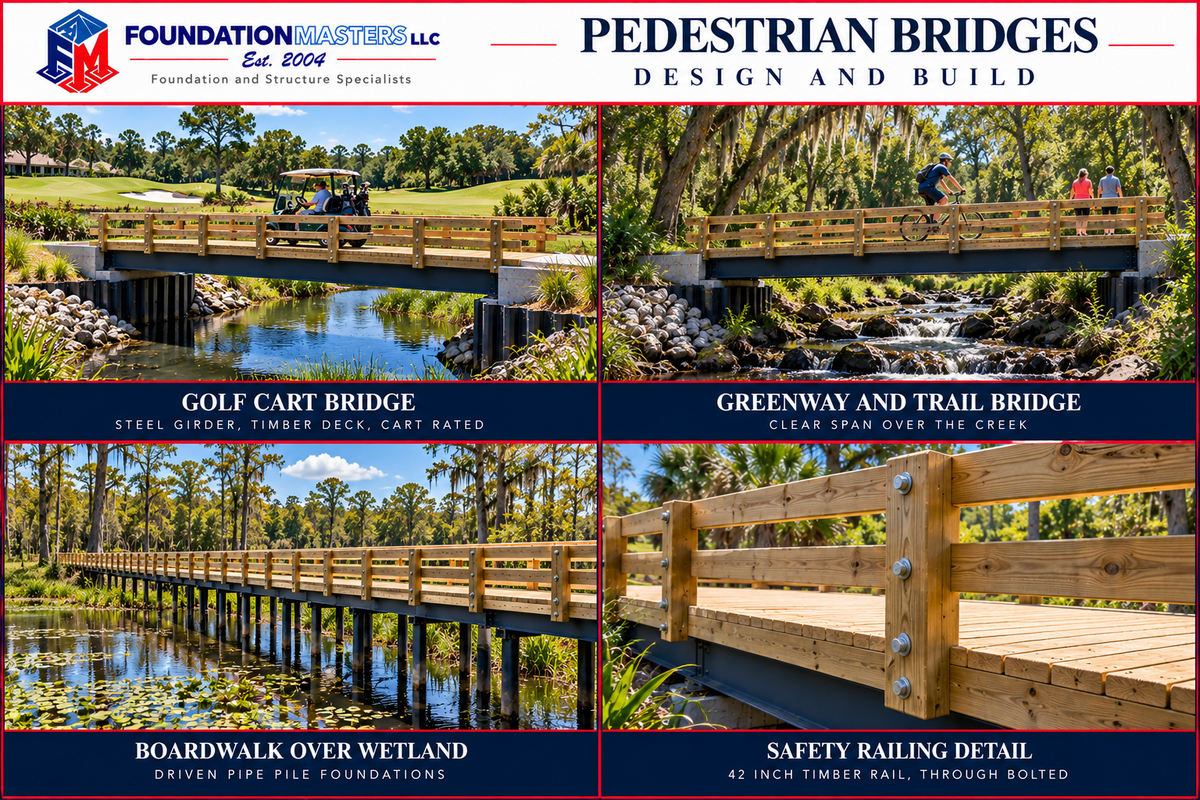
Golf Course Bridges
Cart crossings over creeks, pond outlets and drainage swales. Steel girders under a timber deck, sized for carts and maintenance equipment, with railings that keep a cart on the deck.
Greenway and Trail Bridges
Clear spans over creeks and ravines for walkers and cyclists. Supports kept out of the channel so the next flood passes under instead of piling debris against them.
Boardwalks
Long, low walkways through wetland, marsh and floodplain, carried on small driven pipe piles so the ground underneath is disturbed as little as possible.
Community and HOA Bridges
Walking paths, clubhouse links and lake crossings inside gated communities, designed to match the look of the neighborhood and built to outlast the developer.
Marina and Waterfront Access
Gangway approaches, seawall crossings and waterfront walkways, where salt exposure, tide and surge drive the material choices and the connection details.
Park, Campus and Garden Bridges
Signature spans where appearance is part of the brief. The look gets engineered alongside the structure rather than added afterward.
Foundations Are Where Footbridges Fail
A light bridge still sits on a creek bank, and the bank is what goes first. Water gets behind a shallow footing, the fill washes out, and one end of the bridge drops. The deck and girders are usually fine. The support underneath them is not.
We carry pedestrian bridges and boardwalks on driven FM-PP30 steel pipe piles, set below the depth a flood can scour, with vinyl sheet piling along the banks where the stream can reach the abutment fill. The rig is small enough to work on a fairway edge or a boardwalk alignment without tearing up the site, and driving the pile tells us what the ground is doing as we go. Where the soil is in question, soil borings come first.
How a Pedestrian Bridge Project Runs
1. Site Visit and Layout
We look at the crossing, the banks, the water and the approaches, and talk through who and what will use the bridge. That sets the width, the loads and the railing.
2. Sealed Design
A licensed professional engineer designs and seals the bridge, the foundations and the approaches. That set is what the permit office reviews and what our crews build from.
3. Permits
Local building permits, and where the bridge crosses a stream or wetland, the state and federal water permits on top. We prepare and file the package.
4. Build and Record
Our own crews drive the piles, set the abutments and steel, and build the deck and railings. You get a closeout record of what was built for your files and your insurer.
Pedestrian Bridge FAQs
How much weight does a pedestrian bridge have to carry?
The national design guide uses a crowd load of 90 pounds per square foot across the whole deck. If the bridge is between 7 and 10 feet wide it is also checked for a 10,000 pound maintenance vehicle, and above 10 feet for a 20,000 pound vehicle.
Can a golf cart use a pedestrian bridge?
Yes, if the bridge is designed for it. A deck in the 7 to 10 foot range is designed for a light maintenance vehicle, which covers golf carts and utility carts. Tell us everything that will cross it, including mowers and service vehicles, before the design is set.
How tall does the railing have to be?
Federal highway policy calls for pedestrian railing at least 42 inches tall, with openings small enough that a 6 inch sphere cannot pass through the lower 27 inches and an 8 inch sphere cannot pass through above that. Local codes can add to that, and we design to whichever is stricter.
Does a pedestrian bridge have to be ADA accessible?
A bridge on a public or shared accessible route generally does. Under the ADA standards a ramp can be no steeper than 1 in 12, can rise no more than 30 inches per run, and needs handrails above a 6 inch rise. We lay out the approaches with the bridge so the deck height works with the accessible route.
What does a pedestrian bridge cost?
It depends on the span, the width, the loads it has to carry, the foundations and how hard the site is to reach. A narrow trail bridge and a cart bridge sized for maintenance trucks are very different jobs. We put a real number on it after the site visit.
Steel, timber or concrete?
Most of our pedestrian bridges are steel girders with a timber deck, because the combination spans well, goes in fast with small equipment and is easy to maintain. Near salt water the steel and fasteners are specified for the exposure. The engineer picks the system for the site, not the other way around.
Do I need a permit?
In most cases yes. The local building department reviews the sealed design, and a crossing over a stream or wetland can also need state and federal water permits. We prepare and file the package.
Can you repair an existing footbridge?
Yes. Rotted decks, loose railings and scoured footings are the usual problems, and most are repairable. Our bridge repair process starts with a field survey and an engineering evaluation before anyone proposes a scope.
Talk About Your Pedestrian Bridge
Golf course crossing, greenway span, boardwalk or community bridge. Tell us where it is, how long it needs to be and who will use it.
Call 656-233-7089Or send it in writing through the contact page. Include the property address, the span and a photo of the crossing.