
FMRC-001 · Preliminary Draft
Discipline · Foundations / Settlement
Version · Preliminary Draft v0.1
Compiled · 18 July 2026
Classification · Educational
FMRC-001 · Foundation & Settlement Investigation
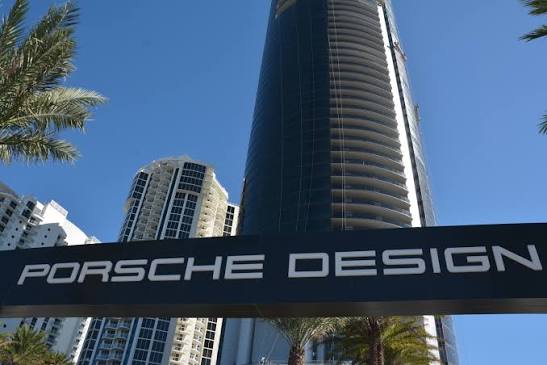
Porsche Design Tower
A public-record investigation into the foundation system, subsurface conditions, and measured surface displacement of a 60-story oceanfront tower on Miami’s northern barrier island.
- Location
- 18555 Collins Avenue, Sunny Isles Beach, Florida
- Height / Stories
- 641 ft (195 m), 60 stories, 132 residences
- Completed
- 2016 (groundbreaking April 2014)
- Structure
- Cast-in-place reinforced concrete
- Foundation
- Deep auger-cast pile system to limestone bearing stratum
- Record status
- Assembled from public sources; primary records pending request
Abstract
This file assembles the publicly documented engineering record for the Porsche Design Tower, a 60-story reinforced-concrete tower completed in 2016 on a barrier-island parcel in Sunny Isles Beach, Florida. The structure is carried by a deep auger-cast pile foundation installed to what was, at the time, a depth record for Miami-Dade County. Between 2016 and 2023, satellite radar interferometry recorded surface displacement across the surrounding block. Two independent datasets differ in magnitude by roughly a factor of five, and the study’s authors caution that part of the larger measurement may reflect horizontal rather than vertical motion.
The published mechanism attributes the movement to slow compression, or creep, of sand layers interbedded within the limestone, with construction vibration proposed as an accelerant. This file separates three categories throughout: what the public record confirms, what engineering analysis can reasonably infer, and what remains an open question answerable only with primary-source records and field data. It draws no conclusion regarding the safety or adequacy of the structure. The foundation design basis has not been reviewed, because it is not yet part of the public record.
Documented in construction records, permits, sealed drawings, inspection reports, peer-reviewed data, or survey measurement, with a citation.
Engineering interpretation reasoned from the evidence and identified plainly as interpretation, not established fact.
A gap the record does not resolve: competing hypotheses, missing data, and investigation still required.
§ 1 · The Documented Record
Project identification and design team.
The following roster is not drawn from marketing material. It is corroborated by two independent public sources: the tower’s 2017 Engineering News-Record project citation, and the party list in the 2016 Millennium Condominium Association complaint, which named the full development team as defendants. Confirmed
| Role | Party |
|---|---|
| Developer / owner | Dezer Development (18555 Developers LLC) |
| Architect | The Sieger Suarez Architectural Partnership |
| General contractor | Coastal Construction of South Florida |
| Structural engineer of record | CHM Structural Engineers |
| Foundation contractor | HJ Foundation Company (Keller Group) |
| Civil engineer | Fortin, Leavy, Skiles |
| Threshold / consulting engineer | Pistorino & Alam Consulting Engineers |
| Named in litigation | NV5 Global / NV5 Holdings |
The geotechnical engineer of record is not established in the public record.
No reviewed source states which firm produced the geotechnical report of record or its scope. NV5 maintains a large South Florida geotechnical practice and is a plausible candidate, but this must be confirmed from the permit file rather than assumed. The geotechnical report is the single most consequential document not yet in hand, and its author is named on its cover.
§ 2 · The Foundation System
Deep piles, carried to competent rock.
The tower is founded on a deep foundation of auger-cast-in-place (CFA) piles, installed by HJ Foundation Company. Sheet piling was installed at the site beginning in 2013. Confirmed These piles set a Miami-Dade County depth record at the time of installation; that record was later surpassed by the same contractor at One Thousand Museum, where piles exceeded 170 ft. The One Thousand Museum figure establishes an upper bound on the era’s practice, not the Porsche tower’s actual pile length. Analysis
A directly relevant analogue.
Because the tower’s own pile schedule is not yet public, the closest defensible reference point is a project by the same contractor in the same municipality. At the Ritz-Carlton Residences in Sunny Isles Beach, HJ Foundation installed 165 auger-cast piles of 36-inch diameter to a depth of 155 ft, plus 104 piles of 18-inch diameter to 45 ft. The contractor reported that the sandy upper strata caused the tops of the large piles to expand to roughly 60 inches in diameter during installation, requiring additional cutoff work. Confirmed This is a direct, on-record observation about the near-surface soils that any tower on this barrier island must be founded through. Analysis
The following define the foundation’s actual capacity and behavior, and none are yet available. Until they are, no assessment of the foundation design is possible:
- Pile schedule: actual count, diameter, length, and design capacity
- Mat and pile caps: thickness, reinforcement, and connection detailing
- Bearing basis: design bearing stratum and pile tip elevations
- Verification: pile load test program and results (static, dynamic, or Statnamic)
- Design loads: gravity and wind demand (a slender cylindrical tower is wind-governed)
- Predictions: the settlement estimates made at design
- Review and monitoring: whether a peer review occurred, and any instrumentation program
§ 3 · Subsurface & Geology
Rock that bears, sand that yields.
The barrier island presents a layered profile: loose to medium-dense fill and sand near the surface, underlain by permeable sand seams, weathered limestone, and finally the competent oolitic limestone that provides end bearing for deep foundations. The groundwater table sits close to sea level and moves with the tide. Analysis
The distinction that matters for long-term performance is between the limestone and the sand within it. Sound limestone does not undergo meaningful long-term settlement. The interbedded sand layers do: under sustained load they can continue to compress slowly for years through grain rearrangement, a process engineers call creep. The 2024 satellite study cross-referenced publicly available geotechnical reports from Surfside and Sunny Isles and reported that the subsurface around the Porsche Design Tower contains roughly 50 percent sand layers within the limestone. Confirmed
That figure is the pivot of the entire settlement question. The same study contrasts this site with 87 Park, which has fewer sand layers and correspondingly less movement confined to its footprint, and with southern Miami Beach, which sits on dense sand-free limestone with high blow counts and shows negligible displacement. Where there is more sand within the rock, there is more measured movement. Analysis
§ 4 · Measured Displacement
Two satellites, one site, five-fold disagreement.
Interferometric synthetic-aperture radar (InSAR) measures how far the ground moves along the satellite’s line of sight (LOS) between passes. Applied to this block over 2016 to 2023, it produced the following for the Porsche Design Tower: Confirmed

The tower sits within what the study labels hotspot A, the Armani-Porsche-Turnberry cluster, where up to 8 cm of vertical subsidence was measured extending beyond individual building footprints into the surrounding ground. Across the wider survey, 35 coastal buildings showed 2 to 8 cm of movement over the period, with roughly 70 percent of buildings in northern and central Sunny Isles registering a signal. Confirmed
Why do the two datasets disagree by roughly five to one?
Some of the gap is expected: the datasets span different years and view the ground from different angles, and line-of-sight is not the same as vertical. But the authors go further and state that a portion of the larger TerraSAR-X displacement may be attributable to horizontal movement, which requires detailed investigation. Horizontal motion of an oceanfront tower is a categorically different question from vertical settlement, and it is the single most important unanswered line in the published record. It has been almost entirely absent from press coverage.
What the numbers do and do not mean.
The quantity that damages a structure is not total settlement but differential settlement, the difference in movement between one point and another, which produces angular distortion in the frame. A building can settle uniformly by a large amount with little distress; it is uneven settlement that cracks structures. The study reports little evidence of differential settlement at these towers and notes that South Florida high-rises are designed to tolerate uniform settlement on the order of tens of centimeters. The study’s senior author has stated publicly that these buildings are not at risk of collapse. Confirmed
Two constraints bound any interpretation. First, the measurements end in 2023; nothing in this record establishes the rate of movement today. Second, the study reports surface displacement, not a diagnosis of its cause at any single building. Both the magnitude and the mechanism at this specific tower remain to be established from ground data. Analysis
§ 5 · The Construction-Vibration Record
A documented mechanism, and an expert who appears twice.
In October 2016, the neighboring 34-story Millennium condominium association sued the Porsche development team in Miami-Dade Circuit Court. The complaint alleged that installation of sheet piling for the Porsche site, beginning in 2013, produced excessive construction vibration that cracked the Millennium’s lobby, parking garage, and pool deck, and that later concrete overspray damaged its south facade. Confirmed
The association retained two Florida Atlantic University engineering professors, Khaled Sobhan and D.V. Reddy, whose report, attached as an exhibit to the complaint, concluded that the cracking was caused by excessive vibration from the sheet-pile driving equipment. The suit named the full team, including the general contractor, foundation contractor, structural engineer, and threshold inspector, and identified roughly 4 million dollars in claimed damages. Confirmed The disposition of the case is not established in the reviewed record and must be pulled from the court docket. Open Question
The same expert, the same mechanism, eight years apart.
Khaled Sobhan is the FAU professor who authored the 2016 vibration-damage report for the Millennium suit. He is also a named co-author of the 2024 satellite study, whose proposed mechanism attributes barrier-island subsidence in part to construction vibration acting on interbedded sand. The same investigator, the same site, and the same causal family of mechanism appear on both ends of an eight-year span. This is not presented here as proof of anything. It is presented as a documented convergence that a serious, unbiased investigation would examine directly rather than leave uncited.
For completeness: no public record reviewed reports any settlement-related claim, repair, or remediation at the Porsche Design Tower itself. The vibration record concerns effects alleged at a neighboring property during construction, not a defect asserted at the tower. Confirmed
§ 6 · What a Full Investigation Requires
The record to obtain before any conclusion.
This file is deliberately incomplete. The following are the primary sources and field measurements a competent, independent investigation would assemble before forming any opinion on the foundation or the movement. Each is obtainable; none has yet been obtained.
Documents to request
- Geotechnical report of record. Boring logs, SPT blow counts, groundwater elevations, rock coring, and the bearing-stratum determination (City of Sunny Isles Beach; also potentially the state coastal-construction file)
- Signed and sealed foundation and structural drawings, and the pile installation records and as-builts
- Pile load-test reports establishing design capacity and factor of safety
- Threshold inspection reports (statutory in Florida; a continuous record across construction)
- Peer-review report, if one was required, and its reviewer
- Construction-phase vibration monitoring from the sheet-pile and pile installation
- The Millennium court docket. Complaint, the Sobhan and Reddy expert report, any monitoring data produced in discovery, and the disposition
- The raw InSAR time series (openly available), for independent re-analysis
Field measurement and analysis
- An independent survey baseline. Precision leveling and, where warranted, continuous tilt measurement, to establish present-day movement rather than inferring it from data that ends in 2023
- A current crack and distortion survey, distinguishing cosmetic from structural indications
- Updated interferometry extending the record past 2023
- A line-of-sight decomposition separating vertical from horizontal components, the specific question the study authors flagged
- A settlement and creep model calibrated to the actual borings, tested against the measured displacement
§ 7 · Provisional Conclusions
What can be said, and what cannot.
What the record supports today. The tower is carried on deep auger-cast piles of record-setting depth for the county, installed by a leading specialty contractor under a structural engineer of record and a statutory threshold inspector. Two independent satellite datasets disagree about how far the site has moved by roughly a factor of five, and the study’s own authors flag a possible horizontal component that requires investigation. The subsurface, per the study’s reading of public geotechnical records, is roughly half sand within the limestone. Construction-phase vibration at this site was significant enough to produce litigation and an expert report. Total movement of the reported magnitude, if uniform, is within what such a structure is designed to absorb, and the study found little evidence of the differential movement that actually damages buildings. Confirmed
What cannot be said, and is not said here. That the building is unsafe: nothing in the public record supports it, and the study’s senior author states the opposite. That the foundation was inadequately designed: the design basis has not been reviewed, because it has not yet been seen. That the movement continues at any particular rate: the measurements end in 2023. Analysis
The value of this file is not the headline number. It is the convergence the public record already contains: a documented vibration mechanism, an expert who appears on both ends of the timeline, a satellite discrepancy the authors themselves could not resolve, and a primary-records file that has not been pulled. That is the work this investigation will now undertake, and later versions of this file will report what those records show. Open Question
§ 8 · Media & Public Coverage
The tower in public circulation.
The settlement question at this site has moved beyond the technical literature into general-audience media. The segment below, produced independently by the channel MadeFor, summarizes the reported displacement at 18555 Collins Avenue. It incorporates site photography produced by Foundation Masters during the field work supporting this file.
It is recorded here for completeness. The framing and conclusions are the producer’s own, and Foundation Masters had no editorial involvement. Where the video and this file differ, the measured record in § 4 and the sources under References govern.
Watch on YouTube · MadeFor ↗
Porsche Design Tower, Sunny Isles Beach
MadeFor, YouTube. Opens on YouTube in a new tab. Site photography by Foundation Masters, LLC. Foundation Masters is not affiliated with the production and did not contribute to its editorial content.
References & Sources
- Aziz Zanjani, F., Amelung, F., Piter, A., Sobhan, K., et al. (2024). InSAR Observations of Construction-Induced Coastal Subsidence on Miami’s Barrier Islands, Florida. Earth and Space Science, 11(12), e2024EA003852. doi.org/10.1029/2024EA003852
- Aziz Zanjani, F., et al. (2024). InSAR displacement dataset (Sentinel-1, 2016-2023). Zenodo. doi.org/10.5281/zenodo.12699617
- University of Miami Rosenstiel School (2024). Study release on South Florida subsidence hotspots. news.miami.edu
- Engineering News-Record (2017). Best Residential/Hospitality: Porsche Design Tower Miami. enr.com
- Keller / HJ Foundation. Ritz-Carlton Residences, Sunny Isles Beach auger-cast pile case study. keller.com
- The Real Deal (10 Oct 2016). Report on the Millennium Condominium Association suit against the Porsche development team. therealdeal.com
- Coastal Construction. Porsche Design Tower Miami project record. coastalconstruction.com
Related · Foundation Masters
Connected research, engineering, and systems.
Research Center
Structural Monitoring
Engineering · Miami
Repair & Foundation Systems
Educational research, not a site-specific engineering opinion.
This file is a preliminary compilation prepared for educational and informational purposes from publicly available records and published research. It does not represent the actual condition of the structure, does not constitute a repair design, safety determination, or professional engineering opinion for this or any specific building, and does not assert that the Porsche Design Tower is unsafe. Conclusions of that kind can be made only in a signed, sealed professional report based on primary records and field investigation. Statements are labeled Confirmed, Analysis, or Open Question to distinguish the documented record from interpretation and from unresolved questions.