
Concrete Pile Foundations
Concrete piles are high-capacity driven deep foundations used across Florida for bridges, coastal and marine structures, high-rise and heavy commercial buildings, and demanding residential work. Foundation Masters designs and installs precast prestressed concrete piles and coordinates cast-in-place concrete pile systems, engineered for high axial and lateral loads, long service life, and durability in aggressive and saturated soils.
Florida’s Longest-Running Foundation Repair & Structural Engineering Firm
For more than 25 years, Foundation Masters has designed, engineered, and installed foundation repair, underpinning, deep foundation, waterproofing, and structural stabilization systems. As Florida’s longest-running foundation repair company under continuous ownership, Foundation Masters continues to provide engineered solutions backed by decades of field experience, documented project performance, and proprietary foundation systems developed specifically for Florida conditions.
Deep Foundation Methods
Compare Foundation Masters’ deep foundation and pile systems. Each method suits different soils, loads, access, and structures, coordinated so design decisions stay consistent across the project.
Engineering Research & Technical Publications
Concrete pile performance depends on far more than the pile itself. Soil profile, driving criteria, structural loads, groundwater, corrosion exposure, and long-term movement all shape how a deep foundation performs over its service life.
The Foundation Masters Research Center contains engineering research, technical articles, Florida geology studies, pile-system comparisons, and field case studies to help engineers, contractors, property owners, and associations understand modern deep foundation technology.
What Concrete Piles Are
A concrete pile is a slender structural element driven or placed deep into the ground to carry building loads past weak, compressible, or saturated surface soils to firmer bearing strata. In Florida, the most common type is the precast prestressed concrete pile: a factory-cast pile with high-strength prestressing strand that keeps the concrete in compression, resisting handling and driving stresses and improving crack resistance and durability. Cast-in-place concrete piles (including auger-cast and drilled systems) are formed in the ground and are used where driving is impractical or vibration must be limited.
Precast Prestressed Concrete Piles
Factory-cast, high-strength concrete with pretensioned strand. Delivered to site and driven to the required resistance. The dominant deep-foundation pile for Florida bridges, coastal structures, and heavy buildings.
Cast-in-Place Concrete Piles
Formed by drilling or augering and filling with concrete (and reinforcement) in place. Useful for low-vibration sites, restricted access, or where pile lengths are hard to predict. See also deep foundation systems.
Why Florida Uses Concrete Piles
Florida’s loose sands, soft clays, high water tables, and coastal exposure frequently require deep foundations. Prestressed concrete piles offer high load capacity, excellent durability in wet and marine environments, and a long service life, which is why they are a Florida Department of Transportation standard for bridge and structural foundations.
Concrete Pile Types & Typical Sizes
Representative characteristics of driven precast prestressed concrete piles. Actual size, reinforcement, and capacity are set by project-specific structural and geotechnical engineering.
How Concrete Piles Are Installed
Driving
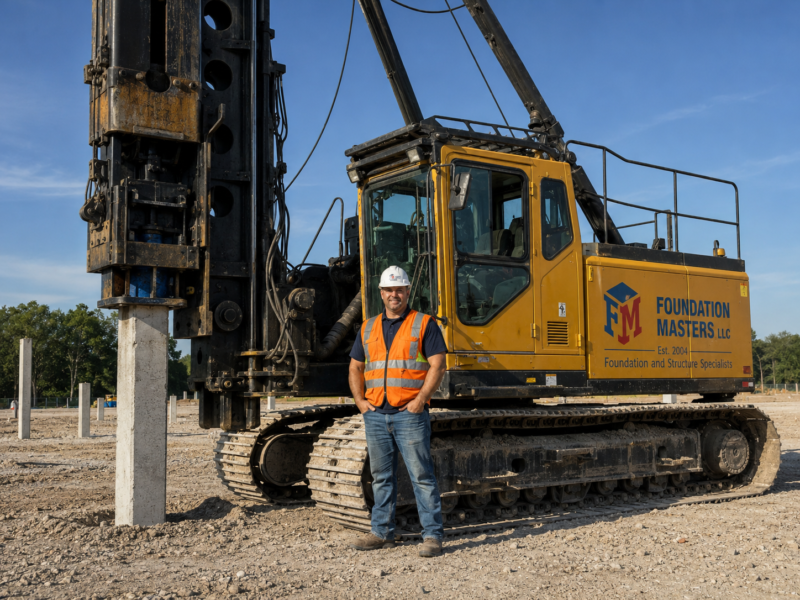
Precast piles are driven with an impact (or, where appropriate, vibratory) hammer to the depth and resistance the design requires. Predrilling or jetting may be used in dense layers or limestone. Our pile driving crews handle installation start to finish.
Verification
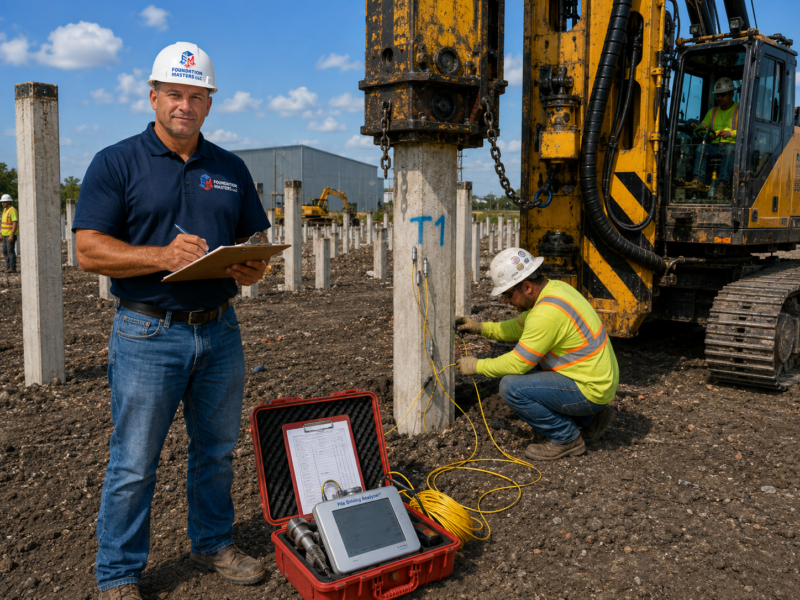
Each production pile is verified by the project driving criterion. Dynamic testing (PDA) and, where specified, static load testing (ASTM D1143 compression, D3689 tension, D3966 lateral) confirm capacity. Vibration monitoring can protect adjacent structures.
Cut-off & Connection
Piles are cut to grade and connected into pile caps, grade beams, or slabs with the detailing the structural design requires, developing the strand and reinforcement into the cap.
Batter & Groups
Piles can be installed vertically or on a batter (incline) and arranged in groups to resist combined axial, uplift, and lateral demands for bridges, seawalls, and heavy structures.
Concrete Pile Load Testing & Verification
Capacity is proven, not assumed. On concrete pile projects we confirm performance with the appropriate combination of driving criteria and load testing, then document the results in a signed and sealed engineering report. Methods are matched to the structure and project requirements, from production driving criteria to full-scale load tests.
Concrete Pile Applications
- Bridge and transportation structures, including our bridge construction work
- Coastal, waterfront, and marine foundations, docks, and seawalls
- High-rise and heavy commercial and industrial buildings
- Elevated coastal homes and demanding luxury residential foundations
- Sites with deep soft soils, high water tables, or scour where shallow footings will not perform
Concrete Piles vs. Timber and Steel Pipe Piles
A general comparison of common driven deep foundation piles. Values are typical/representative and vary with size, soil, and design.
*Representative comparison for planning only. Pile type, size, and capacity are always confirmed by project-specific geotechnical and structural engineering.
Concrete Pile Standards & References
- Florida Department of Transportation Standard Specifications for precast prestressed concrete and driven pile construction, via the Florida DOT.
- Precast/Prestressed Concrete Institute (PCI) recommended practice and the ANSI/PCI 142 specification for precast, prestressed concrete piles, via the PCI.
- ACI 318 structural concrete requirements, via the American Concrete Institute.
- Prestressing strand per ASTM A416, and driven-pile design under the Florida Building Code.
Concrete Pile FAQs
What is a concrete pile?
A concrete pile is a deep foundation element driven or cast into the ground to carry structural loads through weak or saturated surface soils to firmer bearing strata. In Florida the most common type is the precast prestressed concrete pile.
What is the difference between precast and cast-in-place concrete piles?
Precast prestressed piles are manufactured off site with high-strength strand and driven into place. Cast-in-place piles are formed in the ground by drilling or augering and filling with concrete, useful where driving is impractical or vibration must be limited.
When are concrete piles the right choice in Florida?
They are well suited to bridges, coastal and marine structures, high-rise and heavy commercial buildings, and any site with deep soft soils or high water tables where high capacity and long-term durability are required.
How is concrete pile capacity verified?
Capacity is confirmed by the project driving criterion and, where specified, dynamic (PDA) and static load testing, then documented in a signed and sealed engineering report for the piles.
Are concrete piles better than timber piles?
Concrete piles generally provide higher capacity, greater stiffness, and longer durability in marine and wet environments, while timber can be economical for lighter structures. The right choice depends on loads, soils, exposure, and access.
Do you design and install concrete piles?
Yes. Foundation Masters is a design-build firm that engineers and installs deep foundations, including concrete piles, coordinated with our pile driving and deep foundation systems work. Request an engineering review to get started.