
Concrete Restoration for Commercial and Multifamily Structures
Concrete restoration is not resurfacing. On a parking structure, a condominium building or an industrial slab, the concrete is failing because the steel inside it is corroding, and the repair has to deal with that or it buys you a few years at best. Foundation Masters assesses it, engineers it, and documents it.

The Short Answer
Almost all concrete restoration work on buildings and parking structures comes back to one mechanism: reinforcement corroding, expanding, and pushing the concrete off itself. The cracking and the spalling you can see are the late symptoms. The decision that governs cost is how much of the structure is unsound, and that is a measurement, not an estimate.
So the sequence matters. Assess, establish the cause, remove to sound material, deal with the steel, replace, restore capacity if capacity was lost, and protect. Foundation Masters, LLC, Civil Forensic Engineering, Florida Certificate of Authorization CA# 30969, does the assessment and the engineering and carries the work in Florida. Outside Florida we assess, engineer and document, and your contractor executes.
What is actually failing
Reinforced concrete works because the steel and the concrete behave as one material and the concrete keeps the steel in a chemically protected state. Two things break that. Chlorides reach the bar, from salt air, de-icing salt or the mix itself. Or carbonation works in from the surface and drops the pH around the steel.
Once the steel starts to corrode, the corrosion product takes up more volume than the steel it came from. That expansion has nowhere to go, so it splits the cover. First you get a hairline crack following the line of a bar. Then the area around it sounds hollow, which is delamination. Then the cover lets go, which is the spall everybody finally notices.
This matters commercially because the visible damage is a poor guide to the quantity. A structure can be substantially delaminated and still look acceptable from the ground. That is why a real concrete restoration scope starts with sounding the structure rather than with a number.
Why patched concrete keeps failing
This is the single most expensive misunderstanding in the business, and it is worth setting out plainly.
When fresh repair material is placed against concrete that is still contaminated, the repaired zone and the surrounding concrete no longer behave the same way electrochemically. Corrosion can then concentrate just outside the patch, which is why a building that has been patched repeatedly often shows a ring of new spalls around each old repair. The patch did not cause the chloride. It changed where the attack happens next.
It follows that three things decide whether a repair lasts, and none of them is the finish: how far back the removal goes, what is done to the reinforcement once it is exposed, and whether the source of the water or chloride has been addressed. A proposal that does not speak to all three is a price for trowel work.
There is a code for this, and most proposals ignore it
Repairing an existing structure is not an unregulated activity. The American Concrete Institute publishes ACI CODE-562-25, Assessment, Repair, and Rehabilitation of Existing Concrete Structures, Code Requirements and Commentary, issued in 2025 by ACI Committee 562 and superseding the 2021 edition. It is a code rather than a guide, which means it is written in mandatory language and directed at the design professional, and its requirements include corroded reinforcement and the deterioration of metallic embedments.
We are not going to tell you that every patch on every building requires a code compliant design. We are telling you that when capacity is in question, there is a published standard of care for assessing and repairing existing concrete, and that a restoration proposal which cites no assessment standard at all has not engaged with it.
Ask whoever is bidding your building which document their assessment follows. The answer is informative either way.
The concrete restoration sequence
Seven stages. The first two are where the money is decided, and they are the two most often skipped.
| Stage | What happens | Discipline |
|---|---|---|
| 1. Condition assessment | Visual survey, sounding for delamination, cover measurement, and testing where the cause is not obvious. The output is a map of what is unsound, not a lump sum guess. | Engineering |
| 2. Establish the cause | Chloride ingress, carbonation, water, overload, or a construction defect. The cause decides the repair. Skip this and you are buying the same repair again. | Engineering |
| 3. Removal to sound concrete | Unsound and delaminated material comes out, and the removal goes behind the reinforcement where the steel has corroded, not just to the face of it. | Construction |
| 4. Reinforcement treatment | Clean, assess section loss, supplement or replace bar where loss is significant, and treat the steel. Section loss is measured, not eyeballed. | Construction |
| 5. Repair material placement | A repair mortar or concrete selected for the exposure and compatible with the parent concrete, placed to a prepared and profiled surface. | Construction |
| 6. Strengthening where capacity is short | If the member has lost capacity it does not get it back from a patch. That is where externally bonded carbon fiber or added section comes in, designed and sealed. | Engineering |
| 7. Protection and documentation | Coatings, joint treatment or corrosion mitigation as the exposure demands, and a written record of what was found, removed, placed and verified. | Both |
Where carbon fiber fits in concrete restoration
Externally bonded carbon fiber is a capacity tool, and it belongs after the concrete repair rather than instead of it.
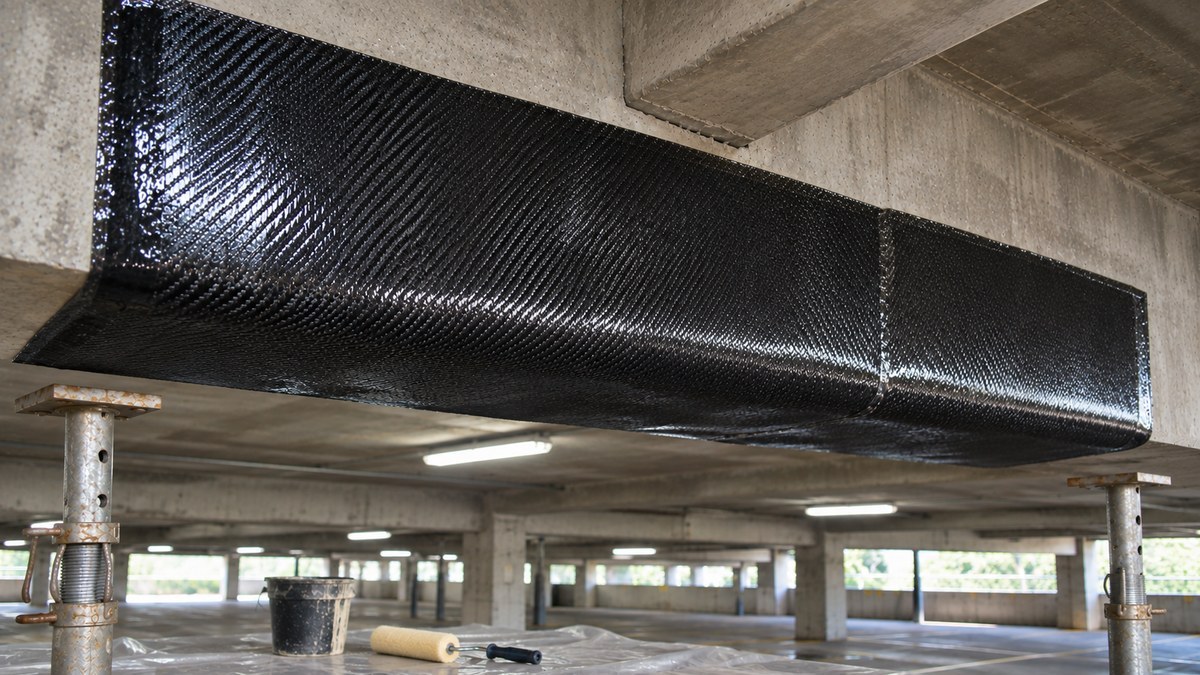
If a beam has lost reinforcement section to corrosion, replacing the concrete restores the cover but not necessarily the capacity. Carbon fiber designed under ACI PRC-440.2-23, the ACI guide for externally bonded FRP systems for strengthening concrete structures, can make that shortfall up without adding weight or taking the member out of service.
What it cannot do is bond to unsound concrete, and it does nothing whatsoever about steel that is still corroding underneath. If somebody offers to wrap a spalling column without opening it up first, they are selling you a cover rather than a repair. The detail of how that design is done, and what a building department wants to see before approving it, is set out on our carbon fiber engineering page and the carbon fiber structural repair page.
Concrete restoration on a parking structure
Parking structures are the hardest version of this problem and the most common large job. The deck takes traffic, it takes water carried in on vehicles, and in coastal or salted environments it takes chloride directly. The structure is usually thin, often post tensioned, and in use every day of the repair.
| What drives the scope | Why it matters to the number |
|---|---|
| Extent of delamination | Sounding the deck and soffit converts opinion into square footage. It is the single biggest variable in the price. |
| Post tensioning | If the structure is post tensioned, demolition near tendons and anchorages is a different job with different risk, and it is not something to discover mid repair. |
| Traffic and phasing | The owner usually needs the structure partly open. Phasing is a cost item and a schedule item, not an afterthought. |
| Joints and drainage | Most chloride arrives as water that was supposed to go somewhere else. Repair without fixing that is a repeat purchase. |
| Capacity after removal | Taking concrete out of a loaded member changes how it carries load while the work is open. Somebody has to own that. |
Where a structure is being assessed rather than repaired, see parking garage inspections.
Condominium buildings and the Florida clock
For Florida condominium and cooperative buildings there is now a statutory trigger that puts this work on a schedule rather than leaving it to a board. Under Florida Statutes 553.899 a milestone inspection is required by a licensed architect or engineer at 30 years from the certificate of occupancy and every 10 years thereafter, and a local enforcement agency may require it at 25 years where local circumstances such as proximity to salt water warrant it.
What that produces, repeatedly, is a milestone inspection that identifies deteriorated concrete and a board that now needs a scope, a number and a schedule. That is the point at which an assessment is worth more than a bid, because the association is about to commit reserves against it.
Confirm applicability for your building with your building official and association counsel. We will tell you what the structure needs, which is a different question from what the statute requires.
How we scope concrete restoration
In two parts, deliberately, and we recommend you hold any bidder to the same split.
| Part | What you get |
|---|---|
| Assessment | Survey and sounding, cause established, damage mapped and quantified, capacity checked where it is in question, and a written report with the repair options and what each one addresses. |
| Repair | Priced against the quantities the assessment produced, with sealed drawings and details where the work is structural, and unit rates for the variation everybody knows is coming. |
The reason to separate them is simple. A repair number produced before anyone has sounded the structure is a guess, and guesses in this field are corrected upward once the work opens up. An assessment costs a defined fee and converts the unknown into a quantity you can hold people to.
Outside Florida we carry out the assessment and the engineering and issue the documents, and your own contractor executes the work. The engineering travels further than the crews do.
Concrete Restoration Questions
What is concrete restoration?
It is the assessment and repair of concrete that has deteriorated, most often because the reinforcement inside it has corroded and expanded. It covers finding what is unsound, removing it, treating the steel, replacing the material, restoring capacity where it has been lost, and protecting the result. It is structural work, not resurfacing.
How is concrete restoration different from concrete repair?
In practice people use both words for the same thing. The distinction worth making is not the word but the scope. Filling and patching treats the surface. Restoration treats the cause, which almost always means dealing with the reinforcement and with whatever is putting water and chloride against it. If the scope does not mention the steel, it is not restoration.
Why does patched concrete keep spalling again?
Because a patch can make the next failure worse. When you place fresh repair material against concrete that is already contaminated, the repaired area and the surrounding concrete behave differently from an electrochemical standpoint, and corrosion can concentrate at the edge of the patch. This is a well known effect in repair engineering, and it is why the removal boundary, the treatment of the steel and the choice of repair material matter more than the trowel work.
Is there a building code for repairing existing concrete?
Yes, and most people working in this field have never opened it. The American Concrete Institute publishes ACI CODE-562-25, Assessment, Repair, and Rehabilitation of Existing Concrete Structures, Code Requirements and Commentary. It is written in mandatory language and directed at the design professional, and it includes requirements covering corroded reinforcement. A restoration proposal that references no assessment standard at all is a price, not a repair.
Does concrete restoration need an engineer?
If capacity is in question, yes. Removing concrete from a loaded member changes how it carries load while the work is open, and deciding how much section loss is acceptable is an engineering judgment. Where the work is cosmetic, it is not. The honest answer on most parking structures and older condominium buildings is that the assessment decides, and the assessment is engineering.
Where does carbon fiber fit into concrete restoration?
After the concrete repair, not instead of it. Externally bonded carbon fiber restores or adds capacity to a member that is short, and it is designed under ACI PRC-440.2-23. It cannot be bonded to unsound concrete and it does nothing about corroding steel underneath. Anyone who offers to wrap a spalling member without dealing with what is behind the spall is selling you a cover.
What does concrete restoration cost?
It is scoped in two parts, and you should insist on that split. The assessment is a defined fee and produces a map of the damage and a quantity. The repair is then priced against real quantities rather than an allowance. Anyone who gives you a repair number before anyone has sounded the structure is guessing, and the guess is always corrected upward once the work opens up.
Do you work outside Florida?
Yes, on a different basis. In Florida we assess, engineer and carry out the work. Outside Florida we do the assessment and the engineering and issue the documents, and your contractor executes the repair. The engineering travels further than the crews do.
Start With the Assessment
Tell us the structure, the age, what you are seeing and whether a milestone or recertification report has already been issued. We will tell you what the assessment involves, what it costs, and what it will answer before anybody prices a repair.
(813) 614-1718