
Geotechnical Engineering Florida
Florida is the one state where the conclusion of a sinkhole investigation is written by statute. The law does not hand the engineer a checklist of tests. It requires tests sufficient, in the professional opinion of the engineer or geologist, to determine the presence or absence of a sinkhole loss, and then it prescribes the sentence the report has to be able to say. Deciding what is sufficient is the engineering.
We help with:
- Subsurface exploration and boring programs
- Foundation engineering and design recommendations
- Sinkhole investigation and remediation planning
- Ground improvement and soil stabilization
- Groundwater review and dewatering considerations
- Forensic geotechnical investigations
- Construction phase geotechnical support

Statewide, from one firm
- Florida Certificate of Authorization CA 30969
- Investigation, design and installation under one roof
- Tampa Bay, Orlando, Miami and Jacksonville
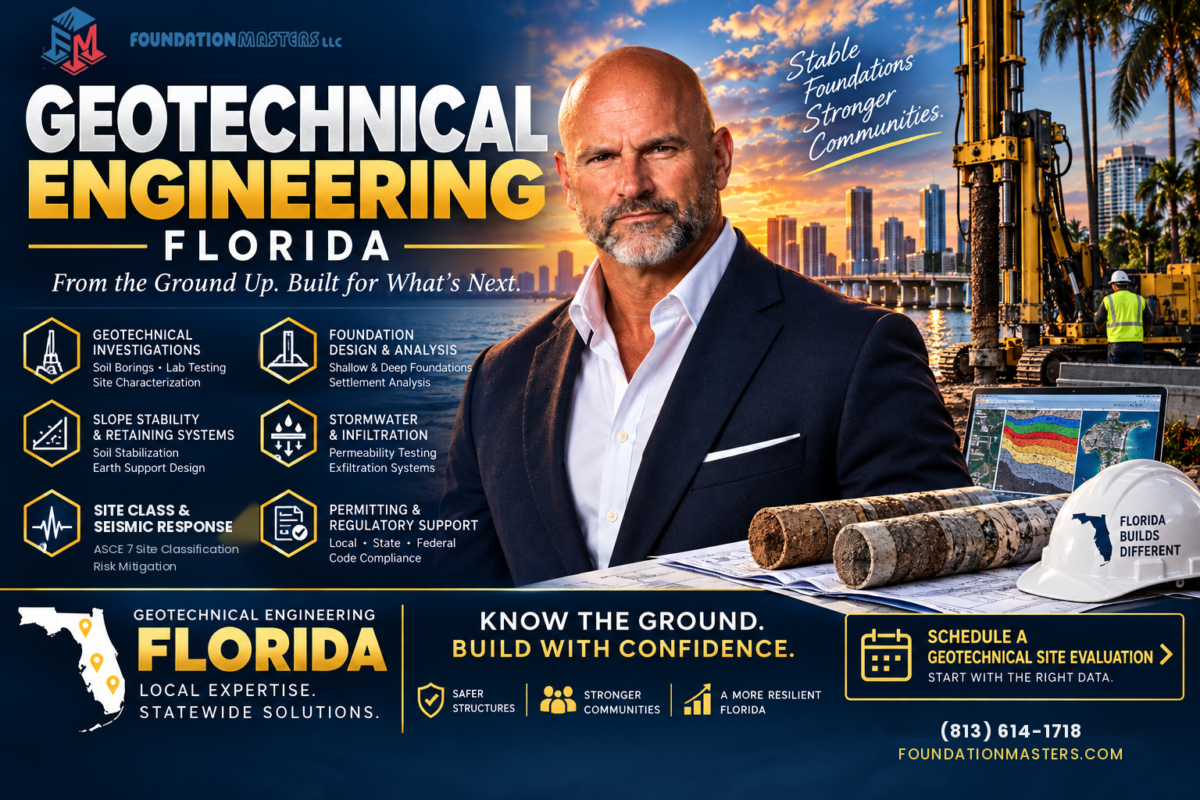
In Florida the Conclusion Is Written by Statute, and the Scope Is Left to You
Most geotechnical work is governed by codes and by practice. Sinkhole work in Florida is governed by two sections of the Florida Statutes, and they do something unusual: they fix the wording of the conclusion while leaving the scope of the investigation to the professional judgment of the engineer or geologist.
What the Testing Section Requires
Section 627.7072 requires the engineer or geologist to perform such tests as are sufficient, in their professional opinion, to determine the presence or absence of sinkhole loss or other cause of damage within reasonable professional probability, and to make recommendations regarding necessary building stabilization and foundation repair.
Notice what is not there. No minimum number of borings. No required geophysical method. No prescribed depth. The statute puts the decision on the engineer and then holds the report to it.
And What the Report Section Requires
Section 627.7073 sets out what the report must contain. Where a sinkhole loss is verified, the professional must state that structural damage has been identified within a reasonable professional probability, that the cause of that damage is sinkhole activity within a reasonable professional probability, what tests were performed, and what stabilization and repairs are recommended.
Where sinkhole activity is ruled out, the statute is just as specific. The report has to say that the analyses and tests conducted were of sufficient scope to eliminate sinkhole activity as the cause of the structural damage.
Which is why the phrase to watch is sufficient scope. It is the standard a Florida sinkhole report is measured against, by the carrier, by opposing counsel and by the next engineer who reads it. An investigation is built to be able to make that statement honestly, or it is not finished. We would rather tell an owner that the scope has to go further than sign a conclusion the work does not support.
Built for Florida Soils, Groundwater, Karst and Foundation Conditions
We provide geotechnical investigation, subsurface exploration, site evaluation, groundwater review, sinkhole evaluation and foundation engineering support across the state. We work for homeowners, developers, contractors, attorneys, municipalities, industrial clients and infrastructure teams.
Florida sites rarely present one problem at a time. Loose sands over clay lenses, porous limestone at a depth nobody predicted, a water table close enough to the surface to change the excavation method, and karst features that do not announce themselves from the street.
What we focus on is constructability, long term performance and recommendations that match the conditions actually found rather than the conditions a template assumes.
Why Clients Choose Us
Geotechnical engineering should not read like a generic report with the address changed. We develop recommendations that have to work in design, in permitting and then in the ground.
- Subsurface exploration and laboratory testing
- Foundation engineering guidance
- Sinkhole investigation and statutory reporting
- Ground improvement strategies
- Forensic review for problem sites
- Our own crews for the work that follows the report
Geotechnical Engineering Services Across Florida
We handle site feasibility, subsurface exploration, laboratory analysis, foundation recommendations, groundwater concerns, sinkhole response and construction phase geotechnical support for residential, commercial, municipal, industrial and waterfront projects throughout Florida.
Site Feasibility and Planning
Site suitability evaluation, project feasibility and early stage exploration, while the deal can still be priced around what is in the ground.
Subsurface Exploration
SPT borings, CPT soundings, geophysical survey, groundwater monitoring and targeted exploration programs scoped to the question being asked.
Foundation Engineering
Recommendations for shallow foundations, mat systems, drilled shafts, piles and deep foundation systems where the ground will not carry a shallow footing.
Ground Improvement
Guidance for stone columns, vibro compaction, soil mixing, densification, grouting and other stabilization methods, chosen against the failure mechanism rather than the catalogue.
Groundwater and Dewatering
Water table evaluation, seepage review, and temporary or permanent control, because seasonal high groundwater is not the level a borehole reads on the day it is drilled.
Sinkhole Investigation and Remediation
Historical review, geophysical screening, confirmatory borings, groundwater review and remediation planning, reported to the standard the statute sets.
Retaining Structures and Earth Support
Embankments, slope stability, seawalls and bulkheads, tiebacks and sheet piling shoring, designed and installed by our own crews.
Stormwater and Infiltration
Permeability testing and exfiltration design input, which on a civil stormwater project is not a separate scope: infiltration and seasonal high groundwater come out of the same holes.
Site Class and Seismic Response
ASCE 7 site classification from the boring data, where the structure and the code require it to be established rather than assumed.
Construction Phase Support
Earthwork observation, fill evaluation, compaction review, pile monitoring and the field calls that have to be made while the excavation is open.
Forensic Geotechnical Engineering
Failure investigation, settlement review and foundation distress analysis, with a written opinion on cause rather than a list of observations.
Foundation Inspection and Repair Engineering
Inspection and repair engineering for structures already moving, tied back to what the subsurface data actually shows.
Florida Sinkhole Investigation and Ground Stabilization
Sinkholes remain a serious concern across much of Florida, and a sinkhole investigation is the one piece of geotechnical work where the report language is set in law. We build the investigation so the conclusion can be stated honestly either way.
- Historical review and the geological context of the parcel
- Structural survey of the existing damage, because the statute asks first whether structural damage exists at all
- Geophysical screening for subsurface anomalies
- Confirmatory borings and laboratory soil testing
- Groundwater monitoring and piezometer review
- Compaction grouting and densification strategies
- Underpinning concepts using helical piers or pin piles
- Rock throat stabilization and grout programs where the mechanism calls for them
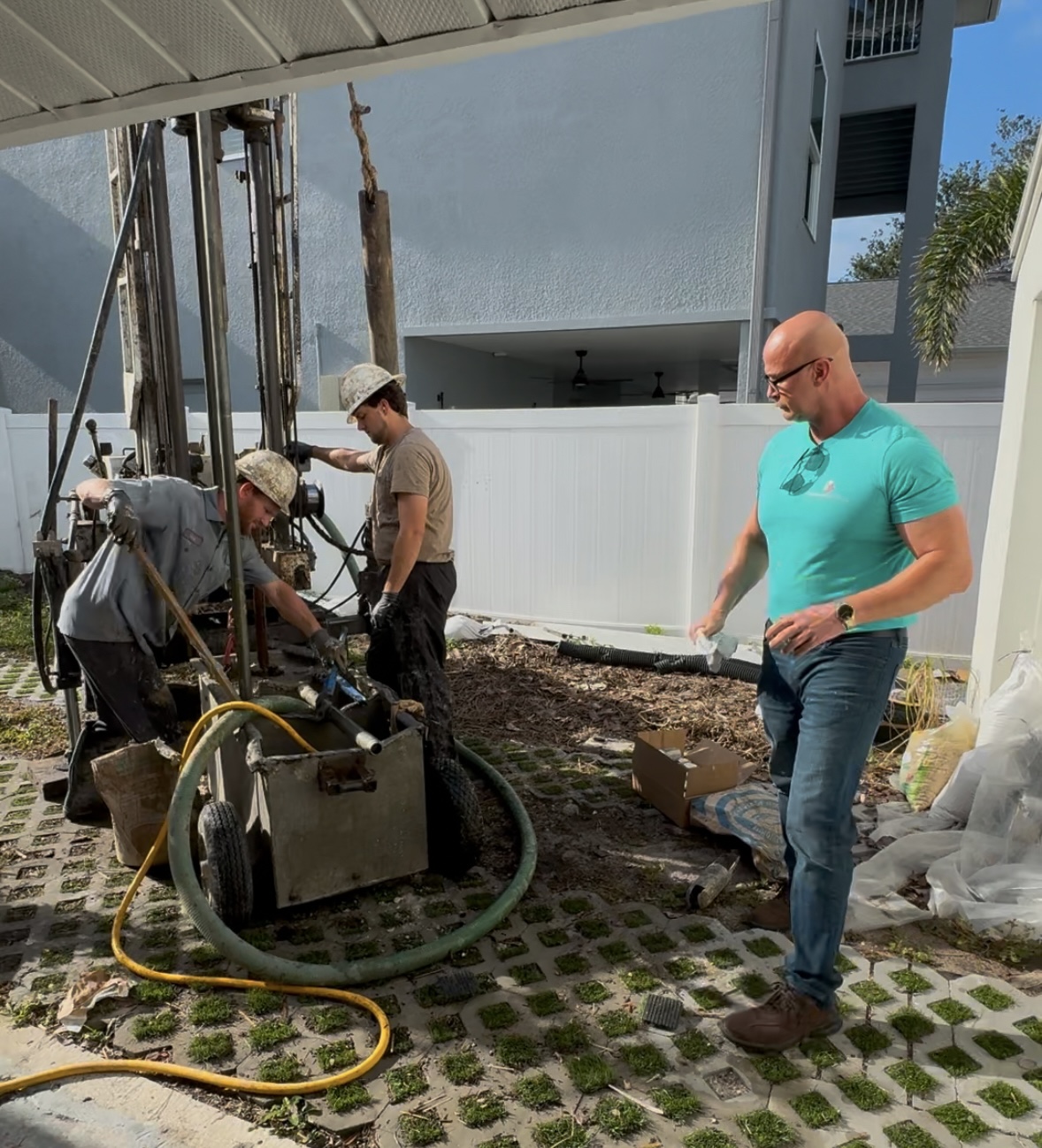
Sinkhole Review · Subsurface Evaluation · Florida Geotechnical Conditions
Testing, Modeling and Subsurface Characterization
Good geotechnical recommendations need more than one boring and a generic conclusion. The exploration is scoped to the question the project is actually asking, and the analysis has to carry the answer through design and into the field.
- SPT and CPT data interpretation
- Settlement and consolidation analysis
- Axial and lateral capacity review for deep foundations
- Groundwater flow and seepage evaluation
- Retaining wall and tieback analysis
- ASCE 7 site class determination from the subsurface profile
- Geophysical survey including ground penetrating radar and electrical resistivity
Foundation Alternatives May Include
- Spread footings where the bearing stratum is there and proven
- Deep foundations such as piles or drilled shafts
- Ring and mat foundation systems
- Ground improvement and densification programs
- Retaining structures and shoring support
- Groundwater control measures

Subsurface Review · Foundation Evaluation · Florida Geotechnical Support
Data First, Then Foundations
Geotechnical engineering earns its money during due diligence and design, not during construction. A project gets delayed or gets expensive when the foundation design moves ahead of the subsurface understanding, and the correction always happens at the worst point in the schedule.
So the questions get answered in order. Site suitability and development limits. Bearing and settlement. What the groundwater does across a season. Whether karst risk is present on this parcel rather than in this county. Then the foundation alternatives, priced against real conditions.
It is also why our geotechnical work sits next to our structural engineering and civil engineering rather than being subcontracted away from them. On a Florida site the grading plan, the foundation and the water table are one problem wearing three hats.
A Geotechnical Report Is Written Once and Read by Five Different Audiences
Most of the pressure on a geotechnical report does not come from the person who commissioned it. It comes from everyone who reads it later, usually under circumstances nobody planned for. That is worth knowing before the scope is set, because the scope is what decides whether the document survives those readings.
The Five Readers
- The structural engineer, who has to design to the bearing values and will ask what happens at the edge of the footprint where there was no boring
- The contractor, who prices the excavation from it and will find out on day one whether the groundwater and the rock depth were right
- The building official, who is checking that the foundation design rests on something and not on an assumption
- The carrier, on a sinkhole claim, reading for whether the analyses were of sufficient scope in the words the statute uses
- The next engineer, years later, when something has moved and somebody wants to know what was known at the time
What That Changes About the Scope
It changes where the borings go, not just how many there are. Exploration placed to characterize the whole footprint and its variability answers more questions than the same number of holes clustered where access happened to be easy.
It changes how groundwater is treated. A single depth to water recorded on a drilling day is a measurement. The seasonal high is an interpretation, and it is the one the design actually needs, so the basis for it belongs in the report rather than in the memory of whoever drilled it.
And it changes what gets written down when the data is ambiguous. Recording the uncertainty honestly, with what would resolve it, is worth more to every one of those five readers than a confident number nobody can trace.
The Investigation Is Not the Same Statewide, Because the Question Is Not
The methods travel. The question the investigation is trying to settle does not. A scope written for one Florida market and reused in another usually collects the right data about the wrong risk, which is the most expensive kind of complete report.
Tampa Bay and the Gulf Coast
Karst risk is the question that shapes the scope in much of this region, alongside variable sands and the depth at which competent material is actually found. Screening and confirmatory work get planned together rather than sequentially.
Orlando and Central Florida
Redevelopment over older site work is common, so the question is frequently what is already down there: previous fill, an abandoned system, and a bearing stratum whose depth changes across the parcel.
Miami and South Florida
Groundwater sits close to the surface and rock depth drives the excavation method and the price of it. Those two answers change a budget more than the foundation type does.
Jacksonville and Northeast Florida
Variable sands and clays, and a tidal river that makes the water condition at a site a moving number rather than a fixed one. Hydrologic soil group also feeds the city drainage guidance directly.
Coastal and Waterfront, Anywhere
Shoreline work adds scour, tidal groundwater and salt exposure to the list, and it usually adds an earth retention or seawall question to the foundation question.
Sites With a Claim History
Where there is a prior sinkhole claim, a prior remediation or a prior report, the scope has to account for what was already done and what was concluded, because the next reader will compare them.
Serving Geotechnical Projects Across the State of Florida
Headquartered in Tampa and Apollo Beach, Foundation Masters mobilizes geotechnical investigation and foundation engineering support to projects throughout Florida.
From the Gulf coast to Central Florida, the Atlantic coast and Northeast Florida, we bring the same field driven approach to every site, matched to the local soils, groundwater and subsurface conditions rather than to a statewide average that describes nowhere in particular.
- Tampa Bay, St. Petersburg and the Gulf coast
- Orlando and Central Florida
- Miami and South Florida
- Jacksonville and Northeast Florida
What We Establish Before Foundations Are Chosen
- Bearing stratum, its depth and whether it is continuous across the footprint
- Seasonal high groundwater, and what it does to the excavation method and the price
- Depth and variability of compressible or organic material under anything carrying load
- Fill history, because a site that was raised once behaves differently from one that never was
- Karst indicators where the geology calls for them
- Infiltration behavior where a stormwater design depends on the ground accepting water
- Whether excavated material can be reused on site, which is a budget question answered by a laboratory
Geotechnical Engineering in Florida: Common Questions
What does a geotechnical engineering firm do in Florida?
It evaluates soil, rock and groundwater conditions to support foundation design, site development, subsurface risk assessment and long term performance. On a Florida site that usually means establishing the bearing stratum and its depth, the seasonal high groundwater, the variability across the footprint, and whether karst risk is present on that parcel rather than in that county.
When should I bring in a geotechnical engineering firm?
Before new construction, a major addition, difficult foundation work, a sinkhole concern or significant site development, and any time soil or groundwater conditions could affect the project. The work earns its money during due diligence and design. A correction made during construction happens at the contractor rate, after the schedule is already committed.
What does Florida law require in a sinkhole investigation?
Two sections of the Florida Statutes govern it. Section 627.7072 requires the professional engineer or professional geologist to perform such tests as are sufficient, in their professional opinion, to determine the presence or absence of sinkhole loss or other cause of damage within reasonable professional probability, and to make recommendations regarding necessary building stabilization and foundation repair. Section 627.7073 then sets out what the report must contain.
What exactly does the sinkhole report have to say?
Where a sinkhole loss is verified, the report must state that structural damage to the covered building has been identified within a reasonable professional probability, that the cause of that damage is sinkhole activity within a reasonable professional probability, what tests were performed, and what stabilization and repairs are recommended. Where sinkhole activity is ruled out, the report has to state that the analyses and tests conducted were of sufficient scope to eliminate sinkhole activity as the cause of the structural damage.
Why does the phrase sufficient scope matter so much?
Because it is the standard the report is measured against, by the carrier, by opposing counsel and by the next engineer who reads it. The statute does not set a minimum number of borings or a required geophysical method. It leaves the scope to professional judgment and then holds the report to it. An investigation is built so that statement can be made honestly, or it is not finished.
Does Florida soil require special foundation design?
Often, yes. Florida sites commonly involve porous limestone, loose sands, clay lenses, high groundwater, coastal soils and karst related concerns, and those conditions can change across a single footprint. The design question is rarely which system is best in general. It is which system suits what the borings actually found on that parcel.
Can you help with a sinkhole investigation?
Yes. We support sinkhole investigations using historical and geological review, a structural survey of the existing damage, geophysical screening, confirmatory borings, laboratory testing, groundwater monitoring and remediation planning, and we report to the standard the statute sets.
What kinds of testing do you use?
Depending on the site, SPT borings, CPT soundings, laboratory testing, groundwater monitoring, and geophysical survey including ground penetrating radar and electrical resistivity. The scope is chosen against the question the project is asking rather than run as a fixed package.
Do you provide foundation recommendations?
Yes. We provide recommendations for shallow foundations, mat and ring systems, deep foundations such as piles and drilled shafts, ground improvement, retaining structures and groundwater control, based on the conditions found rather than a default.
Do you install what you recommend?
Yes, on much of it. We install helical piers, deep foundation systems, sheet piling and earth retention with our own crews. That changes what gets recommended, because the people writing the recommendation know what can actually be installed on that site at the price it was budgeted at.
Can you help during construction?
Yes. We provide geotechnical support during construction, including earthwork observation, fill evaluation, compaction review, pile monitoring and the field calls that have to be made while the excavation is still open.
Do you work on residential and commercial projects?
Yes. We work with residential, commercial, industrial, municipal and infrastructure projects across Florida, for property owners and developers, contractors, homeowners associations, public agencies, investors, and insurance carriers and legal teams.
Can a geotechnical report help with property risk and value?
A professional subsurface investigation helps owners, buyers, lenders, insurers and project teams understand the site conditions and the foundation related risk before the decision is made rather than after. On a parcel with a sinkhole history it is frequently the document the transaction turns on.
Do you provide forensic geotechnical engineering?
Yes. We investigate settlement, failure, sinkhole related damage, foundation distress and other performance problems, and we provide a written engineering opinion on cause rather than a list of observations. That work runs alongside our structural and civil forensic practice.
How do I start a project with Foundation Masters?
Send the address, the survey, any plans, permits or photographs you have, the known site history and what you are trying to achieve. We will tell you what the investigation actually needs to cover before anyone spends money designing to the wrong assumption.
The Rest of What We Do
Geotechnical engineering is one of several disciplines under the same roof here, which is the reason a soil problem and a foundation problem do not have to be investigated by two different companies.
Structural Engineering Florida
Structural engineering for repair design, movement, distress investigation and difficult structural conditions.
Civil Engineering Florida
Civil engineering for drainage, stormwater, site development, utilities and permitting support.
Foundation Repair Florida
Foundation repair supported by engineering analysis, subsurface understanding and practical repair planning.
Drainage and Waterproofing Florida
Engineer led help for groundwater, runoff, slab moisture and water intrusion problems.
Foundation Inspection Florida
Licensed evaluation for settlement, cracking and pre purchase questions, statewide.
Helical Piers
Foundation support and underpinning where subsurface conditions require load transfer to a deeper stratum.
Soil Borings
The investigation itself, including the groundwater and infiltration data most Florida designs are sized from.
Deep Foundation Systems
Pile and pier systems for sites where the ground will not carry a shallow foundation.
Sheet Piling Contractors
Driven sheet piling for retention, cofferdams and shoreline work, installed with our own equipment.
Statutory and Agency References
The primary sources behind the sinkhole reporting sections on this page. Worth reading directly rather than taking any summary of them on trust, this one included.
- Section 627.7072, Florida Statutes, testing standards for sinkhole investigation
- Section 627.7073, Florida Statutes, what a sinkhole report must contain and the certification language
- Florida Geological Survey, for the geological context behind karst and sinkhole risk
- Florida Board of Professional Engineers
Markets We Cover for Geotechnical Work
The city pages carry the local detail: the soils and groundwater that recur in that market and the conditions that drive the foundation decision there.
- Geotechnical engineering in Tampa
- Geotechnical engineering in Orlando
- Geotechnical engineering in Miami
- Geotechnical engineering in Jacksonville
Talk to Our Geotechnical Engineering Team About Your Florida Project
Send the address, the survey and the site history. We will tell you what the investigation actually needs to cover, and what it will support once it is done, before anyone spends money designing to the wrong assumption.
Foundation Masters, LLC
Geotechnical, civil and structural engineering, and deep foundation installation, throughout the State of Florida.
Phone: 813-614-1718
Service area: Statewide, with market pages for Tampa, Orlando, Miami and Jacksonville.