
Geotechnical Engineering Tampa for Karst, Limestone and High Groundwater
Tampa Bay sits on solution weathered limestone under a thick sediment cover, so bearing is often competent while that same limestone drives the karst activity the region is known for. Covered karst is the reason a Tampa site can look ordinary from the surface and still need a boring program that goes looking for what is under the sand.
We investigate the ground first, then design foundations and ground improvement systems around real Tampa conditions, and support them with engineered pipe pile, pile driving and deep foundation systems when a site calls for it.
From neighborhoods to high rises, roadways and coastal infrastructure, our team brings local geology knowledge, construction experience and engineering standards to every Hillsborough County project.

Tampa Bay, from one firm
- Florida Certificate of Authorization CA 30969
- Investigation, design and installation under one roof
- Hillsborough, Pinellas, Pasco and Manatee
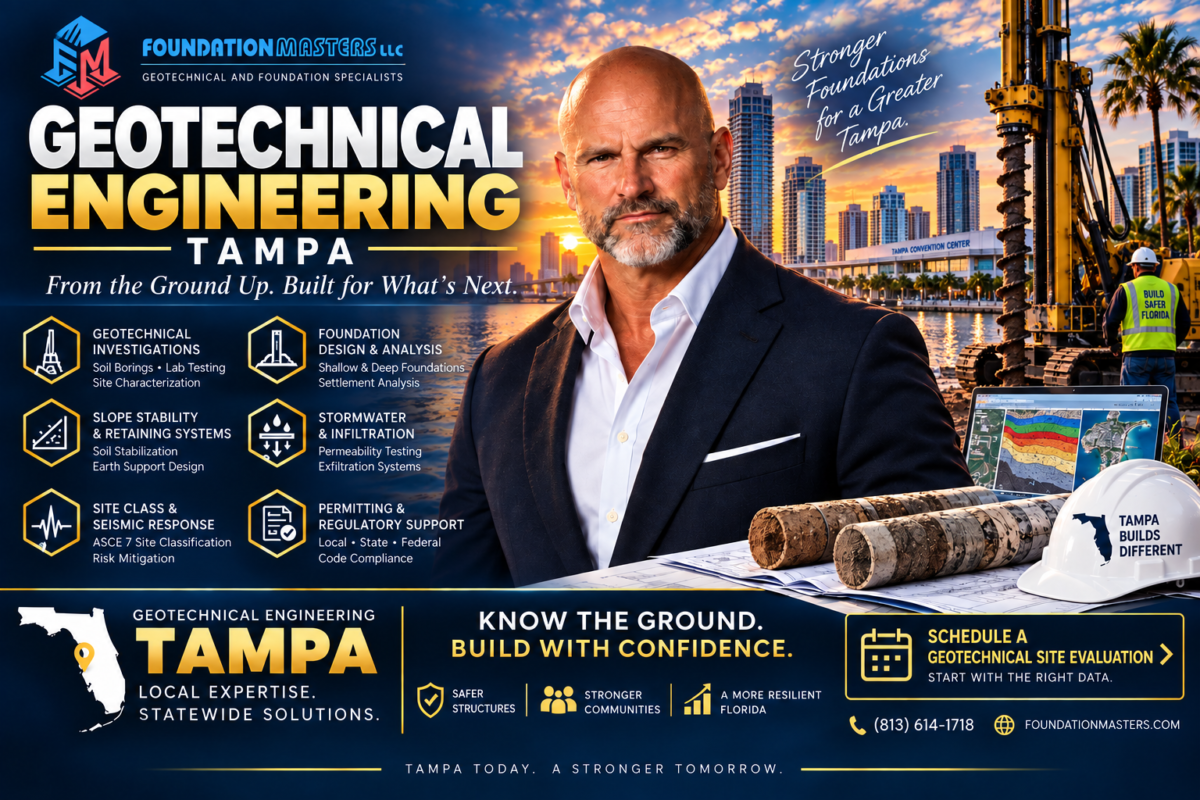
Covered Karst Is Why a Tampa Site Can Look Fine From the Surface
Sinkholes are not one thing, and the difference matters more in Tampa Bay than almost anywhere else in the state. The Florida Geological Survey separates them by how much sediment sits on top of the limestone, and Tampa Bay sits squarely in the category where the cover is thick.
Three Types, and Only Two Apply Here
Solution sinkholes, in the words of the Florida Geological Survey, usually occur where there is little or no sediment cover over the limestone. That is not the Tampa Bay condition, so the two that matter locally are the covered types.
Cover subsidence sinkholes are described as occurring where thick permeable sediments cover the limestone, with the void in the rock filled by sediments raveling downward from above. That is slow, and it shows up as settlement long before it shows up as a hole.
Cover collapse sinkholes occur where sediments overlying the void in the rock suddenly collapse, creating a hole at ground surface. Same geology, different day, very different morning.
A Subsidence Incident Is Not a Verified Sinkhole
This is the distinction that catches Tampa owners out. The state maintains a record of reported ground subsidence, and the Florida Geological Survey is direct about what it is: often a depression is not verified by a licensed professional geologist or engineer to be a true sinkhole, and the cause of subsidence is not known. Those events are called subsidence incidents.
The state disclaimer on that database goes further. Records in it, in many instances, have not been field checked or verified by DEP or FGS professional geologists.
Which is the practical point for a Tampa project. Two neighboring parcels in the same subdivision can carry the same map history and behave differently, because what changed between them is the thickness of the cover, the depth to competent limestone and what the water table has been doing to the sediment in between. Those are measured, not looked up.
Why Geotechnical Engineering Matters in Tampa
Tampa subsurface conditions, solution weathered limestone, karst activity, variable sands, reclaimed land and shallow groundwater, can trigger settlement, voids and water intrusion without proper investigation and design.
Good geotechnical work identifies subsurface risk before it becomes a structural problem, so a project can be permitted, built and trusted for the long term.
Much of the Tampa Bay shoreline is also made ground. Land that was filled, dredged or raised behaves differently from land that never was, and the difference frequently does not appear on a plat. It appears in the borings, which is where we would rather meet it.
What Geotechnical Engineering Delivers
- Identify subsurface risks early, including voids, organics, seasonal high groundwater and soft layers
- Engineer foundations and ground improvement systems for local soil and groundwater behavior
- Prevent costly delays and long term structural performance issues
- Support permitting with documented subsurface data and recommendations
- Establish whether fill history is affecting what is carrying load today
- Give the structural design a bearing value somebody can stand behind
Geotechnical Engineering Services in Tampa
We provide investigation, analysis and foundation support services for residential, commercial, industrial and municipal projects across the Tampa Bay region.
Subsurface Exploration
Site feasibility and due diligence evaluations, SPT borings and CPT soundings to define the profile below your site.
Foundation Engineering
Foundation engineering and settlement analysis, tied to bearing capacity, groundwater and load demands.
Ground Improvement
Stone columns, soil cement mixing and pressure grouting to strengthen weak or variable ground.
Sinkhole Investigation and Remediation
Investigation and remediation design for karst voids, including confirmatory drilling and compaction grouting.
Earth Retention and Slope Stability
Slope stability, earth structures, retaining wall and shoring support.
Groundwater Control
Groundwater control and permanent dewatering systems for excavations below the water table.
Pavement and Roadway Subgrade
Pavement and roadway subgrade design for durable, long performing surfaces.
Deep Foundation Support
Engineered pipe pile, pile driving and helical pier support for high loads or weak soils.
Limestone and Rock Drilling
Limestone drilling where the design has to reach and prove competent rock rather than assume it is there at a depth somebody quoted.
Site Class and Seismic Response
ASCE 7 site classification developed from the boring data, where the structure and the code require it to be established rather than assumed.
Construction Phase Support
Earthwork observation, fill evaluation, compaction review, pile monitoring and the field calls that have to be made while the excavation is still open.
Forensic and Expert Witness
Forensic evaluations and expert witness services for subsurface and foundation disputes.
Sinkhole Investigation and Ground Improvement in Tampa Bay
Karst limestone under Tampa Bay means voids and settlement have to be found and treated, not guessed at. Our sinkhole and ground improvement work moves from evidence to a designed, buildable fix.
- Historical data review and geologic mapping
- Structural condition surveys and forensic assessments
- Geophysics to locate voids, including GPR and electrical resistivity imaging
- Confirmatory drilling and laboratory testing
- Compaction grouting programs
- Underpinning with helical piers, push piers or pin piles
- Rock throat stabilization and controlled excavation
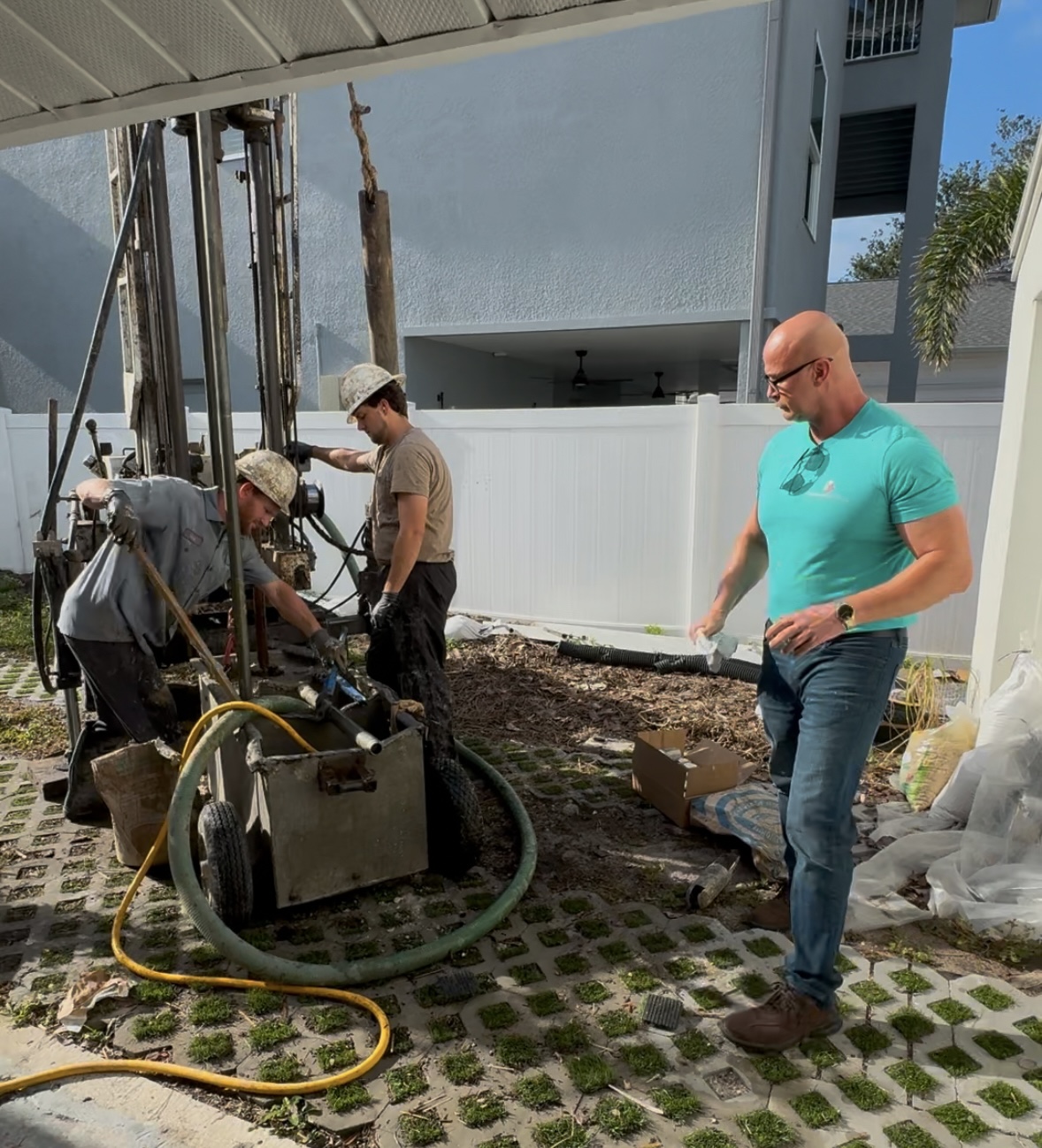
Subsurface Exploration · SPT and CPT · Tampa Bay Geology
Hillsborough County Has an Environmental Agency Most Florida Counties Do Not
Statewide, environmental resource permitting runs through the water management district under Chapter 62-330 of the Florida Administrative Code. In Hillsborough County there is a county agency sitting alongside that, created by its own act of the Legislature, and a project team that has only budgeted for the district permit can be surprised by it.
The Environmental Protection Commission
The Environmental Protection Commission of Hillsborough County was created by the Florida Legislature in 1967 and operates today under Chapter 84-446, as amended, Laws of Florida, the Hillsborough County Environmental Protection Act. Its own guidance describes it as pursuing limited delegation of environmental resource permits from the Department of Environmental Protection while issuing wetland impact permits that are similar to some of them.
The Wetlands Management Division states that it provides local standards of environmental protection, maintenance and utilization of wetlands and other surface waters within Hillsborough County, and it reviews permit applications for construction activities affecting wetlands or surface waters.
Where the Geotechnical Work Meets It
Subsurface data is not filed with an environmental permit, but it decides several of the answers that permit depends on. Whether the ground will accept water. Where the seasonal high sits. Whether the site can be dewatered without drawing down something the reviewer cares about.
Those numbers come out of the same holes the foundation recommendation comes out of, which is the argument for scoping the exploration once, for the whole project, rather than drilling for the structure and then drilling again for the site work.
It is also why our geotechnical work sits next to our civil engineering in Tampa and our structural engineering in Tampa rather than being subcontracted away from them. On a Tampa site the grading plan, the foundation and the water table are one problem wearing three hats.
We do not present a permitting summary as a substitute for the agency. Requirements are revised, delegations change, and the reviewer of record is the authority on their own program. What we do is make sure the subsurface work is scoped so the answers are already in hand when the question is asked.
What Exploration Methods We Use and Why
We use SPT borings, CPT soundings and geophysics such as GPR and electrical resistivity to define soils, groundwater and possible voids before design. The scope is chosen against the question the project is asking rather than run as a fixed package.
- SPT and CPT data interpretation
- Settlement and consolidation analysis
- Axial and lateral capacity review for deep foundations
- Groundwater flow and seepage evaluation
- Retaining wall and tieback analysis
- ASCE 7 site class determination from the subsurface profile
- Geophysical survey including ground penetrating radar and electrical resistivity
Foundation Alternatives for Tampa Sites
- Spread footings where the bearing stratum is there and proven
- Deep foundations such as driven pile or drilled shafts
- Ring and mat foundation systems over variable ground
- Ground improvement and densification programs
- Retaining structures and shoring support
- Groundwater control measures
The Same Region, Several Different Subsurface Questions
Tampa Bay is not one ground condition. Within a short drive the governing question changes, and a scope written for one part of the region and reused in another usually collects the right data about the wrong risk.
Downtown and the Channel District
Higher loads, tighter sites and neighbors close enough that the excavation support question arrives at the same time as the foundation question. Fill history matters here more than most owners expect.
North Hillsborough and the Pasco Line
Moving north, the limestone generally sits closer to the surface and karst screening carries more weight in the scope. This is where the historical review earns its fee before the rig is scheduled.
Coastal and Waterfront
Shoreline work adds scour, tidal groundwater and salt exposure to the list, and it usually adds an earth retention or seawall question to the foundation question.
Reclaimed and Made Ground
Land that was filled, dredged or raised behaves differently from land that never was. The depth of the fill, what it is made of and what is under it are three separate answers.
Older Residential Neighborhoods
Additions and renovations on structures that have already found their level. The question is often whether the existing foundation can take the new load, which is a different investigation from a greenfield one.
Sites With a Claim History
Where there is a prior sinkhole claim, a prior remediation or a prior report, the scope has to account for what was already done and what was concluded, because the next reader will compare them.

Foundation Evaluation · Ground Improvement · Tampa Bay Support
A Tampa Geotechnical Report Is Written Once and Read by Several Audiences
Most of the pressure on a geotechnical report does not come from the person who commissioned it. It comes from everyone who reads it later, usually under circumstances nobody planned for.
- The structural engineer, who designs to the bearing values and will ask what happens at the edge of the footprint where there was no boring
- The contractor, who prices the excavation from it and finds out on day one whether the groundwater and the rock depth were right
- The building official, checking that the foundation design rests on something and not on an assumption
- The carrier, on a sinkhole claim, reading for whether the analyses were of sufficient scope in the words Florida law uses
- The next engineer, years later, when something has moved and somebody wants to know what was known at the time
Where We Work Around Tampa
Headquartered in Tampa and Apollo Beach, Foundation Masters mobilizes geotechnical investigation and foundation engineering support across Hillsborough County and the surrounding Tampa Bay counties.
- Tampa, Brandon, Riverview, Apollo Beach and Plant City
- St. Petersburg, Clearwater and the Pinellas beaches
- Bradenton, Palmetto and northern Manatee County
- Wesley Chapel, Lutz and southern Pasco County
What We Establish Before Foundations Are Chosen
- Bearing stratum, its depth and whether it is continuous across the footprint
- Seasonal high groundwater, and what it does to the excavation method and the price
- Depth and variability of compressible or organic material under anything carrying load
- Fill history, because a site that was raised once behaves differently from one that never was
- Karst indicators, which in covered karst are read from the sediment as much as from the rock
- Infiltration behavior where a stormwater design depends on the ground accepting water
- Whether excavated material can be reused on site, which is a budget question answered by a laboratory
Geotechnical Engineering Tampa: Frequently Asked Questions
Do Tampa soils require special foundations?
Often yes. Karst limestone, reclaimed land and high groundwater may require deep foundations, ground improvement or underpinning to meet code and performance goals. The honest answer for any specific parcel is that it depends on what the borings find, and the borings are cheaper than finding out during construction.
When should I hire a geotechnical engineering firm in Tampa?
Before design or permitting for new builds, additions, coastal work, or when sinkhole risk or poor soils are suspected. The work earns its money during due diligence and design. A correction made in the field happens at the contractor rate, after the schedule is already committed.
Will a geotechnical report help resale value?
Documented subsurface data and foundation recommendations reduce risk for owners, buyers and lenders by improving confidence in the foundation conditions at the property. On a Tampa parcel with any subsidence history it is frequently the document the transaction turns on.
What exploration methods do you use?
We use SPT borings, CPT soundings, and geophysics such as ground penetrating radar and electrical resistivity to define soils, groundwater and possible voids before design. Geophysics narrows the search and confirmatory drilling settles it.
What kind of sinkholes does Tampa Bay actually get?
The covered kinds. The Florida Geological Survey describes solution sinkholes as usually occurring where there is little or no sediment cover over the limestone, which is not the Tampa Bay condition. Here the relevant types are cover subsidence sinkholes, where thick permeable sediments cover the limestone and the void in the rock is filled by sediments raveling downward from above, and cover collapse sinkholes, where sediments overlying the void suddenly collapse and create a hole at ground surface.
There is a sinkhole reported near my address on the state map. Does that mean my property has one?
No, and it is worth understanding why. The Florida Geological Survey notes that often a depression is not verified by a licensed professional geologist or engineer to be a true sinkhole and the cause of subsidence is not known, and those events are recorded as subsidence incidents. The state disclaimer on that database says records in it, in many instances, have not been field checked or verified by department or survey professional geologists. A map dot is a reason to investigate, not a finding.
So is a clean state map good enough to skip the investigation?
No. The same limitation runs in both directions. A parcel with no reported incident nearby has not been examined and cleared, it has simply never been reported on. What decides the question is the exploration program on that parcel.
What does Florida law require in a sinkhole investigation?
Two sections of the Florida Statutes govern it. Section 627.7072 requires the professional engineer or professional geologist to perform such tests as are sufficient, in their professional opinion, to determine the presence or absence of sinkhole loss or other cause of damage within reasonable professional probability, and to make recommendations regarding necessary building stabilization and foundation repair. Section 627.7073 then sets out what the report must contain, including the statement that the analyses and tests conducted were of sufficient scope to eliminate sinkhole activity as the cause of the structural damage where that is the conclusion.
Does Hillsborough County have permitting that other counties do not?
It has a county environmental agency that most Florida counties do not. The Environmental Protection Commission of Hillsborough County was created by the Florida Legislature in 1967 and operates under Chapter 84-446, as amended, Laws of Florida, the Hillsborough County Environmental Protection Act. Its wetlands division reviews permit applications for construction activities affecting wetlands or surface waters in the county. Confirm the current requirements with the agency for your specific project, because programs and delegations are revised.
How many borings does my Tampa project need?
There is no fixed number, and anyone who quotes one before seeing the site is pricing a package rather than answering a question. The layout is driven by the structure, the footprint, the loads, the known geology and what the historical review turns up. Placement usually matters more than count, because exploration spread to characterize variability answers more than the same holes clustered where access was easy.
Can you tell me the depth to limestone before you drill?
Not honestly. Published mapping and nearby records give a range and a reasonable expectation, and in covered karst that expectation can be wrong by a lot across a single footprint. We will tell you what the regional data suggests and then go find out.
Do you provide foundation recommendations, or just the data?
Recommendations. We provide guidance for shallow foundations, mat and ring systems, deep foundations such as driven pile and drilled shafts, ground improvement, retaining structures and groundwater control, based on the conditions found rather than a default.
Do you install what you recommend?
Yes, on much of it. We install helical piers, deep foundation systems, pipe pile and sheet piling with our own crews. That changes what gets recommended, because the people writing the recommendation know what can actually be installed on that Tampa site at the price it was budgeted at.
Can you support the project during construction?
Yes. We provide geotechnical support during construction, including earthwork observation, fill evaluation, compaction review, pile monitoring and the field calls that have to be made while the excavation is still open.
How do I start a project with Foundation Masters?
Send the address, the survey, any plans, permits or photographs you have, the known site history and what you are trying to achieve. We will tell you what the investigation actually needs to cover before anyone spends money designing to the wrong assumption.
Geotechnical Work That Ties Into the Whole Project
Our Tampa geotechnical work connects directly to foundation design, repair and the deep foundation systems we install, so the recommendation on the report matches what gets built.
Geotechnical Engineering Florida
The statewide hub, including what Florida law requires of a sinkhole investigation and the report that follows it.
Structural Engineering Tampa
Structural engineering for repair design, movement, distress investigation and difficult structural conditions in Tampa.
Civil Engineering Tampa
Civil engineering for drainage, stormwater, site development, utilities and permitting support in Tampa.
Foundation Repair Tampa
Foundation repair supported by engineering analysis, subsurface understanding and practical repair planning.
Pipe Pile
Engineered pipe pile for high loads and for sites where the bearing stratum is well below the footing.
Pile Driving Contractors
Driven pile installation with our own equipment and crews, from mobilization to production records.
Limestone Drilling Contractor Florida
Drilling through and into Florida limestone where the design has to reach and prove competent rock.
Retaining Wall Contractor Tampa
Retaining structures and earth support, designed against the soil profile and the groundwater behind them.
Soil Borings
The investigation itself, including the groundwater and infiltration data most Florida designs are sized from.
Deep Foundation Systems
Pile and pier systems for sites where the ground will not carry a shallow foundation.
Helical Piers
Foundation support and underpinning where subsurface conditions require load transfer to a deeper stratum.
Contact Us
Send the address and the site history and we will tell you what the investigation needs to cover.
Sources and Agency References
The primary sources behind the karst and permitting statements on this page. Worth reading directly rather than taking any summary of them on trust, this one included.
- Florida Geological Survey, Sinkholes, including the definitions of solution, cover subsidence and cover collapse sinkholes
- Subsidence Incident Report System disclaimer, on what the state database has and has not been verified against
- Section 627.7072, Florida Statutes, testing standards for sinkhole investigation
- Section 627.7073, Florida Statutes, what a sinkhole report must contain
- Environmental Protection Commission of Hillsborough County, the county environmental agency and its wetlands program
- Southwest Florida Water Management District, the permitting district for the Tampa Bay region
Other Markets We Cover
Each city page carries the local detail: the soils and groundwater that recur in that market and the conditions that drive the foundation decision there.
- Geotechnical engineering statewide in Florida
- Geotechnical engineering in Orlando
- Geotechnical engineering in Miami
- Geotechnical engineering in Jacksonville
Jeff Earl, CEO
Foundation Masters, LLC · Construction and Engineering Management
Florida CA: 30969
Office: 813-614-1718 · Direct: 656-233-7089
Email: [email protected]
Start Your Tampa Geotechnical Engineering Project
From subsurface investigation and sinkhole evaluation to foundation design and ground improvement, Foundation Masters delivers geotechnical engineering built for real Tampa Bay conditions.
Foundation Masters, LLC
Geotechnical, civil and structural engineering, and deep foundation installation, throughout Tampa Bay and the State of Florida.
Phone: 813-614-1718
Service area: Hillsborough, Pinellas, Pasco and Manatee counties, and statewide.