
Bridge Contractor North Carolina
Foundation Masters, LLC. Licensed Florida engineering firm, CA# 30969. Residential and light commercial bridge design and construction across North Carolina, from the mountain coves west of Asheville to the sounds behind the Outer Banks.

In the North Carolina mountains a great many homes sit at the end of a private road, and that road crosses a creek. When that crossing goes, the house is cut off. Foundation Masters designs and builds those crossings, along with development entrances, farm and timber access, and replacements for spans that have washed out or quietly stopped being safe.
We are a design build firm, which means the investigation, the drawing and the structure all come out of one shop instead of three. Jeff Earl founded Foundation Masters after two decades in deep foundations, earth retention and structural repair, and a licensed professional engineer seals the plan set before anything gets driven.
North Carolina sits inside a Southeast footprint that also covers Florida, Georgia, Alabama, Mississippi, Tennessee and South Carolina. Everything is indexed on the bridge contractor hub.
After Helene: Private Crossings Are the Weak Link
Hurricane Helene showed exactly where the mountain road network breaks. According to North Carolina Emergency Management, nearly 19,000 households across 39 counties lost safe access to their homes, much of it because private roads, culverts and bridges washed away. The state built a Private Roads and Bridges program to respond, and by late 2025 it had more than 6,500 submissions covering over 3,700 separate sites, with initial repair estimates around 547 million dollars.
Most of those crossings were never engineered. A pair of logs, a culvert pipe under a pile of fill, or an old flatbed trailer set across the banks will carry a pickup for years. It will not survive a mountain creek in full flood, because the water does not push the bridge off. It digs out what the bridge is sitting on.
That is the design problem we start from in the mountains. The replacement has to clear the flood, sit on foundations that do not care if the bank erodes around them, and carry a fire engine. If you are working through the state program, ask the program directly what it will reimburse and what documentation it needs. We provide the sealed design and the record of what was built either way.
Three Kinds of Ground in One State
North Carolina crosses three completely different pieces of geology between the Tennessee line and the Atlantic. The foundation that is right in one of them is wrong in the other two.
The Mountains
Asheville, Boone, Waynesville, Hendersonville, Franklin, Sylva, Burnsville and Spruce Pine. Hard crystalline rock, often shallow, under steep slopes and fast streams that carry boulders in a flood.
Rock is close, but scour and debris are what take bridges here.
The Piedmont
Charlotte, Greensboro, Winston-Salem, Raleigh, Durham, Chapel Hill and Hickory. Gneiss, schist and granite under a deep blanket of saprolite, rock that has weathered in place into something that digs like stiff soil.
That saprolite is commonly 50 to 65 feet thick and can run much deeper.
The Coastal Plain
Fayetteville, Greenville, New Bern, Jacksonville, Wilmington and the Outer Banks. Unconsolidated sand, silt and clay with no rock in reach, a shallow water table and tidal water on the sounds.
Piles build capacity in friction, and the coast adds storm surge and permitting.
The line between the Piedmont and the Coastal Plain is the Fall Zone, where rivers drop off the hard rock onto the sediment over a stretch of rapids. Roughly along a line through Roanoke Rapids, Raleigh and Fayetteville, the ground under a bridge changes character completely.
This page covers North Carolina. The rest of the bridge practice is below.
The FM-H20 Fire Truck Rated Bridge
A loaded pumper weighs somewhere north of fifteen tons. The pickup that has been crossing your bridge for years weighs three. Those are not the same question, and at the end of a mountain road there is usually no second way in. The FM-H20 is the bridge we build so that the answer is yes before anybody has to ask.
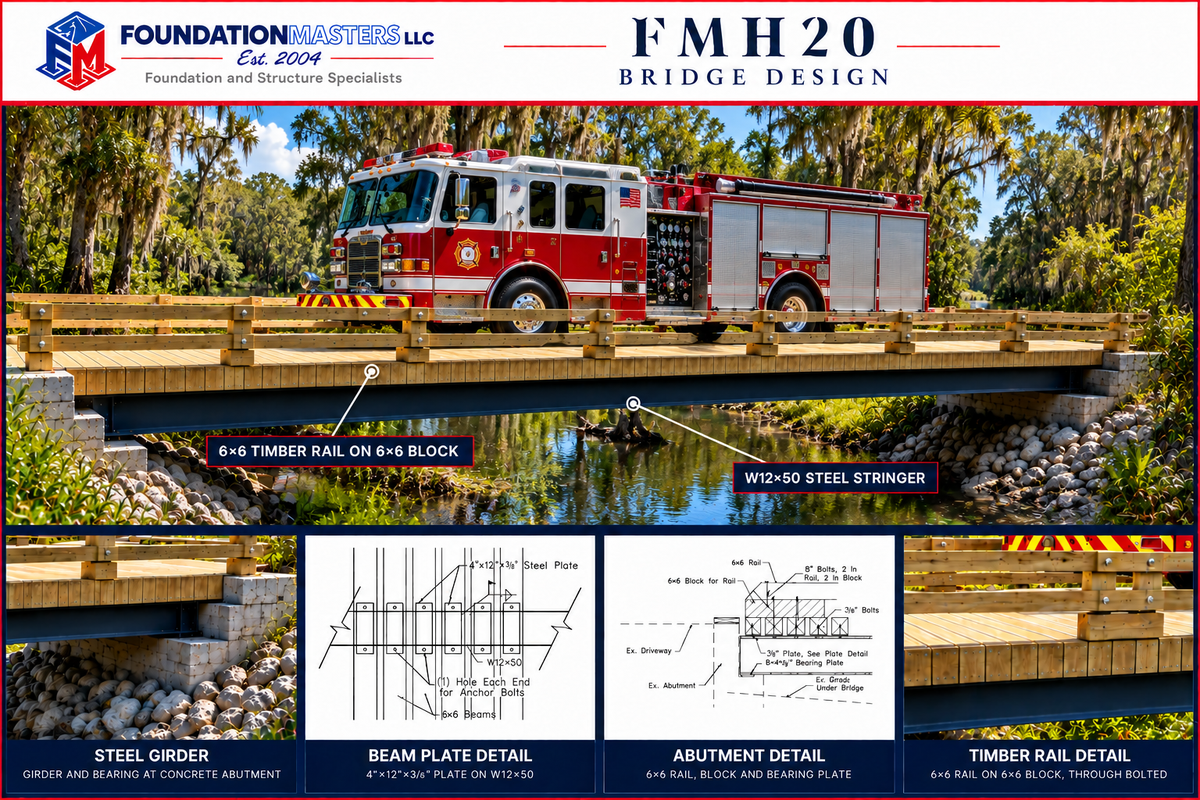
FM-H20 Specification
- Steel girder superstructure with timber deck
- Fire truck H-20 loading, 20 ton deck capacity
- Maximum span up to 60 feet
- Abutments rated to 80 tons at a 2 to 1 safety factor
- Vinyl sheet piling at the abutments, driven 60 inches below the mud line
- Lifetime warranty
Why the Sheet Pile Is Not Optional
Erosion is the leading reason private bridges fail, and Helene proved it across the mountains. A creek in flood goes for the loose fill behind the abutment first, and once that is gone the bridge has nothing to sit on.
Vinyl sheet pile driven below the mud line puts a wall between the stream and that fill. Embedment gets set by the crossing and the soil, not by a catalog default.
Full detail on the FM-H20 fire truck rated residential bridge page. Starting price is around 3,300 dollars per linear foot.
Foundations: The FM-PP30 Driven Pipe Pile
Four FM-PP30 piles carry each abutment. Three inch schedule 40 pipe, thirty tons apiece, driven with a pneumatic hammer by our own crews. Driven rather than hydraulically pressed matters on a steep or narrow bank, because a pressed pile has to react against structure that is not there yet and a driven one does not.
What the pile is looking for changes as you cross the state. In the mountains it often reaches refusal on rock quickly, and the job is making sure the abutment is seated below the depth a flood can scour. In the Piedmont it has to get through the saprolite, which can be deep and uneven from one end of a crossing to the other. On the Coastal Plain there is no rock to find, so the pile is driven until it develops capacity in the sand and clay, and that is a longer pile.
This is also where the pipe pile approach earns its place over a drilled shaft on a residential job. The rig is small enough to get down a mountain driveway and work on a creek bank, and driving the pile tells you what the ground is doing as you go.
Designing a Mountain Crossing
Clear the Flood, Not Just the Water
A mountain creek in flood carries trees, root balls and boulders. A deck set low with supports in the channel catches that debris, and a debris jam turns a bridge into a dam. A single clear span with the steel well above the high water mark lets the debris go under instead of piling up against it.
Seat the Abutments Out of Reach
The abutments get set back from the edge of the channel and founded below the depth a flood can dig, with sheet pile between the stream and the approach fill. On a narrow cove road, that often means a slightly longer span to keep the supports out of the water entirely.
Many mountain streams are classified as trout waters, and state rules require an undisturbed buffer at least 25 feet wide along them, including their unnamed tributaries. Work inside that buffer needs an approved variance before any ground is disturbed. A clear span that keeps the abutments back from the bank is the design that fits those rules most easily, and we plan the crossing around them from the start.
The Coast and the Sounds
Twenty North Carolina counties fall under the Coastal Area Management Act. A crossing over navigable water in those counties, through marsh or wetland, or within 75 feet of the normal high water line on an estuarine shoreline is likely inside an Area of Environmental Concern and needs a CAMA permit from the Division of Coastal Management or the local permit officer.
The engineering problem is the same one we design for in Florida every week. There is no rock to drive to, the water table is high, and hurricane surge and scour govern the design more than the truck on the deck. The deck is tied down to the girders and the girders to the abutments, and the piles go deeper than an inland crossing of the same span would need.
What We Build in North Carolina
Private Road Crossings
The one span standing between a mountain home and the state road. Built so that emergency apparatus can use it, and so the next flood does not cut the house off again.
Washout Replacements
Crossings lost to Helene or to any big storm since. We design the replacement for the flood that took the old one out, not the weather of an average year.
Development Entrances
The first structure anyone sees coming into a subdivision or a gated mountain community, and the one that has to survive a full construction cycle first.
Farm and Timber Access
Tractors, loaded trailers and log trucks crossing repeatedly rather than once. Different loading, different deck, different approach detail.
Greenway and Trail
Foot and cart crossings over branches and ravines on greenways, golf courses and campuses. Light loads, but the same scour and foundation questions.
Repair and Replacement
Spans that have begun to sag, scour out at the banks or rot at the deck. We look at it and write up what we find before anyone proposes a scope.
North Carolina Service Areas
Asheville and Western North Carolina
Asheville, Black Mountain, Hendersonville, Waynesville, Brevard, Sylva, Franklin, Marion and Burnsville. Steep streams and the heaviest Helene damage.
The High Country
Boone, Blowing Rock, Banner Elk, Jefferson and West Jefferson. Mountain coves, steep private roads and winter access.
Charlotte and the Foothills
Charlotte, Concord, Gastonia, Mooresville, Hickory, Morganton and Lenoir. Piedmont saprolite with lake and creek crossings.
The Triad
Greensboro, Winston-Salem, High Point, Burlington and Asheboro. Saprolite of uneven depth, where borings earn their cost.
The Triangle
Raleigh, Durham, Chapel Hill, Cary, Wake Forest and Sanford. Piedmont rock to the west, the Fall Zone to the east.
The Coast
Wilmington, Jacksonville, New Bern, Morehead City, Greenville and the Outer Banks. No rock, high water, CAMA permitting and surge.
Already have a builder lined up? We will do the investigation, the design and the sealed set and hand it to them.
North Carolina Bridge FAQs
What does a residential bridge cost in North Carolina?
The FM-H20 starts around 3,300 dollars per linear foot. Span, bank condition, how far the piles have to go and how hard the crossing is to reach are what move it from there. A steep mountain site costs more to reach than a flat one. We put a real number on it after we have stood on the bank.
My bridge washed out in Helene. Can you replace it?
Yes. We design the replacement for the kind of flood that took out the old one, with a clear span above the high water, abutments set back from the channel and sheet pile protecting the fill. If you are working with the state Private Roads and Bridges program, check with the program on what it covers and what paperwork it needs. Our sealed design and construction record support that either way.
How deep do the piles go in North Carolina?
It depends on which part of the state you are in. In the mountains the pile often reaches rock quickly. In the Piedmont it has to get through the saprolite, which is commonly 50 to 65 feet thick and uneven. On the Coastal Plain there is no rock to reach, so the pile is driven until it develops capacity in the sand and clay, which means a longer pile.
Do I need a permit to build over a creek?
In most cases yes. A span over a stream generally needs the county permit, and depending on the water body a federal authorization through the Corps of Engineers. In the mountains, trout waters carry a 25 foot undisturbed buffer that needs a variance to work inside. On the coast, the CAMA rules apply in the twenty coastal counties. We prepare and file the package rather than handing you a drawing and wishing you luck.
Will a fire truck really cross it?
Yes, and that is the whole reason the rating exists. H-20 means the deck is sized for apparatus loading at 20 tons rather than for passenger vehicles. Where the bridge is part of a required fire department access road, the local fire code official sets the load it has to carry, and some codes call for 75,000 pound apparatus, so we confirm the requirement with the fire marshal before the design is set. It is worth asking your local volunteer department what they actually run, because a rural tanker carrying several thousand gallons of water can be heavier than the engine everyone pictures.
Can you get equipment down a steep mountain driveway?
Usually, yes. That is one of the reasons we drive pipe piles instead of drilling shafts on residential crossings. The rig is small and the materials come in manageable lengths. Tell us about the grade, the turns and any weight limits on the road in, and we plan the delivery around them.
What about hurricanes on the coast?
On a crossing in Wilmington, New Bern or the Outer Banks the governing event is often the water, not the truck. Scour at the supports and uplift on the superstructure both get designed for, and the foundation goes deeper than an inland crossing of the same span would need.
Should I repair my existing crossing or replace it?
That depends on what is actually wrong, and the honest answer is not always the more expensive one. Scoured abutments and rotted timber on an otherwise sound steel frame are repairable. A structure that was never rated for the loads crossing it now, or one whose foundations have been undermined, is a replacement. We look at it and put the finding in writing before anybody talks about price.
Talk About Your North Carolina Crossing
New bridge, washout replacement, development entrance, or a crossing that has started to move. Tell us where it is and what has to get across it.
Call 656-233-7089Or send it in writing through the contact page. Include the property address, the span and a photo of the crossing.