
Push Piers vs Helical Piers: Which Is Right for Your Foundation?
Two good systems, built for different jobs. How push piers and helical piers differ, where each one works in Florida soil, and how an engineer decides between them.

The Short Answer
A push pier is a steel pipe pressed into the ground using the weight of the house as the reaction. A helical pier is a steel shaft with spiral plates that is screwed into the ground with torque. Both carry the structure down to firm soil. The difference is what drives them, and that decides where each one works.
Foundation Masters installs both, plus driven pipe piles and micropiles, so we have no reason to push you toward one. Every Foundation Masters push pier project is designed under our Florida engineering firm (Certificate of Authorization CA 30969), with Andre Hawks, P.E. as Engineer of Record.
Straight answers for homeowners holding a push pier proposal, from the engineers who design and install them.
Side by Side
| Push piers | Helical piers | |
|---|---|---|
| How it goes in | Pressed down with a hydraulic ram against the weight of the structure | Screwed in with hydraulic torque, like a large screw |
| How capacity is verified | Hydraulic pressure at refusal, recorded for each pier | Installation torque, correlated to capacity, recorded for each pier |
| Needs a heavy structure | Yes, the house is the reaction | No |
| New construction | No, there is nothing yet to push against | Yes |
| Light structures, decks, porches | Usually not | Yes |
| Tension or uplift loads | No | Yes |
| Deep soft soil over firm layers | Excellent, drives until it finds bearing | Good, limited by torque and shaft strength |
| Shallow limestone | Stops on the rock | Cannot screw into solid rock |
| Typical cost per pier | Usually lower | Usually higher |
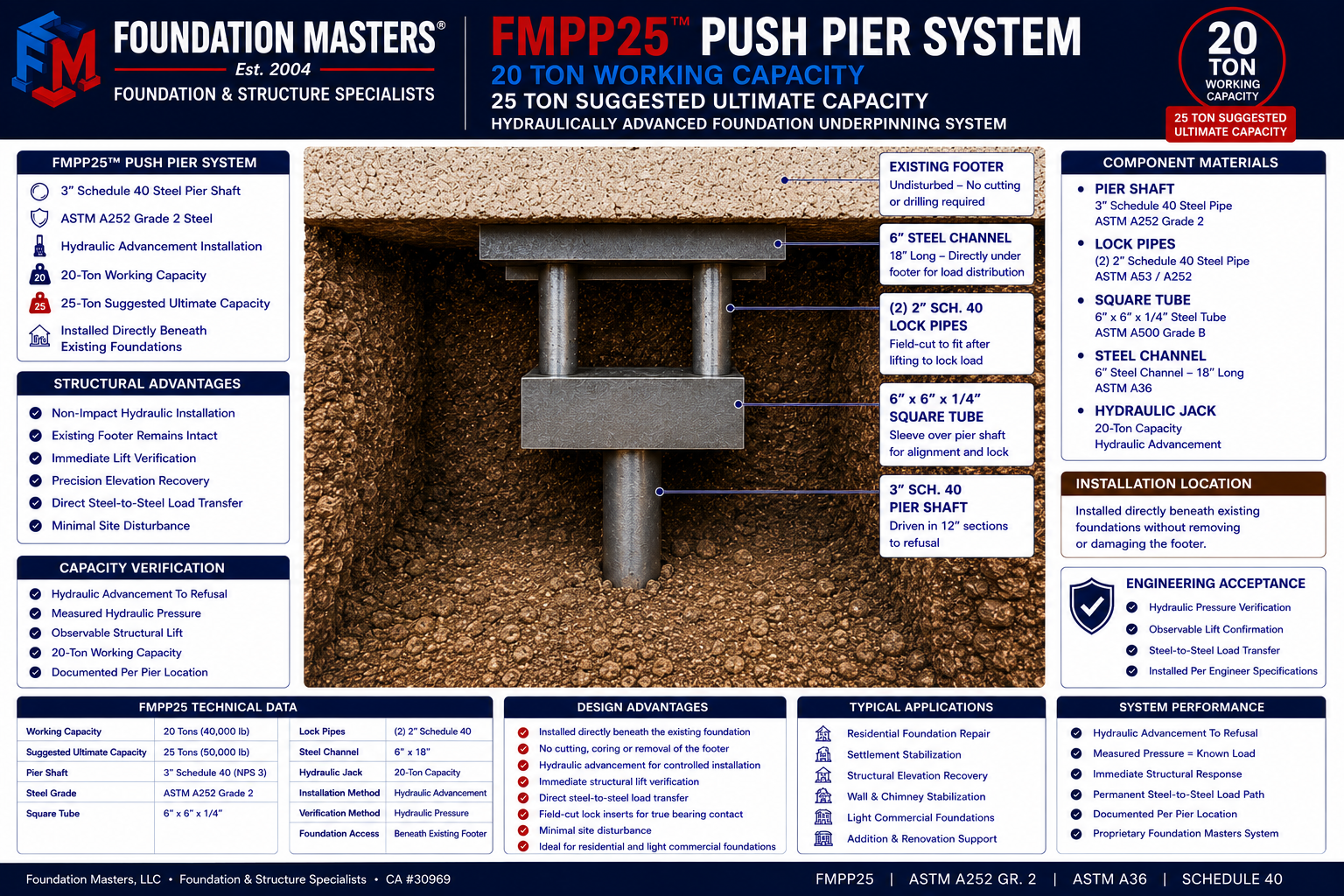
| Foundation Masters system | FM-PP25 push pier | Engineered helical piers |
When Push Piers Are the Better Choice
Push piers are usually the first choice for an existing, reasonably heavy house that is settling on deep soft soil, which describes a lot of Florida. The weight of the house drives each pier until it reaches firm bearing, and the installation pressure proves the capacity of every pier. They can also lift a settled house back toward level. See how push piers work and our FM-PP25 push pier.
When Helical Piers Are the Better Choice
Helical piers do not need the weight of a house, so they work where push piers cannot: new construction, additions, pool houses, decks, porches, light slabs and anything that must resist uplift. They install quietly without vibration, which matters on finished properties. See helical piers Florida and our local pages for Tampa, Orlando, Miami and Jacksonville.
When Neither Is the Right Answer
Some sites need something else. Where installation force would crack a light footing, the driven FM-PP30 pipe pile puts no load into the house. Where limestone is shallow or access is very tight, micropiles drilled into rock may be the answer. Heavier structures move up to the FM-PP45 and FM-PP100. Industry guidance on both pier types is published by the Deep Foundations Institute, and Florida code requirements are set by the Florida Building Commission.
Lifetime Transferable Warranty
Our pier and pile systems are backed by the Foundation Masters Lifetime Transferable Warranty for the life of the structure. That includes push piers and helical piers alike.
Push Piers vs Helical Piers: Frequently Asked Questions
What is the difference between push piers and helical piers?
A push pier is pressed into the ground using the weight of the house as the reaction. A helical pier has spiral plates and is screwed into the ground with torque. Push piers rely on the structure being heavy; helical piers do not, so they also work for light structures and new construction.
Which is better, push piers or helical piers?
Neither is better everywhere. Push piers are usually the first choice for heavy existing homes settling on deep soft soil. Helical piers win on light structures, new construction, additions and tension loads. The soil and the structure decide, which is why an engineer should make the call.
Are helical piers more expensive than push piers?
Often, per pier. National price guides commonly show helical piers costing more per pier than steel push piers. The total project cost depends on how many piers and how deep, so a design with fewer, better placed piers can close the gap.
Can helical piers be used for new construction?
Yes. Helical piers can be installed before the building exists because they do not need the weight of the structure to drive them. Push piers cannot.
Do helical piers work in Florida limestone?
Helical piers screw through soil but cannot screw into solid rock. Where limestone is shallow, push piers, driven pipe piles or drilled micropiles are usually used instead.
Not Sure Which System Your House Needs?
Tell us about the structure and the movement, or send the proposal you already have. Our engineers will recommend the system that fits, even if it is not the one you were quoted.
Call 813-614-1718Or send the proposal, photos and any reports through the contact page.