
Micropile Requirements in Florida
The micropile requirements in the Florida Building Code, why micropiles are not an exception to the 8-inch pipe rule, and the grout and reinforcement requirements that decide whether a small diameter element qualifies as one at all.
The Short Answer
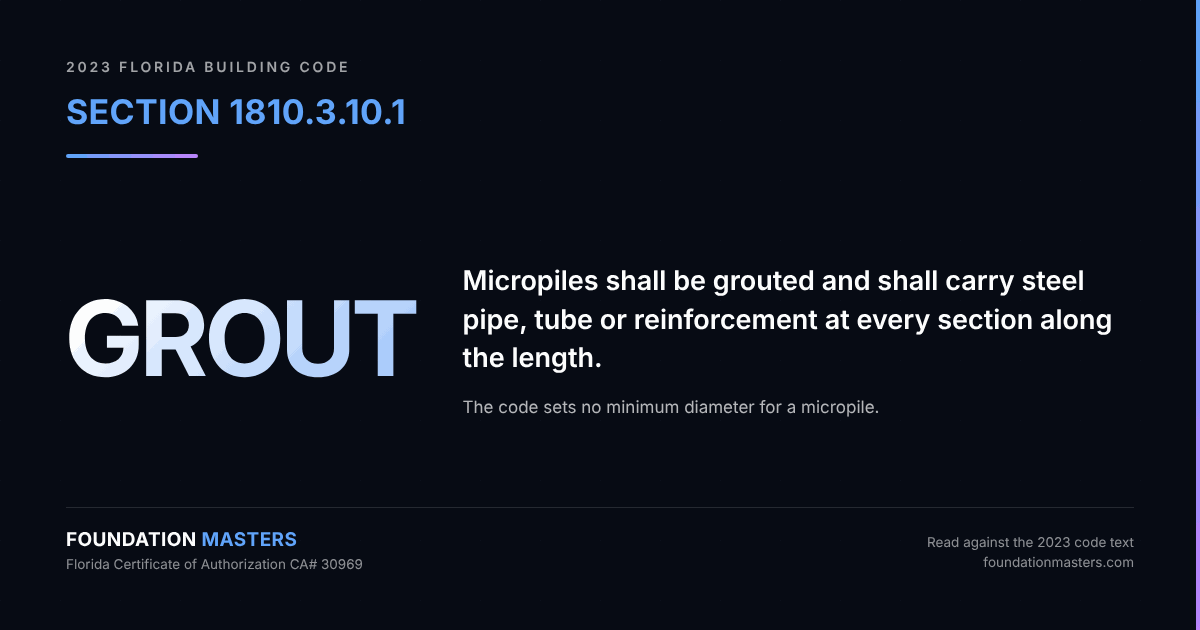
Yes. Section 1810.3.10.1 of the 2023 Florida Building Code states that micropiles shall be grouted and shall have either a steel pipe or tube or steel reinforcement at every section along the length. Grout is not optional and it is not a detailing preference.
The code states no minimum diameter for a micropile, which is why a small diameter element can sometimes be used where the 8-inch minimum in Section 1810.3.5.3.4 would otherwise bar it. That is not an exception clause. A micropile is a separate element type with its own section, and whether a given element qualifies is a determination for the engineer of record and the building official.
The micropile requirements in Section 1810.3.10.1
Two things are doing the work in that sentence. The first is the bond zone: a micropile carries load through grout to ground bond along its length, not by end bearing on a driven tip. The second is continuity: steel at every section, with grout around it, for the whole length.
Micropiles shall develop their load-carrying capacity by means of a bond zone in soil, bedrock or a combination of soil and bedrock. Micropiles shall be grouted and have either a steel pipe or tube or steel reinforcement at every section along the length.
Florida Building Code 2023, Eighth Edition, Section 1810.3.10.1
Micropile requirements for materials, Section 1810.3.10.2
Note the allowable stress line. Micropiles get 0.4 Fy, which sits between the 0.35 Fy default for other pipes and tubes and the 0.5 Fy available where justified under Section 1810.3.2.8.
Micropile requirements versus a small pipe pile: the distinction that matters
This is the question that brings most people here, and it usually arrives at plan review. A small diameter steel pipe is not a micropile because somebody writes micropile on the drawing. The classification follows the element and how it carries load.
| Driven steel pipe pile | Micropile | |
|---|---|---|
| Governing section | 1810.3.5.3.4 | 1810.3.10 |
| Minimum diameter | Nominal outside diameter not less than 8 in | None stated in the code |
| How it carries load | Driven to end bearing on competent stratum, with shaft friction | Bond zone in soil, bedrock or both |
| Grout | Not required | Required |
| Steel along the length | The pipe itself | Pipe or tube, or reinforcement, at every section |
| Allowable stress | 0.35 Fy, or 0.5 Fy where justified | 0.4 Fy |
| Installation | Driven | Drilled and grouted |
A grouted, drilled, bond-zone element is a micropile. A small driven pipe is a small driven pipe, and Section 1810.3.5.3.4 applies to it.
Where micropile requirements are genuinely the right call
Restricted access
Low headroom, interior work, or a site a driving rig cannot reach. Micropile equipment is small and the element is installed in short sections.
Adjacent to sensitive structures
Drilling and grouting avoids the ground movement that driving can transmit through soft ground to a neighbouring foundation.
Irregular rock profile
Where the bearing surface is steeply sloping or pinnacled limestone, a bonded element in a drilled socket can be more reliable than chasing refusal with a driven tip.
Tension and lateral demand
The continuous reinforcement and the bond along the length suit uplift and combined loading in a way a driven open pipe does not.
When micropile requirements point the other way
Micropiles are slower and more expensive per element than driven pipe, and they depend on grout quality and bond that are harder to verify in the field than a refusal criterion you can watch.
Where the site is open, the rig can reach, and there is competent limestone to drive to, a driven pipe pile at 8 inch nominal or larger is usually the faster and more verifiable answer. The right question is not which element is better, it is which one suits the ground and the access.
Micropile Requirements Questions
Do micropiles have to be grouted in Florida?
Yes. Section 1810.3.10.1 of the 2023 Florida Building Code states that micropiles shall be grouted and have either a steel pipe or tube or steel reinforcement at every section along the length.
Is there a minimum diameter for a micropile?
The code states no minimum diameter for micropiles. That is different from steel pipes and tubes used as deep foundation elements, which must be at least 8 inches nominal outside diameter under Section 1810.3.5.3.4.
Are micropiles an exception to the 8-inch pipe rule?
Not as a written exception. Section 1810.3.5.3.4 contains no exception clause. Micropiles are a separate element type with their own section, so the 8-inch requirement does not reach them. Whether a particular small element qualifies as a micropile is a determination for the engineer of record and the building official.
What steel does a micropile need?
Section 1810.3.10.2 allows reinforcing bars conforming to ASTM A615 Grade 60 or 75, or ASTM A722 Grade 150. Steel pipe or tube must have a minimum wall thickness of 3/16 inch and a minimum yield strength of 45,000 psi.
What allowable stress applies to a micropile?
Table 1810.3.2.6 gives pipes or tubes for micropiles 0.4 Fy, capped at 32,000 psi.
Can I call a small driven pipe a micropile to get around the diameter rule?
No. A micropile develops capacity through a grouted bond zone and must be grouted with steel at every section. A driven pipe that is not grouted and carries load by end bearing is governed by Section 1810.3.5.3.4 whatever it is labelled.
Micropile Requirements or a Driven Pile?
Send us the access constraints, the loads and the geotechnical report. We install both, so the recommendation you get is about your ground rather than about what is on our yard.
(813) 614-1718