
Structural Engineer West Palm Beach
Palm Beach County sits one county line north of the High Velocity Hurricane Zone and gets none of its provisions. What it does not get is a pass on the exposure. The coast here is squarely inside the wind borne debris region, and the ground underneath the county runs from cemented coquina limestone at the ocean to organic soil out by the lake that is measurably lower than it was a century ago.

Outside the Zone, Not Outside the Exposure
The most common engineering mistake in Palm Beach County is treating it as a milder version of Broward. It is not a milder version of anything. It is a different code path over completely different ground.
A project here runs the general statewide provisions of the Florida Building Code rather than the High Velocity Hurricane Zone provisions, which changes the product approval route and the evidence a submittal has to carry. At the same time the ocean front and the Intracoastal corridor are inside the wind borne debris region, so opening protection and pressure design are not optional. And the ground problem changes three times between the beach and Lake Okeechobee.
Where We Come In
- New residential and commercial construction across Palm Beach County
- Wind and load-path design on the statewide code path, not the HVHZ path
- Foundation design on coquina limestone, deep sand and organic soils
- Deep foundations and earth retention for below grade and waterfront work
- Structural evaluation of cracking, settlement and distress
- Milestone inspection support on aging oceanfront and Intracoastal mid rise
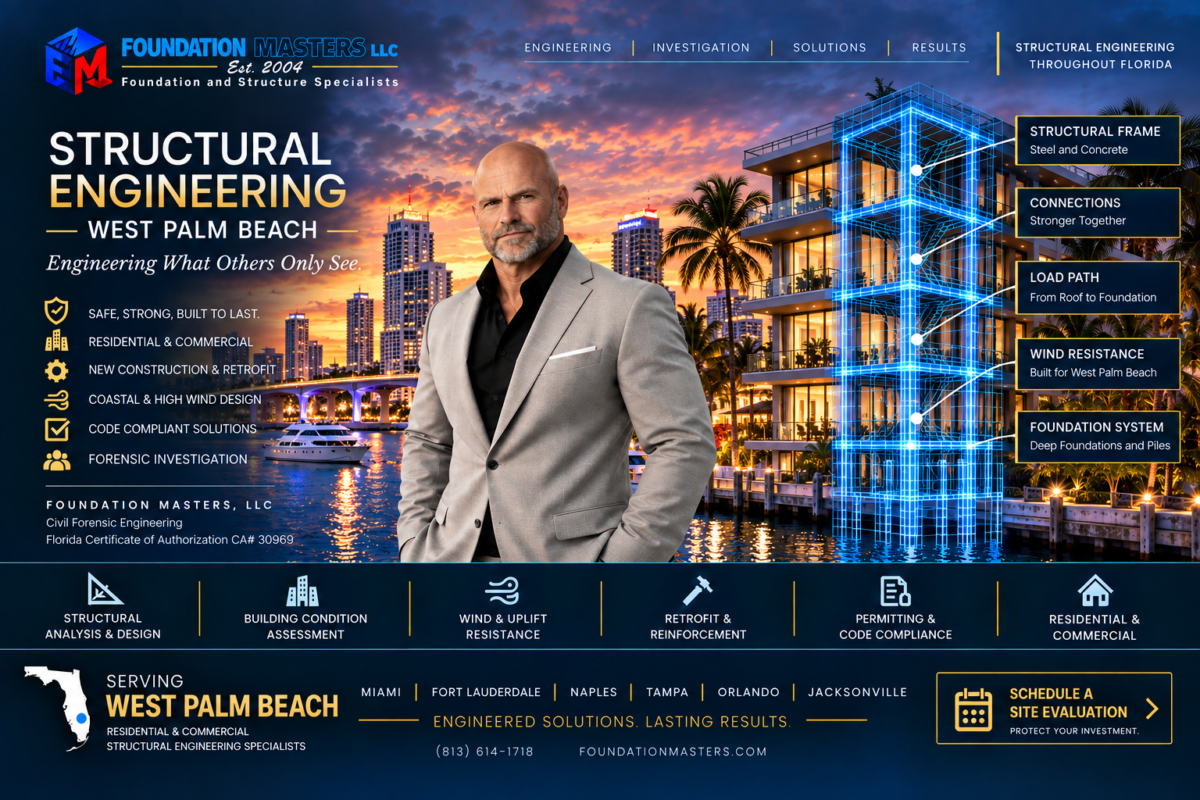
The County Line Ends the Zone. It Does Not End the Debris Region.
The High Velocity Hurricane Zone covers Miami-Dade and Broward counties only. The Palm Beach County line at the Broward border is where those provisions stop. North of it, projects follow the general statewide provisions of the Florida Building Code, with the statewide product approval path rather than the separate approval protocols used inside the zone.
That is a real difference and it is worth understanding, because it changes what documentation a submittal needs. What it does not change is the wind. The Florida Building Commission publishes the Risk Category IV design wind speeds inside the zone as one hundred ninety five miles per hour for Miami-Dade County and one hundred eighty five miles per hour for Broward County. Palm Beach County is the next county up the same coastline. Nothing about a county boundary calms the air above it.
The wind borne debris region is defined separately from the zone, and it is the definition that actually governs opening protection here. Under the current code, referencing ASCE 7-22, a wind borne debris region is an area within a hurricane prone region either within one mile of the mean high water line where an Exposure D condition exists upwind at the waterline and the ultimate design wind speed is one hundred thirty miles per hour or greater, or anywhere the ultimate design wind speed is one hundred forty miles per hour or greater.
What That Definition Means on a Real Parcel
- There are two independent tests, and satisfying either one puts the building in the debris region. Failing the first does not get you out of the second.
- The one mile test depends on an Exposure D condition upwind at the waterline, which exists where flat terrain and water prevail upwind for at least five thousand feet.
- The second test has no distance in it at all. Where the ultimate design wind speed reaches one hundred forty miles per hour, the debris region applies regardless of how far inland the parcel sits.
- Inside the debris region, glazed openings need impact resistant protection or the structure has to be designed for a breached envelope, which is a different and usually more expensive structure.
- We run both tests against the actual parcel and risk category rather than assuming from the address, because the answer is what drives the opening schedule and the lateral system.
And the Coastal Line on Top of It
The Palm Beach County ocean front also carries the state coastal construction control line, established under section 161.053, Florida Statutes. Seaward of it, Section 3109 of the Florida Building Code governs the foundation directly. The structure has to be elevated and supported on piles or columns, shallow foundations and stemwalls are not permitted, and the design ratio of pile spacing to pile diameter is not to be less than eight to one for individual piles.
All major structures seaward of that line are required to be designed to resist the predicted forces associated with a one hundred year storm event, and a professional engineer or architect registered in Florida has to certify to the local building official that the plans follow Section 3109.
The Six Variables, Filled In for Palm Beach County
Every structural engineering problem in Florida is the same six variables holding different values. Palm Beach County is the widest spread of those values inside a single county anywhere we work.
Wind, Exposure, and the Zone Next Door
- Ultimate design wind speed. High on the southeast coast, and Palm Beach County is on the same coastline as the two counties that make up the High Velocity Hurricane Zone. We pull the value for the actual parcel and risk category from the current code maps rather than quoting a county figure, because design pressure rises with the square of speed.
- High Velocity Hurricane Zone. Palm Beach County is not in it. That zone is Miami-Dade and Broward only. The county follows the general statewide code path, which changes the product approval route and the testing evidence a submittal has to carry.
- Exposure category. Ocean frontage on the barrier island and the wide open Intracoastal both produce open water exposure. Move into the built up grid west of Flagler Drive and the exposure drops. Out in the agricultural west, flat open terrain brings the exposure question back for a different reason.
Water, Age, and What Is Under the Slab
- Flood zone. Coastal high hazard on the ocean side, a different flood problem along the Intracoastal and the C canals, and a managed water system out west. The substantial improvement threshold decides whether a renovation stays a renovation or becomes a full code upgrade.
- Milestone inspection. Under section 553.899, Florida Statutes, residential condominium and cooperative buildings of three habitable stories or more get a first milestone inspection at thirty years of age, which a local enforcement agency may pull forward to twenty five years where conditions such as proximity to salt water warrant it, then every ten years after. One to four family dwellings with three or fewer habitable stories are exempt.
- Soil and foundation type. This is the variable that separates Palm Beach County from everywhere else. Cemented coquina limestone near the ocean, deep sand in the middle of the county, and deep organic soil in the west. Three different foundation problems under one county commission.
Structural Engineering Services in West Palm Beach
The same six services we provide across Florida, described in the terms a Palm Beach County project actually runs into.
Structural Design and Drawings
Signed and sealed structural engineering drawings for new construction, additions and remodels, on the statewide code path and built to the criteria for the specific parcel.
Wind and Envelope Design
Debris region testing, opening protection strategy and lateral system design, so the envelope decision and the structure agree with each other rather than fighting at plan review.
Foundation Design and Installation
Deep foundation systems designed and driven by the same company, which in a county with three distinct soil regimes is the difference between a specified pile and a suitable one.
Geotechnical Investigation
Soil borings and geotechnical engineering to establish whether the site is on coquina, on sand, or on organic soil that will keep losing volume.
Structural Evaluation
Investigation of cracking, settlement, corrosion and distress, with a written engineering opinion on cause and a repair scope that addresses the cause.
Civil and Site Engineering
Civil engineering for grading, drainage and site work across a county whose water is managed by canal from the lake to the ocean.
Three Different Grounds Between the Ocean and the Lake
Most Florida counties have one soil story. Palm Beach County has three, and they are separated by miles rather than by feet. A firm that designs a foundation here off a regional assumption is guessing about which third of the county it is in.
Near the ocean sits the Anastasia Formation. In Palm Beach and Martin counties it is a sandy coquinoid limestone, and the ratio of quartz sand to shell fragments varies by outcrop. The rock ranges from a coarse grained shell fragment limestone to a sandstone, and it hardens at the surface when exposed to the atmosphere. It rarely extends more than about three miles inland from the Intracoastal Waterway, which is almost exactly the strip that holds West Palm Beach, Palm Beach and the barrier island communities.
West of that strip the county runs into deep sand, then into the organic soils of the agricultural area near Lake Okeechobee. Those organic soils are the most unusual foundation condition in the state. A subsidence marker installed at a research station in the agricultural area in 1924 was nine feet long. By 2009 the soil depth at that site was thirty seven inches. Measured subsidence rates there ran about one and one eighth inches per year from 1924 to 1967, about half an inch per year from 1968 to 2009, and about a quarter inch per year from 2010 to 2019.
The mechanism is well understood. Oxygen penetrates the soil once it is drained, which stimulates aerobic microorganisms that decompose organic matter far faster than the anaerobic organisms in flooded soil. Overall subsidence across the agricultural area has been put at roughly six and a half feet. For a structural engineer the implication is blunt: out there the ground is not a stable datum. It is a material that continues to lose volume, and a shallow foundation on it is a foundation on something that is still leaving.
At the Ocean: Coquina
Variable cementation is the whole problem. The sand to shell ratio changes between outcrops, so the same formation can be rock at one boring and dense sand at the next. Pile refusal depths are hard to predict, cavities and soft seams occur, and corrosion protection is a design decision rather than a coatings decision.
In the Middle: Deep Sand
Usually workable for shallow foundations if the density is real and the water table is respected. The failures we see here are compaction failures and uncontrolled fill, not material failures. Settlement shows up as differential movement across a footprint rather than uniform drop.
In the West: Organic Soil
Highly compressible, with ongoing volume loss from oxidation after drainage. Shallow foundations are generally not the answer. The structure either bypasses the organic layer with deep foundations or the organic material gets removed and replaced under engineered control.
Thirty Nine Municipalities, Plus the County
Palm Beach County states it plainly: there are thirty nine incorporated municipalities within Palm Beach County. Atlantis, Belle Glade, Boca Raton, Boynton Beach, Briny Breezes, Cloud Lake, Delray Beach, Glen Ridge, Golf, Greenacres, Gulf Stream, Haverhill, Highland Beach, Hypoluxo, Juno Beach, Jupiter, Jupiter Inlet Colony, Lake Clarke Shores, Lake Park, Lake Worth Beach, Lantana, Loxahatchee Groves, Manalapan, Mangonia Park, North Palm Beach, Ocean Ridge, Pahokee, Palm Beach, Palm Beach Gardens, Palm Beach Shores, Palm Springs, Riviera Beach, Royal Palm Beach, South Bay, South Palm Beach, Tequesta, Wellington, Westlake and West Palm Beach.
Add unincorporated Palm Beach County and that is forty possible jurisdictions for a project in one county. Several of those municipalities are physically tiny, a few square blocks in some cases, and a parcel can sit inside one without the address suggesting it. The authority having jurisdiction sets the submittal package, the review sequence, the inspection schedule and the local amendments that apply, so getting it wrong is not a formality.
On oceanfront work the Florida Department of Environmental Protection joins the review where the coastal construction control line applies, and the local building official still needs the engineer certification that the design follows Section 3109. Sequencing those reviews so they do not each wait on the other is most of the schedule risk on beachfront work in this county.
Milestone Inspections on the Palm Beach County Mid Rise Stock
Section 553.899, Florida Statutes, requires a milestone inspection of residential condominium and cooperative buildings three habitable stories or more. The first inspection comes at thirty years of age. A local enforcement agency may pull it forward to twenty five years where conditions such as proximity to salt water warrant it. After the first, the cycle is every ten years.
Buildings of one to four dwelling units with three or fewer habitable stories are exempt. That covers most of the single family stock in Palm Beach, El Cid and the Northwood neighborhoods, and almost none of the oceanfront and Intracoastal condominium inventory from Singer Island down through Highland Beach.
A great deal of that inventory went up in the decades Palm Beach County grew fastest, which puts a large share of it at or past the age the statute keys on. Proximity to salt water is exactly the condition the twenty five year provision exists for, and an oceanfront building on the southeast coast is as exposed to chloride as Florida gets.
Corrosion Is the Long Game Here
On the southeast coast the structural problem that eventually arrives is not wind. It is chloride. Salt reaches reinforcing steel, the steel corrodes, corrosion product occupies more volume than the steel it replaced, and the concrete around it spalls. On a balcony edge or a column at the perimeter of a parking level, that sequence is the whole repair history of a building.
The engineering question on an aging oceanfront structure is therefore not whether there is spalling. There will be. It is how deep the chloride front has moved, whether the affected steel has lost section, and whether the member still has the capacity the original design assumed. Those are testing and evaluation questions, and they get answered before a repair scope means anything.
We also design and install sheet piling and handle seawall permitting, which matters on the Intracoastal and the finger canals where the retention holding the ground is part of the structural system whether it was drawn that way or not.
Palm Beach County, Ocean to Lake
Nine areas across roughly fifty miles of county, and the governing variable changes more than once along the way.
Palm Beach and Worth Avenue
Barrier island, open water exposure on both sides, control line jurisdiction on the ocean front, and the highest value residential stock in the county on some of the tightest lots.
Downtown West Palm Beach and Flagler Drive
Mid rise and high rise on the mainland waterfront. Coquina at depth, open water exposure off the Intracoastal, and below grade work that runs into rock and water in the same excavation.
El Cid, Northwood and the Historic Districts
Older single family stock with original foundations that were never engineered for the loads or the additions they now carry, inside districts with their own review overlays.
Singer Island and Riviera Beach
Oceanfront condominium towers reaching milestone age, with chloride exposure on two sides and equipment access limited by causeway and lot geometry.
Jupiter, Juno Beach and Tequesta
The north county coast, three separate municipalities in a short stretch, with inlet proximity and the most active shoreline change in the county.
Palm Beach Gardens and North Palm Beach
Inland from the coquina strip, on sand and managed fill, where settlement and compaction control govern rather than rock or organics.
Delray Beach and Boynton Beach
Dense infill and mixed use redevelopment on constrained downtown lots, where below grade parking, earth retention and adjacent structures become one engineering problem.
Boca Raton and Highland Beach
The south county coast, immediately north of the Broward line and the zone boundary, with heavy oceanfront mid rise and high rise inventory.
Wellington, Royal Palm Beach and the Glades
The agricultural and equestrian west, running out to Belle Glade, Pahokee and South Bay, where organic soil and ongoing subsidence make deep foundations the default rather than the upgrade.
What We Establish Before Drawing
- Which of the forty jurisdictions in this county has authority over the parcel, and which local amendments come with it.
- Both wind borne debris region tests run against the actual parcel, risk category and upwind terrain.
- Coastal construction control line status where the parcel is near the ocean front.
- Flood zone, base flood elevation and the design flood elevation the governing ordinance actually requires.
What the Borings Have to Answer
- Which of the three soil regimes the site sits in, since that single answer changes the foundation type.
- On coquina, the depth and consistency of cementation across the footprint and whether cavities or soft seams are present.
- On sand, real density and fill history, because uncontrolled fill is the most common cause of settlement we investigate here.
- On organic soil, the thickness of the organic layer and the depth to competent bearing material below it.
When a Remodel Stops Being a Remodel
A large share of the structural work in Palm Beach County is renovation, addition and redevelopment rather than new construction on raw land. The coastal strip was built out decades ago and the downtown cores are being rebuilt on themselves. The structural question on that work is rarely how to fix the damage. It is whether the code still lets the building stay what it is.
Federal floodplain management rules define a substantial improvement as work whose cost equals or exceeds fifty percent of the market value of the structure before the work began, and they define substantial damage the same way against the value before the damage. Cross that threshold and the building is treated as new construction, which on an oceanfront parcel can mean elevating the structure and putting it on piles.
Local ordinances may set a stricter threshold than the federal minimum, and the number that governs is the one in the ordinance for the jurisdiction the parcel sits in. With forty possible jurisdictions in this county that is not a footnote. It decides whether the project is a permit or a redesign, and it is worth knowing before a scope gets committed.
Criteria First, Then Drawings
The failures we get called to look at in Palm Beach County are rarely calculation errors. They are criteria errors. A building designed as though being outside the zone meant being outside the debris region. A footing sized off a boring from the sand belt on a site that turned out to be on coquina. A slab out west on organic soil that was treated as a stable datum.
So we settle the criteria before we draw. Jurisdiction. Debris region status by both tests. Control line status. Wind speed for the parcel and risk category. Exposure. Flood zone and design flood elevation. Which soil regime the site is in. Those answers, confirmed against the governing sources, and only then does the structure get designed.
Then we install what we designed. We drive the pipe pile, install the micropiles, build the drilled shafts and set the sheet piling with our own crews and our own equipment. Nothing gets value engineered out of the foundation between the seal on the drawing and the work in the ground, because one company answers for both.
Structural Engineering in West Palm Beach: Common Questions
Is West Palm Beach in the High Velocity Hurricane Zone?
No. The High Velocity Hurricane Zone covers Miami-Dade and Broward counties only, and the Palm Beach County line at the Broward border is where those provisions stop. Palm Beach County projects follow the general statewide provisions of the Florida Building Code, with the statewide product approval path rather than the separate protocols used inside the zone.
If Palm Beach County is not in the zone, do I still need impact protection?
Very likely yes, because opening protection is driven by the wind borne debris region rather than by the hurricane zone, and those are two different definitions. Inside the debris region, glazed openings need impact resistant protection or the structure has to be designed for a breached envelope. We run the debris region test on the parcel before the opening schedule gets set.
What is the wind borne debris region exactly?
Under the current code, referencing ASCE 7-22, it is an area within a hurricane prone region that meets either of two tests. First, within one mile of the mean high water line where an Exposure D condition exists upwind at the waterline and the ultimate design wind speed is one hundred thirty miles per hour or greater. Second, anywhere the ultimate design wind speed is one hundred forty miles per hour or greater. Meeting either one is enough.
What is an Exposure D condition?
It exists where flat terrain and water prevail in the upwind direction for a distance of at least five thousand feet. On the Palm Beach County ocean front that is the normal condition looking east, and along wide stretches of the Intracoastal it can be the condition looking west as well. It matters because it is one half of the first debris region test and it also drives the design pressures directly.
Does the coastal construction control line apply in Palm Beach County?
Yes, along the ocean front. It is established by the State of Florida under section 161.053, Florida Statutes. Seaward of it, Section 3109 of the Florida Building Code requires the structure to be elevated and supported on piles or columns, shallow foundations and stemwalls are not permitted, and a Florida registered engineer or architect has to certify to the building official that the design follows Section 3109.
Which building department reviews my West Palm Beach project?
One of forty possibilities. Palm Beach County states that there are thirty nine incorporated municipalities within the county, plus unincorporated Palm Beach County. Several are physically very small and a parcel can sit inside one without the address making that obvious. Each sets its own submittal package, review sequence and local amendments, so we confirm jurisdiction at the start.
What soil should I expect in West Palm Beach?
It depends how far from the water you are. Near the ocean and the Intracoastal the Anastasia Formation is present, a sandy coquinoid limestone that rarely extends more than about three miles inland from the Intracoastal Waterway. West of that strip the county runs into deep sand, and further west into deep organic soil. Three regimes, three different foundation answers.
What is coquina and why does it matter to my foundation?
Coquina is rock formed from shell fragments cemented together by calcium carbonate. In Palm Beach County the Anastasia Formation is a sandy coquinoid limestone in which the ratio of quartz sand to shell fragments varies by outcrop, and the material ranges from a coarse grained shell fragment limestone to a sandstone. That variability is the engineering issue. The same formation can behave as rock at one boring and as dense sand at the next, which makes pile refusal depths hard to predict without site specific borings.
Why do foundations out near Belle Glade need special treatment?
Because the ground there is organic soil that is still losing volume. A subsidence marker installed at a research station in the agricultural area in 1924 was nine feet long, and by 2009 the soil depth at that site was thirty seven inches. Measured rates ran roughly one and one eighth inches per year from 1924 to 1967, about half an inch per year through 2009, and about a quarter inch per year from 2010 to 2019. Oxygen reaching drained soil lets aerobic organisms decompose the organic matter. A shallow foundation on that material is founded on something that continues to leave.
Does my Palm Beach County condominium need a milestone inspection?
If it is a residential condominium or cooperative building of three habitable stories or more, yes. Section 553.899, Florida Statutes, sets the first milestone inspection at thirty years of age, and a local enforcement agency may require it at twenty five years where conditions such as proximity to salt water warrant it. After the first, the cycle is every ten years. One to four unit buildings with three or fewer habitable stories are exempt.
My oceanfront building has spalling concrete. What does that mean?
Usually chloride induced corrosion of the reinforcing steel. Salt reaches the steel, the steel corrodes, and the corrosion product takes up more volume than the steel it replaced, which breaks the concrete cover off from the inside. The real questions are how deep the chloride front has moved, whether the steel has lost section, and whether the member still has the capacity the design assumed. Those get answered by testing and evaluation before a repair scope means anything.
Do you install the foundations you design?
Yes. Foundation Masters is an engineering firm and a deep foundation contractor in the same company. We design the structure and the foundation, and our own crews drive the pipe pile, install the micropiles, build the drilled shafts and set the sheet piling. It closes the gap between what was engineered and what got installed, which is where a large share of foundation problems start.
Palm Beach County and the Southeast Coast
The rest of what we do in Palm Beach County and down the southeast coast.
Luxury New Construction in Palm Beach
Structural and foundation engineering for high end new construction in Palm Beach, where the criteria and the finish level both run at the top of the market.
Palm Beach new construction190 SE 2nd Avenue, Delray Beach
A mixed use project in downtown Delray Beach with below grade parking, where earth retention, foundation and structure had to be solved as one problem.
Delray Beach projectStructural Engineer Fort Lauderdale
The next county south, inside the High Velocity Hurricane Zone, with a county seawall elevation standard on top of it.
Fort Lauderdale structural engineeringStructural Engineer Miami
The other half of the zone, where the county line is a code line and the limestone sits within a few feet of the surface.
Miami structural engineeringDrainage and Waterproofing Fort Lauderdale
Below grade waterproofing and site drainage on the southeast coast, where the water table and the structure are the same conversation.
Southeast coast drainage and waterproofingGeotechnical Engineering
Borings and subsurface investigation, which in a county with coquina, sand and organic soil is not an optional line item.
Geotechnical engineering FloridaSeawalls and Marine Structures
Design, permitting and installation of seawalls and bulkheads on Intracoastal and finger canal lots in Palm Beach County.
Seawall contractorPile Driving and Deep Foundations
The installation side of the business, including pipe pile, micropiles, drilled shafts and sheet piling driven by our own crews.
Pile driving contractorsStatewide Structural Engineering
The Florida hub page, with the full service list and every market we cover across the state.
Structural engineering FloridaTalk to a Structural Engineer About Your Palm Beach County Project
Tell us the address and the scope. We will establish the jurisdiction, the debris region status, the control line status and which soil regime the site is in, and tell you what the project actually requires before you spend money designing the wrong thing.
Foundation Masters, LLC
Structural engineering, geotechnical engineering and deep foundation installation in West Palm Beach, Palm Beach, Jupiter, Boca Raton and Palm Beach County.
Phone: 813-614-1718
Service area: West Palm Beach, Palm Beach, Singer Island, Riviera Beach, Palm Beach Gardens, Jupiter, Juno Beach, Tequesta, Lake Worth Beach, Delray Beach, Boynton Beach, Boca Raton, Wellington, Belle Glade and all of Palm Beach County.