
Drainage and Waterproofing Tampa
Foundation Masters provides homeowners, condominium boards and commercial property managers in Tampa with engineer designed solutions to stop flooding, water intrusion, hydrostatic pressure and soil erosion.
The City of Tampa explains its own flooding in one sentence: due to the lack of topographic relief, it is difficult for water to quickly drain from the land. That sentence is the whole problem, and it is why a drain alone often fails here.
We are a licensed Florida engineering firm and a repair contractor in the same company, and we were the first engineering firm to pioneer the waterproofing industry in Florida. Qualifying work carries a lifetime transferable warranty.
Contractor Execution With Engineering Behind It
Foundation Masters is a licensed Florida engineering firm, CA# 30969, and a repair contractor. We work throughout Tampa and Hillsborough County on single family homes, townhomes and duplexes, condominium and association owned buildings, and commercial property from strip retail to warehouse and industrial sites.
The work is usually standing water that will not leave, moisture coming up through a slab, hydrostatic pressure against below grade concrete, soil washing out from under a slab edge or a driveway, parking lot drainage that has stopped functioning, or the water half of a problem somebody has already been told is a foundation problem.
The difference is not the trench or the membrane. The difference is deciding what is actually wrong before anything is installed. We pair contractor work with in house civil engineering in Tampa, geotechnical engineering and structural engineering, so the diagnosis, the sealed design and the installation come from one accountable party rather than three.
Tampa is an incorporated city with its own stormwater department, and outside the city limits the work is reviewed by Hillsborough County. Where a site discharges to a regulated system, the Southwest Florida Water Management District becomes part of the conversation as well.
- Licensed Florida engineering firm, CA# 30969, with contractor execution in the same company, so nobody waits on a third party for a sealed drawing.
- The first engineering firm to pioneer the waterproofing industry in Florida, which is a different starting point from a landscaping crew selling trench work.
- The Seal Tight Waterproofing System, engineered for coastal hydrostatic pressure rather than adapted from a basement product designed for a climate Florida does not have.
- We tell you when the answer is drainage and not foundation repair in Tampa, which costs us the larger job and is the right call more often than the industry admits.
- Soil borings and subsurface investigation, because the depth of the water table decides whether a drain can discharge at all.
- Engineered discharge design rather than a pipe that ends somewhere hopeful, including sump and pumped discharge where gravity will not do it.
- Commercial and parking lot capability, including catch basin rebuilds, storm pipe replacement and subgrade stabilization.
- Sheet piling cutoff walls in the same company where groundwater control demands them.
- Lifetime transferable warranty on qualifying work. Full terms on our warranties page.
Why Drainage and Waterproofing in Tampa Is So Critical
Tampa sits on a coastal plain around Tampa Bay with very little natural fall and shallow groundwater across a great deal of the city. Normal annual rainfall at Tampa International Airport is 49.48 inches, and nearly two thirds of that arrives between June and September. August alone normally delivers just over nine inches. Summer storms here are not spread evenly across a week. They are concentrated, intense, and they land on ground that is already wet.
The City of Tampa is unusually direct about what follows. In its own guidance to residents it attributes the most frequent flooding in the city to rainfall, and explains that due to the lack of topographic relief, it is difficult for water to quickly drain from the land. It also notes that localized tidal flooding occurs along Bayshore and in the Westshore area of the peninsula. That is a municipality telling you plainly that the constraint is not how much water falls. The constraint is where it can go.
Underneath all of it is the surficial aquifer. The Southwest Florida Water Management District describes it as the uppermost unconfined aquifer, composed primarily of unconsolidated sand and sometimes clay and shell, and notes that in the northern part of the District the confining clay is thin and discontinuous, so the water table often lies in direct connection with the Upper Floridan aquifer beneath it. Unconfined means the top of that groundwater is free to rise. After a wet week it does, and on a low lot it can come up to meet the bottom of a slab.
The model code has an answer for this, and Florida houses never trigger it. Section R405 of the International Residential Code requires a foundation drain around concrete and masonry foundations, and the detail it specifies is a real system: gravel or perforated pipe set at or below the top of the footing, the gravel extending a foot beyond the footing and six inches above it, the whole assembly wrapped in an approved filter membrane, discharging by gravity or mechanical means into an approved drainage system. But R405 applies only where a foundation both retains earth and encloses habitable or usable space below grade. A Florida house on a slab has no below grade space, so none of it is required, and almost none of it gets built.
What Florida asks for instead is grading. Section R401.3 requires the grade to fall a minimum of six inches within the first ten feet from the foundation, with impervious surfaces sloping at least two percent away. That is a rule about the yard, not the slab, and it says nothing about how to keep water out of concrete.
Then there is the part almost nobody knows. Outside a flood hazard area, the Florida Building Code sets no minimum finished floor elevation above adjacent grade at all, and elevation certification is required only inside flood hazard areas. In a flood zone the lowest floor has to reach base flood elevation plus one foot under R322.2.1, and an elevation certificate has to be submitted when the lowest floor is placed and again at final inspection. Outside one, nobody measures how high your slab sits, because there is no inspection step that would catch it.
So lots get scraped flat and slabs get poured close to grade. It is faster, it is cheaper, and it is entirely legal. Then the wet season arrives, the water table rises to meet the underside of the slab, and moisture comes up through the concrete, damages finishes and accelerates structural deterioration. That is not a construction defect in the legal sense. It is a house built exactly to a code that never asked the question, and it is happening across Hillsborough County right now.
Before you spend anything, check what flood zone you are actually in, using the FEMA Flood Map Service Center or Hillsborough County Find My Flood Zone. It changes what is worth doing and it changes what your insurer will say about it.
Investigation & Diagnosis
Site survey and grade check, moisture testing at the slab, groundwater depth, review of the existing storm system, and a written engineering opinion that names the mechanism before anybody quotes a trench.
Engineered Drainage
Collection, conveyance and a discharge point that has been verified to work, including sump and pumped discharge where the water table or the outfall elevation rules out gravity.
Below Grade Waterproofing
The Seal Tight Waterproofing System applied to below grade concrete and footings, so the slab and the wall are decoupled from groundwater rather than merely surrounded by a pipe.
There Are Two Water Problems, Not One.
This page is called drainage and waterproofing because those are two different jobs solving two different problems, and confusing them is the most expensive mistake a Tampa property owner makes with water.
The first problem is surface water. Rain lands, and it has to leave. That is a question of grade, collection and conveyance, and the honest constraint on it is discharge. A drain is not a place for water to go. It is a path to somewhere lower. On a flat lot over shallow groundwater, with an outfall that may itself be under water at high tide, the path can be missing. That is why yards in Tampa flood with drains already in them, and why the second contractor is often installing a longer version of the thing that did not work.
The second problem is water that is already there. Groundwater rises against the underside and the edge of a slab and pushes. That is hydrostatic pressure and capillary movement through concrete, and no amount of surface drainage touches it, because the water is not arriving from the surface. It is arriving from below. Concrete is not waterproof. It is porous, and it will move moisture through itself steadily and quietly for years.
The two problems produce different symptoms. Standing water, soggy ground and slow draining pavement are surface problems. Buckled wood floors, tile popping loose, mildew odor at the slab edge and efflorescence along a baseboard are below grade problems. A great many Tampa properties have both at once, and most quotes address one of them and price it as though it were the whole job.
So the first thing worth paying for is not a trench. It is somebody establishing which of the two you have, and whether there is anywhere for water to actually discharge. Get that wrong and the work is decorative. Get it right and it is usually permanent.
Parking Garage Waterproofing in Tampa
A below grade parking level is the hardest waterproofing problem in the city, and it is the one most often handled backwards. The structure sits in the groundwater rather than above it, so it behaves less like a building and more like the hull of a boat. Water is pressing against it continuously, and the only question is whether the assembly that was supposed to hold that pressure is still doing it.
Water gets in through a short list of places. Cracks in walls and floor slabs. Grouted tie back penetrations left from the original excavation. Cold joints where the deck meets the wall. Breaches at the termination, where the above grade wall meets the top edge of the waterproofing. And it is made worse from above by the ordinary things nobody looks at, roof leaders discharging to grade beside the structure and back pitched paving that ponds against the wall instead of running away from it.
Downtown Tampa adds a second mechanism on top of that one. Along the Hillsborough River corridor and through the Channel District, the water arriving on a high tide is brackish rather than clean rain. Brackish water carries chlorides, chlorides reach the reinforcement, and corroding steel occupies more volume than the steel it replaced, which cracks and spalls the concrete from the inside. That is how a drainage problem becomes a structural one. We have wrapped columns in carbon fiber at a downtown hotel on the river corridor for exactly that reason, after years of tidal water reaching the lower level. The corrosion was the expensive end of a sequence that started with water.
None of this is getting easier. NOAA projects St. Petersburg reaching roughly 68 high tide flooding days a year by 2050, and Clearwater Beach about 73, against a handful a year recently. A lower level that takes water a few times each wet season now is describing its future, not its worst case.

Two Things Nobody Tells the Owner
The first is that where the water appears inside the garage is frequently not where it got through the assembly. Water travels laterally between the membrane and the concrete before it finds a way in, so the wet column and the actual breach can be a considerable distance apart. Chasing the wet spot is how an owner pays three times for the wrong repair.
The second is that the standard fix treats the symptom rather than the defect. Because excavating to reach the original exterior waterproofing gets called cost prohibitive, the work is done from the dry side instead: epoxy or urethane injected into the cracks, or a crystalline coating brushed onto the inside face. Forensic practice is candid that this addresses where the moisture shows up and leaves the waterproofing deficiency exactly as it was. Water then migrates to the next available path, and the injection gets repeated.
That is why nobody warranties an injection for the life of the structure. You cannot warranty a symptom. If a garage has been repaired repeatedly and still takes water, the repairs were probably not wrong so much as aimed at the wrong side of the wall.
Fix It From the Water Side
We work the positive side, the face groundwater actually touches. Excavate to expose the wall and the footer, establish where the assembly has failed rather than where the stain is, treat that surface with the Seal Tight Waterproofing System, and then engineer the discharge so the structure is not asked to hold back a standing head of water indefinitely. Where the water table or a submerged outfall rules out gravity, that means a designed sump and pumped discharge rather than a pipe pointed hopefully downhill.
Alongside it, the things a wet garage usually also needs: catch basin and trench drain repair, subgrade stabilization, sheet piling cutoff walls where groundwater control demands them, and concrete repair where chlorides have already reached the steel.
There is also a compliance clock. Under Florida Statute 553.899, condominium and cooperative buildings of three or more habitable stories face milestone inspections at 30 years from the certificate of occupancy and every 10 years after, and a garage that is part of such a building sits inside that scope. Waterproofing is separately a named item in the structural integrity reserve study requirements, and for budgets adopted after 31 December 2024 reserves for named items cannot be waived or reduced. Confirm how both apply to your building with your association counsel.
Corrected properly from the water side, the work carries a lifetime transferable warranty. If you want the structure assessed rather than the water stopped, that is a different service and it lives on our parking garage inspection in Tampa and high rise building inspection pages.
Tampa and Hillsborough County
On flat ground the useful distinction is not the neighborhood name. It is what the water is doing where you are, and whether the ground beneath you sends it down, holds it, or hands it back.
South Tampa, Bayshore & the Interbay Peninsula
Bayshore, Hyde Park, Davis Islands, Palma Ceia, Ballast Point and the peninsula down to MacDill.
Low elevation, tidally influenced groundwater, and outfalls that can be submerged at high water. This is where discharge is the binding constraint and where a gravity drain is most likely to need a pumped alternative. See Hyde Park and Davis Islands.
Downtown, Ybor & the River Corridor
Downtown, Channel District, Ybor City, Tampa Heights and Seminole Heights along the Hillsborough River.
Older building stock on shallow footings, a high proportion of impervious surface, made ground in the historic port and industrial areas, and river stage as a factor in what a storm system can accept. See Ybor City and Seminole Heights.
Westshore, Town N Country & the West Side
The Westshore business district, Town N Country, Carrollwood and the commercial corridors on the western side of the city.
Large parking fields, aging storm infrastructure, localized tidal flooding noted by the city in the Westshore area, and the parking lot drainage and subgrade work that goes with retail and office property at scale.
Brandon, Riverview & Eastern Hillsborough
Brandon, Riverview, Apollo Beach, FishHawk, Plant City and the unincorporated county east and south of the city.
County review rather than city, more karst influence inland, and sites where water disappearing rather than standing is the thing worth investigating. See Hillsborough County and Apollo Beach drainage.
Signs You Need Drainage and Waterproofing in Tampa
- Standing water or soggy yards after storms.
- Buckled wood floors or tile popping from slab moisture.
- Water stains or efflorescence along baseboards and walls.
- Mildew odor or visible mold near slab edges.
- Driveway or parking lot flooding that drains slowly.
- Cracking or settlement that appeared after a wet season, which may be a foundation repair question as well as a drainage one.
- Carpet or flooring adhesive failing in one area of a room and nowhere else.
- A drain, French drain or sump that was installed and did not fix the problem.
- Soil washing out from beside a driveway, a walkway, a pool deck or a slab edge.
- Downspouts discharging within a few feet of the foundation, or gutters that overflow in every storm.
- A catch basin or storm inlet on the property that ponds rather than accepts water.
- Anything an inspector, insurer, adjuster or buyer has flagged as a moisture or drainage issue.
Soil leaving the site is the one to act on quickly. Water that stands is a nuisance. Water that moves is carrying your lot with it, and it does not stop on its own.
Our Proven Tampa Waterproofing and Drainage Solutions
Foundation Masters developed the first true engineered waterproofing system in Florida to solve these issues. The process is:
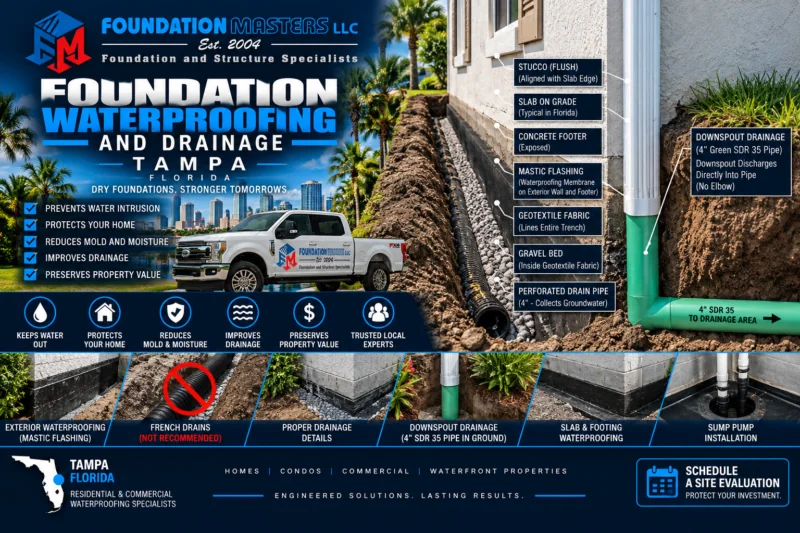
- Excavating a trench roughly twelve inches below the slab edge to expose the footer and the wall.
- Applying the Seal Tight Waterproofing System to protect below grade concrete and footings.
- Designing engineered drainage piping or sump discharge to redirect water away from the structure and the underlying soils, to a discharge point that has been verified.
- Installing gutters and grading corrections to control surface runoff at the source.
Alongside that, depending on what the investigation finds: catch basin and storm pipe repair, subgrade stabilization, compaction and pressure grouting where washout has left voids, sheet piling cutoff walls for groundwater control, retaining wall work in Tampa where grade has to be held, and coordination with house leveling or structural repair where movement has already happened.
This stops moisture intrusion, prevents soil washout and reduces settlement risk under Tampa properties. Where the ground has already moved, our foundation repair team in Tampa handles the structural side of the same problem.
Common Questions About Drainage and Waterproofing in Tampa
Why does my yard flood even with drains installed?
The flat terrain in Tampa and episodically high groundwater mean that after heavy rain or high tide, soils saturate and drains cannot empty because groundwater is already near the surface. A drain is a path to somewhere lower, not a place to store water. If there is nowhere lower that is not already full, the drain fills from below and does nothing.
Why is my slab letting moisture through?
Many older homes were built with slabs at or near grade. When storms drop several inches of rain quickly, the water table can rise and contact the slab, degrading vapor barriers and wicking moisture through concrete. Concrete is porous. Without a functioning barrier beneath it and protection at the edge, it will move moisture upward continuously.
Can you waterproof an existing home in Tampa?
Yes. Our Seal Tight System is engineered for coastal hydrostatic pressure to keep slabs dry. On an existing house the work is done from outside, by excavating to expose the footer and the below grade wall, treating that surface, and then handling the water that will keep arriving.
Does tidal water in Tampa Bay affect my property?
High tides can raise nearby groundwater and reduce infiltration. Properly engineered drainage and waterproofing decouple the slab from groundwater pressure and route water to safe discharge. The City of Tampa also notes localized tidal flooding along Bayshore and in the Westshore area of the peninsula, so on low lying property the tide is a design condition rather than a curiosity.
Do you handle commercial parking lot drainage problems?
Absolutely. We repair and retrofit catch basins, storm pipes, and subgrade failures for retail centers, HOAs, and industrial facilities across Tampa and Hillsborough County. See our parking lot drainage services.
Where can I check my property flood risk?
Use the FEMA Flood Map Service Center or the Hillsborough County Find My Flood Zone tool. Both are free and take a few minutes.
Do I have a drainage problem or a foundation problem?
Frequently both, and the order matters. Water that removes soil causes movement, and movement produces cracking that looks structural because it is. But underpinning a structure while water keeps taking the soil out from under the rest of it is an expensive half measure. We establish which mechanism is running before recommending either, and we would rather tell you the answer is drainage than sell you a pier scheme you did not need.
What is the Seal Tight Waterproofing System?
It is our engineered below grade waterproofing system, developed for Florida conditions rather than adapted from a product designed for northern basements. It is applied to below grade concrete and footings after excavation exposes them, and it is intended to resist hydrostatic pressure rather than simply shed incidental moisture.
Do you install French drains?
No, and we are direct about why. A French drain trenched into a Florida lot frequently sits in the water table rather than above it, which means the pipe is already full before the first storm arrives. A pipe sitting in groundwater is not carrying anything anywhere. It only works if there is a genuine outfall lower than the pipe so it can daylight, or if it is mechanically pumped. Those are the only two options, and the model code says the same thing when it requires foundation drainage to discharge by gravity or mechanical means. On most flat Tampa lots the gravity option does not exist, so we establish the discharge first and let that decide the system, rather than burying pipe and hoping.
Is there a vapor retarder under my slab?
On an older Tampa house, quite possibly not, or not one still doing anything. Modern practice is a sheet meeting ASTM E1745, which caps water vapor permeance at 0.1 perms, and the 2021 International Residential Code raised the residential requirement to a minimum ten mil Class A sheet with six inch lapped joints. Houses built before that thinking took hold may have a thin sheet that was punctured during construction, or nothing at all. It is not something you can retrofit under an existing slab, which is why the work is done at the edge and below grade instead.
What does the Florida Building Code require for site drainage?
Section R401.3 requires grade to fall at least six inches within the first ten feet from the foundation, with impervious surfaces sloping at least two percent away from the building. That governs the site. Florida has no prescriptive waterproofing code for a slab on grade the way northern codes do for basement walls, so the code tells you where to send water and stops short of telling you how to keep it out of concrete.
Is the warranty transferable if I sell the house?
Yes. Qualifying drainage and waterproofing work carries a lifetime transferable warranty, which means the benefit follows the property to the next owner rather than expiring with you. That matters in a market where a buyer inspection will surface a moisture history whether or not you mention it. Full terms are on our warranties page.
Do you work on condominium and association property?
Yes. Association work is a common part of what we do in Tampa, and it usually involves a board that needs a written engineering basis for a decision rather than a sales quote. Waterproofing is also one of the items named in the Florida structural integrity reserve study requirements for residential condominiums of three or more habitable stories, so it is frequently a reserve question as much as a repair question. Confirm applicability with your association counsel.
What does drainage and waterproofing work cost in Tampa?
It varies with the length of wall or slab edge involved, how deep the footer sits, groundwater depth, whether a gravity discharge exists or a pumped system is required, how much soil has already been lost and needs replacing, site access, and the engineering scope. Depth and discharge are usually the two variables that move the number most. We inspect at no charge and give you a written scope rather than a figure over the phone.
Why does my parking garage flood every wet season?
Because a below grade level sits in the groundwater rather than above it, and the wet season raises the water table while the storm system it drains to is already full. If the structure is near the river or the bay, a high tide can also raise groundwater and submerge the outfall the sump was designed to discharge into. The flooding is seasonal because the water table is seasonal, not because the pumps are lazy.
Will a flooding garage show up on an inspection or a reserve study?
Very likely, and increasingly so. Under Florida Statute 553.899, condominium and cooperative buildings of three or more habitable stories face milestone inspections at 30 years from the certificate of occupancy and every 10 years after, and a garage that is part of such a building falls inside that scope. Waterproofing is also a named item in the structural integrity reserve study requirements, and for budgets adopted after 31 December 2024 reserves for named items cannot be waived or reduced. In Miami-Dade the county recertification guidelines go further and ask the engineer directly about groundwater elevation versus floor elevation, leakage, efflorescence and sump pump operability. Confirm how any of it applies to your building with your association counsel.
Parking Lot Drainage and Commercial Waterproofing in Tampa
We repair and retrofit parking lot drainage systems, rebuilding catch basins, replacing storm piping and stabilizing subgrades for shopping centers, associations and industrial sites, including sheet piling cutoff walls where groundwater control demands it.
On commercial property the failure is rarely the pavement. It is the subgrade under the pavement, which fails because water has been sitting in it or moving through it for years. Repaving over that produces a lot that looks correct for two seasons and then repeats. We investigate the subgrade and the storm system before recommending surface work.
Learn more about our parking lot drainage services, our commercial foundation repair work and commercial foundation repair in Tampa.
Engineering Capabilities That Strengthen the Work
This page focuses on drainage and waterproofing in Tampa, but the surrounding disciplines are what let us diagnose a harder site correctly:
- Geotechnical Engineer Tampa
- Civil Engineering Tampa
- Structural Engineer Tampa
- Soil Borings
- Foundation Inspections
- Retaining Wall Contractor Tampa
- Seawall Contractors Tampa
- Flood Asset Protection
- Luxury New Construction Tampa
Planning a new build? Engineered drainage and waterproofing are designed in from day one rather than added after the first wet season.
Related Pages
These pages cover the rest of our drainage and waterproofing work while this page remains our main destination for drainage and waterproofing in Tampa.
Get a Drainage and Waterproofing Inspection in Tampa
Because Florida has no prescriptive waterproofing code for a slab on grade, you need people who understand local soils, a fluctuating water table and coastal pressures, and who will look at the discharge before selling you the collection. Our engineers provide free inspections and permanent solutions backed by a lifetime transferable warranty on qualifying work.
If your yard holds water after every storm, your floors are cupping over a slab, an existing drain has not solved anything, a parking lot ponds where it used to drain, or soil is disappearing from beside a slab edge, start with a diagnosis rather than a product. Call (813) 614-1718 or (656) 233-7089 for direct help with flooding, moisture intrusion or drainage system failure.
Find the Water. Give It Somewhere to Go. Keep It Out of the Concrete.
Whether it is a South Tampa lot that will not drain, a slab moving moisture into finished floors, a Westshore parking field ponding after every storm, an association building with a waterproofing line item in its reserves, or a drain somebody already installed that did not work, Foundation Masters brings contractor execution with engineering behind it.
Built on real diagnosis, technical depth, and clean execution.