
Drainage and Waterproofing Sarasota
Foundation Masters provides homeowners, condominium boards and commercial property managers in Sarasota with engineer designed solutions to stop flooding, water intrusion, hydrostatic pressure and soil erosion.
More than 55 square miles of mainland Sarasota drains through one tidal creek that is 7.2 miles long. That single ratio explains more about flooding here than any soil report will.
We are a licensed Florida engineering firm and a repair contractor in the same company, and we were the first engineering firm to pioneer the waterproofing industry in Florida. Qualifying work carries a lifetime transferable warranty.

Contractor Execution With Engineering Behind It
Foundation Masters is a licensed Florida engineering firm, CA# 30969, and a structural repair contractor. We work mainland Sarasota across the whole of it: the downtown and bayfront towers, the historic neighborhoods near the bayous, the postwar residential grid east of the Trail, the newer subdivisions out toward Fruitville and Bee Ridge, and the commercial, medical and retail property along the main corridors.
The work is usually standing water that will not clear, moisture coming up through a slab, hydrostatic pressure against below grade concrete, structured parking that leaks or floods, catch basins and storm piping that have stopped conveying, subgrade washout under slabs and pavement, or the water half of a problem somebody has already been told is a foundation problem.
This page is about the mainland. Conditions on the keys are genuinely different and each has its own page, so if your property is on Siesta Key, Lido Key, St. Armands Key, Longboat Key or Casey Key, start there. We pair contractor work with in house civil engineering, geotechnical engineering in Sarasota and soil borings, so the design and the installation answer to the same firm.
A licensed Florida professional engineer signs and seals the drawings. Inspections are free.
Signs You Need Drainage and Waterproofing in Sarasota
- Standing water or soggy yards after storms
- Buckled wood floors or tile popping from slab moisture
- Water stains or efflorescence along baseboards, walls and garage columns
- Mildew odor or visible mold near slab edges
- Driveway, parking lot or parking deck flooding that drains slowly
- Water that arrives from a direction the contours do not explain
- Sand or fines washing out from under a slab, driveway or pavement
- Rust staining, cracking or spalling on concrete near grade
- A property that never flooded until the storms of the last few years
The last one comes up constantly in this market and it deserves a straight answer rather than reassurance. In a great many cases the property has not changed and the rainfall has, and the system it drains into was sized against a different assumption.
Fifty Five Square Miles Drain Through One Seven Mile Creek
Most pages about Sarasota drainage talk about the beaches. That is the wrong end of the problem for the mainland, and the right end is a watershed almost nobody mentions by name.
Phillippi Creek is a tidal creek 7.2 miles long. Its watershed covers more than 55 square miles, it is fed by more than 100 miles of man made canals, and it is the primary drainage for more than 120,000 properties. That is an enormous catchment discharging through a very small outlet, and because the lower creek is tidal, the capacity of that outlet is not even a constant.
The consequences are documented across sixty years. In September 1962 about a thousand homes were inundated after 17 inches of rain, with roughly 2.3 million dollars of damage at the time. In June 1992 a flood described as a hundred year event destroyed hundreds of homes after 14 inches over three days. In November 1997 ten inches fell over thirty hours and the flooding returned. In 2024, Hurricane Debby put down nearly 18 inches in a matter of hours and levels in the creek topped 10 feet, the highest in more than two decades.
And the reason has been stated plainly in reporting on the county system: the existing infrastructure was based on climate projections from 1996 and was never designed to exceed more than about ten inches of rain. When people say a property that never flooded has started flooding, that is usually the honest explanation. The ground did not change. The design assumption was overtaken.
Sarasota County is now doing serious work about it, and it should be said clearly rather than grudgingly. Phase 1 of the Phillippi Creek dredging removed roughly 60,000 cubic yards of sediment between South Tuttle Avenue and South Beneva Road and reached substantial completion in June 2026, with lower creek dredging beginning in May 2026, inside an estimated 42 million dollar investment across the two phases.
Surface Water
Grade, collection and conveyance. The Florida Building Code requires the ground to fall six inches within the first ten feet from the foundation, and two percent on impervious surfaces. Necessary, and on its own nowhere near sufficient here.
Water Already Under the Slab
Hydrostatic pressure and capillary movement through porous concrete. Surface drainage never reaches it, and in a basin that stays charged after a large event it is present long after the yard looks dry.
Where You Sit in the Basin
The mainland Sarasota variable. Upstream, mid basin or near the tidal reach are three different problems with three different answers, and the street address tells you which one you have.
Dredging Restores Capacity. It Does Not Add Any.
The county work on Phillippi Creek is real, it is expensive, and it will help. Removing sixty thousand cubic yards of sediment from a creek restores conveyance that had silted away, and property in the affected reaches will drain better than it did. Nothing on this page is an argument against it.
But it is worth being precise about what that kind of project does. Dredging restores a channel to something closer to its design capacity. It does not increase the design capacity, and the design capacity is the thing the record keeps testing. A basin of more than fifty five square miles feeding a creek of seven point two miles is a geometry, and geometry is not something a maintenance program changes.
Which produces the conclusion that actually matters to a property owner and that no contractor quoting you a trench will say out loud. When the receiving system is at capacity, your property is protected by whatever is on your property. Not by the creek, not by the county, not by the street. By your grade, your collection, your discharge arrangement and whether there is anything at all between your slab and the ground.
That is also why the two halves have to be designed together. A collection system that performs beautifully into a full ditch has achieved nothing. A discharge point that is below the receiving level during the event you actually care about is a decoration. We check the outlet, and where the honest answer is a designed sump and a pump rather than a gravity line, we say so.
And on the below grade side there is no ambiguity at all: waterproofing is the only part of the system whose performance does not depend on anybody else. It keeps water out of the concrete regardless of how much of it is standing outside. Borings settle what is actually under your slab and how deep the loose material runs.
City of Sarasota or Sarasota County
Sarasota is two jurisdictions that share a name, and owners mix them up constantly. Property inside the city limits is permitted and inspected by the City of Sarasota, which also administers its own flood information and floodplain function. Property outside the city, which is a great deal of what people call Sarasota, is unincorporated Sarasota County, and the county handles permitting, flood maps and stormwater there.
It matters more than it sounds. The two publish different flood resources, run different processes, and answer different questions, and advice from somebody three miles away can be entirely accurate and still not apply to your parcel. Worth noting for the keys as well: Lido Key and St. Armands Key are inside the City of Sarasota, while Siesta Key and Casey Key are county.
On the flood side, in a mapped flood hazard area the lowest floor has to be at or above base flood elevation plus one foot, with certification at lowest floor placement and again at final inspection. Whether an older structure gets pulled into that turns on a substantial improvement or substantial damage determination made by the floodplain official with jurisdiction, and the threshold is 50 percent of the market value of the structure alone, not the land.
One correction while we are here, because it appears on a great many pages about this region. There is no general Florida rule requiring a finished floor slab to be twelve inches above grade. The code requires the six inch fall in ten feet described above, and a foundation drain only where a foundation both retains earth and encloses habitable or usable space below grade, which a Florida slab on grade house never does.
Check your zone through the FEMA Flood Map Service Center, and take anything that turns on a determination to the authority with jurisdiction over your parcel and to counsel.
The Design Assumption, Not the Average
Pages about this coast routinely quote 50 to 60 inches a year. The nearest well documented long records run below that. The Bradenton normal for 1991 to 2020 is 56.28 inches and the Tampa normal is 49.48 inches. Quoting the top of a range as the average inflates every number that follows from it.
You will also see three inches of rain in an hour described as an ordinary summer storm. It is not. That is close to the peak rate in events the National Weather Service treats as extremely rare.
But in Sarasota the annual average is not the number that decides anything, and this is the market where that is clearest. What decides outcomes is the event total against the design assumption. A system built around not exceeding roughly ten inches behaves entirely differently when an event delivers fourteen, seventeen or eighteen, and the record contains all three.
So the useful design question here is not what falls in an average year. It is what happens on your property during the event that exceeds what the public system was built for, because the record says that event arrives.
What the Work Actually Is
Foundation Masters developed the first true engineered waterproofing system in Florida to solve these issues. The process is four steps and it does not vary much.
- Excavating a trench to roughly 12 inches below the slab edge to expose the footer and wall
- Applying the Seal Tight Waterproofing System to protect below grade concrete and footings
- Designing engineered drainage piping or sump discharge to safely redirect water away from the structure and the underlying soils
- Installing gutters and grading corrections to control surface runoff
This stops moisture intrusion, prevents soil erosion, and helps reduce settlement risk under Sarasota properties. Alongside it we handle trench drain and catch basin repair, storm pipe replacement, subgrade stabilization and void filling where material has been carried out, vapor retarder work under new slabs, and seawall repair and permitting on bayfront and creekfront property.
What we will not do is quote you a collection system without telling you where it discharges and what that discharge point does during a real event. In a basin like this one, that is the whole design.
If the Water Is at the Bottom of Your Garden
A large amount of mainland Sarasota property backs onto the creek itself or onto one of the hundred plus miles of man made canals feeding it. On those lots the receiving water is not somewhere down the road, it is your property line, and two problems that look separate are one problem.
The bank is your outfall and it is also the edge of your ground. Material leaves a bank from behind rather than from the water side: runoff crosses the top at one point and cuts down, or groundwater exits the face and carries fines out with it. What you eventually see at the waterline is the last stage of something that began well inland, which is why waterline repairs on their own so often fail to hold.
The second thing is elevation. During the events that matter, the creek is high. A gravity outfall into a channel that is above your pipe invert during the storm is not an outfall, it is a route for water to come the other way. That is a measurement, and it is one we take before specifying anything.
So on creekfront and canal front work we look at where water crosses the bank, what is behind any wall, and what the receiving level actually does, before we price the job. Sheet piling where an edge has to be cut off, and permitting where the fix is structural.
Below Grade Parking in a Basin That Fills
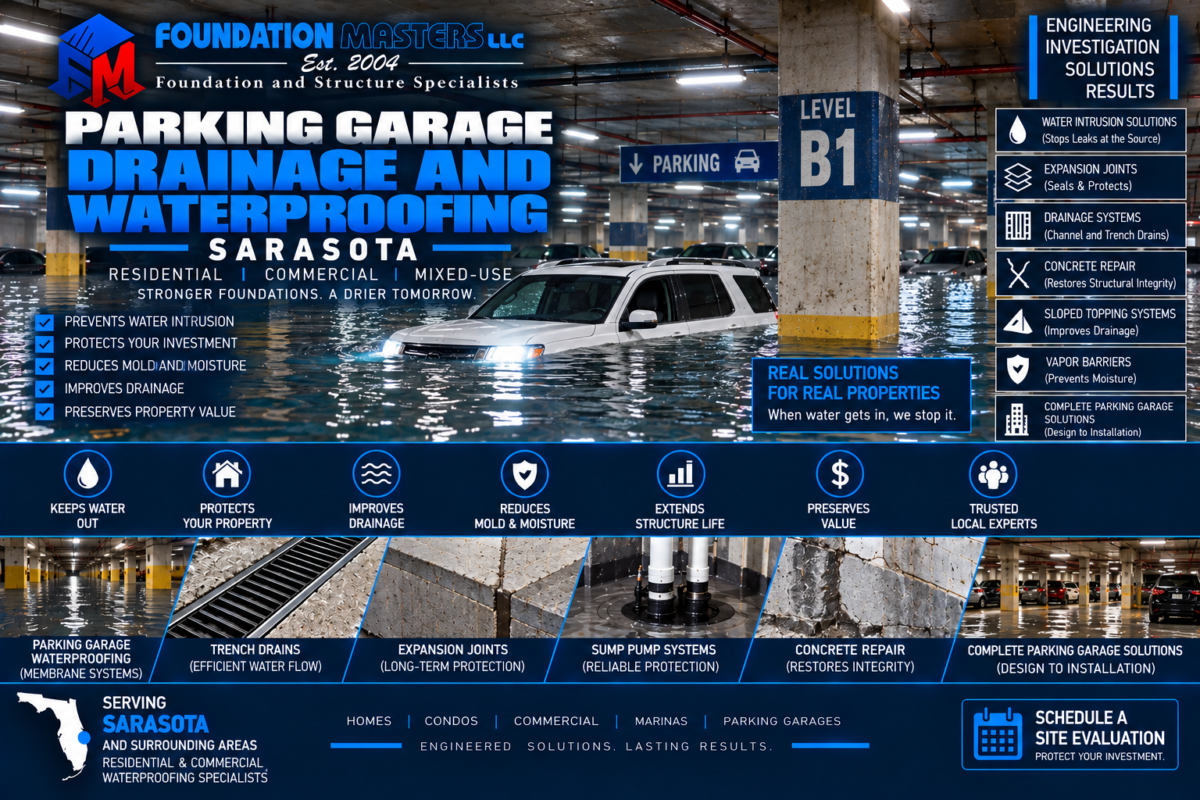
Downtown Sarasota and the bayfront carry a concentration of structured and below grade parking that the rest of this market does not have, and a parking structure is the least forgiving building type there is for water. It is a horizontal concrete deck with vehicles on it, salt and chloride bearing runoff coming off those vehicles, expansion joints, and a drainage system that has to work by gravity into whatever the surrounding ground and the storm system will accept.
The failure sequence is consistent. Deck drains and catch basins silt up, so water ponds instead of clearing. Ponded water finds joints and cracks. Chlorides travel with it to the reinforcing steel. Corroding steel occupies more volume than the steel it replaced, so it cracks the concrete from the inside and pushes the surface off, which is the spalling and the rust staining that boards and managers eventually notice on soffits and columns. By that point the water has been doing the work for years.
Below grade levels add hydrostatic pressure to all of that, and in a basin that stays charged after a large event the pressure does not relieve itself on the schedule anybody expects. For association property there is now a funding dimension as well: under the structural integrity reserve study requirements, waterproofing and exterior painting is one of the enumerated components a residential condominium association with a building of three habitable stories or higher has to include in its study.
Mainland Sarasota
The useful question on the mainland is not the neighborhood name. It is which basin you drain into, where in that basin you sit, and whether the receiving water is fresh or tidal at your outfall.
Downtown, the Bayfront and the Rosemary District
The towers, the mixed use and the structured parking. Below grade levels, deck drainage, chloride driven concrete deterioration, and association scopes driven by reserve studies rather than by an owner noticing something.
The Bayou Neighborhoods
The older residential areas around Hudson Bayou and Whitaker Bayou. Mature, low lying, tidal at the bottom end, and full of houses with slabs at or near grade and vapor barriers from another era.
The Phillippi Creek Basin
The residential and commercial areas through the middle of the county, out along Bee Ridge, Fruitville and Beneva. This is the ground the county has been dredging, and where in the basin you sit changes the answer completely.
The Keys and Neighboring Markets
Island conditions are different and have their own pages: Siesta Key, Lido Key, St. Armands Key, Longboat Key and Casey Key. South to Venice and north to Bradenton.
Sarasota Drainage and Waterproofing
Why does my yard flood even with drains installed?
Because a drain only works if what it discharges into is lower and has room. On the mainland your water ultimately reaches a ditch, a canal or the creek, and during the events that matter those are full. A collection system feeding a full receiving system moves nothing, no matter how well it was installed. That is why we survey the outlet before designing the collection.
Why is my slab letting moisture through?
Because water is reaching it and there is nothing between the two. Many Sarasota houses were built with slabs at or near grade with vapor barriers to the standards of their day. Concrete is porous, so once the water table contacts the slab, capillary movement carries moisture upward with no crack involved at all, and in a basin that stays charged that contact lasts a long time.
Can you waterproof an existing home in Sarasota?
Yes. Our Seal Tight System is engineered for hydrostatic pressure and is applied to the positive side, the face the groundwater actually touches, which is why it works on a structure that is already built rather than only on new construction.
My property never used to flood. What changed?
Usually not your property. Reporting on the county stormwater system has been explicit that the existing infrastructure was based on climate projections from 1996 and was never designed to exceed about ten inches of rain. Hurricane Debby delivered nearly 18 inches in hours in 2024 and Phillippi Creek topped 10 feet, the highest in more than two decades. A system performing outside its design assumption is a different thing from a system that has failed, and it explains a great many properties that were fine for thirty years.
Will the Phillippi Creek dredging fix my flooding?
It will help, and property in the affected reaches should drain better than it did. Phase 1 removed roughly 60,000 cubic yards of sediment between South Tuttle and South Beneva inside an estimated 42 million dollar investment across two phases. But dredging restores a channel toward its design capacity rather than increasing that capacity, and a watershed of more than 55 square miles discharging through a 7.2 mile creek is a geometry. When the receiving system is at capacity, your property is protected by what is on your property.
Do tides affect drainage on the mainland?
At the lower end, yes. Phillippi Creek is a tidal creek and the bayous are tidal at their mouths, so property in the lower reaches has a discharge elevation that moves twice a day. Further upstream the tide stops mattering and basin storage takes over. Which of those two you are dealing with is decided by where you sit, and it changes the design.
Am I in the City of Sarasota or the county?
A great deal of what people call Sarasota is unincorporated Sarasota County rather than the City. It decides who permits your work, who inspects it, whose flood resources apply and who makes a substantial improvement determination on your structure. It is worth establishing before you start anything, and it is the most common piece of confusion we encounter in this market.
Do you handle commercial parking lot and parking garage drainage?
Yes, and downtown Sarasota is one of the markets where we do most of it. We repair and retrofit catch basins, deck drains, storm piping and subgrade failures, and we handle the concrete restoration that follows once chlorides have reached the reinforcing steel. Details on parking lot drainage systems.
Our condominium board has a reserve study. Does waterproofing belong in it?
Yes. Under the structural integrity reserve study requirements, a residential condominium association with a building of three habitable stories or higher must have the study cover an enumerated list of components, and waterproofing and exterior painting is one of them, alongside roof, structure, fireproofing, plumbing, electrical, and windows and exterior doors. It is not a discretionary maintenance item any more. Boards should take the specifics to association counsel.
Do you install French drains in Sarasota?
Only where the outlet supports one. A French drain moves water by gravity to a lower point, so it is exactly as good as the point it discharges into. On the mainland that point is frequently a ditch or a canal that is full during the event you care about, in which case the trench becomes storage beside your foundation rather than drainage away from it. Which system is right is a measurement rather than a preference.
Is it true that Florida requires slabs to be 12 inches above grade?
No. The Florida Building Code requires grading that falls six inches within the first ten feet of the foundation and two percent on impervious surfaces. It does not impose a general twelve inch finished floor rule. Minimum elevations come from the flood map and the local flood ordinance, and those apply only in mapped flood hazard areas.
Does drainage and waterproofing work carry the lifetime warranty?
Qualifying drainage and waterproofing work carries a lifetime transferable warranty, which means it passes to the next owner of the property. The scopes and the exclusions are set out on our warranties page.
Drainage and Waterproofing Services
- Seal Tight Waterproofing System on the positive side of below grade concrete
- Engineered perimeter drainage designed against a surveyed outfall
- Designed sump and pumped discharge where gravity is not available during the event
- Catch basin, deck drain, trench drain and storm pipe repair and replacement
- Parking lot and parking deck drainage systems
- Below grade and structured parking waterproofing, joints and membranes
- Subgrade stabilization and void filling under slabs and pavement
- Grading corrections and gutter and leader discharge
- Vapor retarder detailing under new slabs
- Seawall and bank repair, and seawall permitting
- Sheet piling where a creek or canal edge has to be cut off
When the Water Has Already Done Damage
Prolonged saturation does two things to a foundation. It weakens the bearing material, and it carries fines out of it. The drainage work stops the water. The structural work corrects what has already moved.
- Foundation repair in Sarasota
- Geotechnical engineering in Sarasota and soil borings
- Foundation settlement repair, which explains uniform settlement, tilt, sagging and hogging
- Helical piers, push piers and pipe pile underpinning
- Weathered cracks and how to read what a crack is telling you
- Steel corrosion in structural concrete
- Structural engineering in Venice, certified foundation repair and foundation inspection
Statewide context sits on foundation repair in Florida and drainage and waterproofing in Florida.
Where Else We Work
Drainage and Waterproofing Florida · All Locations · Siesta Key · Lido Key · St. Armands Key · Longboat Key · Casey Key · Venice · Bradenton · Anna Maria Island · Holmes Beach · Port Charlotte · Punta Gorda · Cape Coral · Madeira Beach · Tampa · Flood Asset Protection · Efflorescence · Steel Corrosion · Foundation Inspection Florida · Warranties
Get a Drainage and Waterproofing Inspection in Sarasota
Because Florida has no statewide waterproofing code, you need people who understand local soils, seasonal water tables and how the regional conveyance actually behaves during an event. What the code does require is narrower than most owners think. The Florida Building Code requires grading that falls six inches within the first ten feet of the foundation, and two percent on impervious surfaces within that distance. It requires a real foundation drain only where a foundation both retains earth and encloses habitable or usable space below grade, which a Florida slab on grade house never does. Outside a mapped flood hazard area there is no minimum finished floor elevation above adjacent grade and no elevation certification.
Put plainly, on a typical Sarasota house the detail that would actually keep water out of the slab is not required and is therefore usually not there. We build it anyway, because the absence of a requirement is not the same as the absence of a problem, and because in a basin this size the public system will sometimes be full when you need it most.
Under new slabs we detail vapor retarders to ASTM E1745, which caps water vapor permeance at 0.1 perms across all classes and requires 45 pounds per inch tensile and 2,200 grams puncture resistance for Class A. The 2021 IRC raised the residential requirement to a minimum 10 mil Class A sheet with 6 inch lapped joints.
Inspections are free. In Sarasota the first two things we want to establish are where in the basin your property sits and what your discharge point does during a real event, because between them those two answers decide the entire design.
Find Out Where Your Water Actually Goes
Call for direct help with flooding, moisture through a slab, hydrostatic pressure, parking deck or garage drainage, storm piping that has stopped conveying, washout under slabs and pavement, or a creek bank losing ground. We will tell you what is wrong before we tell you what it costs.