
House Leveling in Miami, FL
Foundation Masters, LLC. Florida licensed engineering firm, CA# 30969.

Every page below is already part of this service area. Jump straight to the one you need.
Foundation Masters, LLC is the trusted house leveling specialist in Miami. Our Florida licensed engineering team brings decades of structural and geotechnical experience to lift, level and stabilize homes across Miami and Miami-Dade County.
We correct uneven floors, settlement, crawl space deterioration and structural movement using engineered methods tailored to South Florida soils, high groundwater and coastal conditions. From a simple floor lift to deep underpinning or a complete house relocation, our engineers design a code compliant plan and handle the permitting locally.
Miami is the one market in Florida where the usual question is turned around. Across most of Miami-Dade the limestone is shallow, sometimes within a couple of feet of the surface, and rock makes an excellent bearing material. So the question here is rarely how deep we have to go. It is what sits between your slab and that rock, and whether anything at all is wrong below grade in the first place.
House Leveling and Foundation Services in Miami
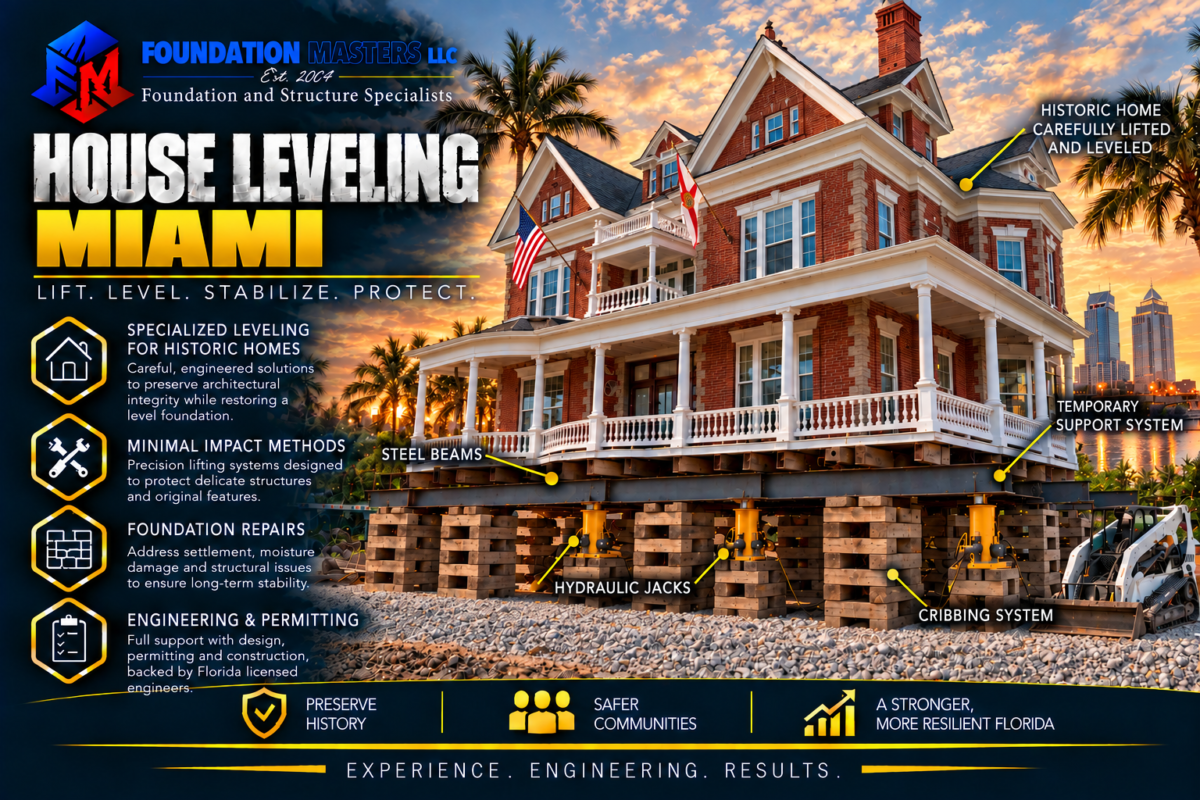
House Leveling and Floor Lifting
Correct uneven floors, sinking piers and settlement related damage to restore safety and value. See smart jacks for adjustable support under a settled floor system.
Underpinning and Structural Stabilization
Engineered solutions including helical piers, push piers, pipe pile and deep foundation support installed by licensed pile driving contractors, designed for Florida soils.
Structural Shoring and Temporary Support
Emergency stabilization to secure your home during repairs or renovations. See state code resources at the Florida Building Commission.
Home and Building Moving
Safe relocation of houses and light commercial structures with full engineering oversight and local permitting. Verify contractor licensing via the Florida DBPR.
Crawl Space Repair and Encapsulation
Moisture control, wood rot replacement and mold remediation for South Florida homes. Health guidance is available through EPA Mold Resources.
Engineering Inspections and Preliminary Plans
Free initial inspection and preliminary drawings. Verify Florida engineers via the Florida Board of Professional Engineers License Search.
Financing Options
Flexible programs to help homeowners afford necessary foundation and leveling work. Consumer information is available through the Florida Department of Financial Services.
Subsurface Investigation
Here the useful question is how deep the rock is and what is above it. Soil borings answer both, and on a Miami lot they usually do not have to go far.
Pressure Grouting and Void Filling
Where a void, a soft pocket or loose fill near the surface is the problem rather than the depth of bearing, grouting treats that zone directly. On shallow rock that is often the whole job.
Seawall and Bulkhead Work
On a canal or bay lot the wall and the structure behind it are one problem. See seawall and bulkhead work and sheet pile Miami.
New Construction Foundations
We design and install foundations for new work as well as repairs. See luxury new construction Miami.
Warranty Coverage
Our engineered repairs carry written coverage. Review the foundation repair warranties before you sign with anyone.
For structural repair details, see our Foundation Repair Miami page. For sealed reports, letters and structural opinions, see Structural Engineer Miami.
In Miami the Rock Is Right There
Anyone who has tried to dig a post hole in Coral Gables knows this already. Across much of Miami-Dade the limestone is at or near the surface, and in many neighborhoods a footing is bearing on rock or on a thin layer of material directly over it. That is a genuinely good position to be in. Rock does not consolidate, it does not shrink and swell, and it does not care what the water table did last August.
It also changes what a foundation problem means here. Where the house is on or close to the rock, true settlement of the natural ground is uncommon, and cracking usually has a different cause that has nothing to do with the soil. Where something soft sits between the slab and the rock, that layer is the entire problem, and the repair is short, direct and often cheaper than the same work anywhere else in the state.
Fill Over Muck and Marl
In the low ground, the old transverse glades and much of the canal side development, the original surface was marl or peat. Lots were raised with fill. Under that fill the soft material is still there, still compressing.
The Everglades Margin
West of the coastal ridge, out past Kendall and west Doral, the rock is still there but what sits on it is marl and organic soil rather than sand. That is a compressible layer, and it behaves nothing like the ridge.
Dredge Fill on the Barrier Island
Miami Beach and the bay islands are largely made land, pumped up out of Biscayne Bay. Hydraulic fill placed that way was never compacted the way engineered fill is today.
A Very Shallow Water Table
Groundwater in Miami-Dade sits close to the surface and moves with rainfall and tide. It rarely causes settlement on rock, but it governs how any excavation, void or washout behaves.
Coastal Flooding and Surge
Days of standing water work on fill, on slab edges and on anything already loose. A flood rarely creates a new problem. It finds the one that was there and makes it visible.
Plumbing Leaks Beneath the Slab
In a county this well drained a leak does not pond, it moves material. This is one of the most common real causes we find in Miami, and it is cheap to confirm before anyone talks about piers.
Voids and Washouts in Fill
Water running through loose fill above hard rock has nowhere to soak away, so it travels sideways and carries sand with it. The result is a void under a slab edge, a walk or a driveway.
Seawall and Canal Bank Movement
A wall losing soil behind it takes support away from whatever sits inside it. On a canal lot the patio and the slab edge are usually where that shows up first.
Wood Deterioration
Most Miami houses are block on grade, but the older frame stock and any raised floor system can lose girders and joists to moisture, and that produces floors that feel exactly like settlement.
Several of these produce the same cracking on the same wall. Telling them apart is what the inspection is for, and it is the reason we measure before we quote.
Is It the Ground, or Is It the Building
This is the first question we answer on a Miami-Dade call, and it matters more here than almost anywhere else, because good bearing means a cracked wall is less likely to be a soil problem. Spending money on piers under a house that is not settling is the most expensive mistake available in this market, and it happens.
Points Toward the Ground
- Floor elevations that show a real slope or a dish, not just an out of level finish
- Movement concentrated at one corner, one wall or one addition
- A raised pad, a filled lot, a canal bank or a known muck area
- Cracking that keeps reopening after it is patched
- A void, a dropped slab edge or sand washing out at grade
Points Toward the Structure
- Cracking at the tie beam, over openings or at lintel ends rather than at the floor
- Rust staining, spalling concrete or a crack following a line of reinforcing
- Floors that measure flat while the walls are still cracking
- Damage that tracks the salt exposure of the elevation it is on
- A crack pattern that matches the original construction joints
We settle it with measurements. Floor elevations across the whole structure show whether anything has actually moved and in what shape. If the floors are flat and the cracking is in the beam, then no pier under that wall is going to fix it, and we will tell you so in writing. If the elevations show real movement, soil borings tell us how far down the soft material goes and where the rock is, and the repair gets designed to that.
Signs a Miami Home Needs Leveling
One of these on its own is often nothing. Several of them along the same wall, or any of them getting worse month over month, is the point at which measuring beats waiting.
Inside the House
- A floor running downhill across a room, or a soft spot that gives underfoot
- Diagonal cracking out of the upper corners of doors and windows
- Doors that drag or will not latch any more
- Gaps showing at the baseboard or along the ceiling line
- Grout opening in a straight run across tile
- Terrazzo cracking along one continuous line rather than in a pattern
Outside and in the Yard
- Stair step cracking through the mortar joints of block or stucco
- A dip in the slab edge, or grade falling away on one side of the house
- A Florida room, lanai or carport pulling away from the structure
- A driveway, walk or pool deck tilting or breaking along one line
- A seawall leaning, or soil loss showing up behind it
- Sand washing out at a downspout, a hose bib or a slab edge
Cracking that reopens every year after you patch it is the single most useful symptom you can report to us, because it tells us something is still moving rather than having moved once and stopped.
Choosing the Right Method in Miami-Dade
There is no single best method. There is a best method for your soil profile, your structure and the load the repair has to carry. On shallow rock the governing question is usually how to get the load through a relatively thin soft layer and onto competent material, which is a different and often smaller problem than deep underpinning elsewhere in Florida.
Helical Piers
Shafts with helix plates turned to a target depth, where installing torque confirms capacity. Good through fill and marl, and the torque record tells you what each pier actually found on the way down.
Push Piers
Steel sections driven below the footing with the weight of the house as the reaction. On rock they can reach a very firm set quickly, which is an advantage as long as the set is real and not a thin ledge.
Pipe Pile
Driven pipe where the load is large or the fill is deeper than a retrofit pier should span. Installed by our own pile driving crews rather than subcontracted out.
Pressure Grouting
Fills and densifies where a void or loose fill near the surface is the problem rather than the depth of bearing. On a Miami lot with a washout over hard rock, this is frequently the correct and cheaper answer.
Smart Jacks
Adjustable steel supports on new engineered footings, set under the girders of a raised floor system so the floor levels without touching the perimeter.
FM PP25 Push Pier
Our own push pier system, engineered and specified in house so the bracket, the pipe and the connection to your footing are designed as one assembly.
FM PP30 Pipe Pile
A heavier pipe pile for larger loads and deeper bearing, which is what deep hydraulic fill and commercial structures on the water call for.
Structural Shoring
Temporary shoring makes the structure safe while the permanent repair is designed, permitted and built. On anything unsafe it is the first move, not the last.
Drainage Correction
Collection, discharge and grade work so water is not moving fill around under your slab next season. See drainage and waterproofing.
There is one trap worth naming. A pier that hits apparent refusal almost immediately looks like the best result on the job, but a thin rock ledge with soft material under it can read the same way on a gauge. That is why we want the boring log and the torque or set record for every pier, not just a crew saying it felt solid.
How a Miami House Leveling Project Runs
1. Free Inspection
We walk the house inside and out, read the cracking and the drainage, and shoot floor elevations so the movement is recorded as measurements instead of impressions.
2. Ground or Building
Before anything else, whether this is a soil problem at all. Flat floors with cracked beams is a structural repair, not an underpinning job, and the answer changes the entire scope.
3. Find the Rock
How deep it is and what sits above it. Where that governs the repair, soil borings turn the question into a log, and in Miami that log is usually short.
4. Engineered Design
Our licensed engineers select the system, lay out the pier or jack locations and set target depths from the boring data, then issue signed and sealed plans with calculations.
5. Miami-Dade Permitting
Miami, Miami Beach, Coral Gables, Doral, Hialeah, Aventura, North Miami and Homestead each run their own building department, and the unincorporated areas go to Miami-Dade. We confirm it from the parcel.
6. Install, Lift and Documentation
Crews install the system, then lift in controlled increments with elevations monitored across the structure. You finish with sealed plans, the install record, closing readings and written warranty coverage.
Drainage correction is part of the repair, not an upsell. Getting the load onto rock fixes the structure. Controlling where water runs is what keeps it from moving the fill around again, and on a well drained lot over hard rock, water travels further sideways than most people expect.
Serving Miami and Miami-Dade County
We proudly serve Miami, Miami Beach, Coral Gables, Doral, Kendall, Hialeah, Aventura, North Miami, Brickell, Homestead and surrounding communities. For statewide service, visit our House Leveling Florida hub.
Why Choose Foundation Masters in Miami
Licensed Florida engineering firm, CA# 30969, with decades of combined experience
Owner operated by Jeff Earl with Andre Hawks, P.E. as Professional Engineer of Record
Free on site inspections and preliminary engineering drawings
Fast permitting and code compliant documentation
Trusted by homeowners, builders and real estate professionals across Miami-Dade
Geotechnical and pile driving capability in house, so the investigation and the repair are the same firm
That last point is the one that protects you here. Whoever tells you how deep the fill runs over the rock should be able to hand you the log that says so. We take the borings, we read the samples, we design the repair and our own crews install it, which means nobody is handing you an alarming report and pointing you toward a different company to pay for the fix.
We are also willing to tell you to do nothing, and in Miami we say it more often than anywhere else we work. Good bearing means a cracked wall frequently is not a settlement problem at all. If the elevations come back flat and the cracking is in the beam or the stucco, that is what the report will say, along with what to watch for. A written engineering opinion that your foundation is fine is worth real money in a market where houses change hands on inspection findings, and we are not going to withhold one to sell you piers you do not need.
Schedule a House Leveling Inspection in Miami
Call us today to schedule your free inspection and receive preliminary plans for your house leveling or structural stabilization project. You are also welcome to send photographs, plans or a written description of what the house is doing for a preliminary review before anyone comes out.
Call Now
Main Office: 813-614-1718
Direct, emergency or temporary shoring: Jeff Earl 656-233-7089
Need help paying for your project? Ask about our financing programs when you call.
Statewide Engineering
House Leveling Florida · Foundation Repair Florida
Structural Engineering · Geotechnical Engineering
Soil Borings · Warranties
House Leveling Miami FAQs
These come up on nearly every first call from a Miami homeowner. If yours is not here, call the office and ask it directly.
What causes a house to need leveling in Miami?
High groundwater, coastal flooding, sandy and limestone soils, plumbing leaks, and wood deterioration can cause settlement and uneven floors in South Florida homes.
How do you level a house in Miami?
Depending on loads and soils, we use helical or push piers, pressure grouting, and structural shoring to lift and stabilize the structure, engineered to meet Florida Building Code and local permitting requirements.
Can you level and also move my house?
Yes. Foundation Masters is one of the leading house and building movers in Florida, providing engineering plans, permitting, and safe relocation.
How much does house leveling cost in Miami?
Costs vary by home size, access, and severity of settlement. Simple floor lifts may be a few thousand dollars, while deep underpinning or relocation is higher. We provide free inspections and detailed proposals.
Will I need to leave my home during leveling?
Many projects allow you to remain in place, while major lifts or structural replacement may require temporary relocation. We will advise before work begins.
Do you handle permitting and code compliance?
Yes. As a licensed engineering firm, we prepare plans, manage permitting, and coordinate with Miami-Dade and local building departments to ensure compliance.
Is my house sitting on rock, and how would I know?
Across much of Miami-Dade the limestone is shallow, so there is a fair chance your footings are on it or close to it. The quick tells are how hard it is to dig anywhere on the lot and whether the original grade was raised. The reliable answer comes from borings, and in Miami those borings usually do not have to go far to find the rock.
Someone told me houses do not settle in Miami. Is that true?
It is closer to true here than anywhere else in Florida, and that is worth knowing. Rock does not consolidate, so where a house bears on it or near it, real settlement is uncommon. What does move is fill, marl and organic soil sitting on top of the rock, and plenty of Miami lots have some of that. The honest answer is that it depends on your lot rather than on the city.
Do I still need soil borings if the rock is that shallow?
Where the cause is shallow and obvious, elevation readings and a site inspection are enough. Where the repair depends on how thick the fill or marl is above the rock, borings are the only way to design from measured data rather than assumption, and they also guard against a pier setting on a thin ledge with soft material underneath it.
Will all the piers be the same depth?
In Miami they are more likely to match than almost anywhere else we work, because the rock gives a consistent target. That is a genuine advantage of this market. It still has to be confirmed pier by pier with the torque or the set recorded, because a lot that was filled unevenly will not give the same number everywhere.
My cracking is in the tie beam and over the windows, not down at the floor. Is that still a foundation problem?
Often it is not, and that distinction is worth real money to you. Where floor elevations come back flat and the cracking sits in the beam, over openings or along a line of reinforcing, the cause is usually in the structure or the concrete rather than in the ground, and no pier under that wall will fix it. We measure first so you are not paying for underpinning that was never the answer.
Looking for other areas? Visit our Florida House Leveling hub for statewide service.
Free Miami House Leveling Inspection
Uneven floors, a settling slab edge, a leaning seawall, or cracking that comes back every year no matter how many times you patch it. We measure it, we engineer it, and we stand behind the lift.
Call 813-614-1718