
Florida Building Code Pipe Pile Requirements
The pipe pile code requirements in the Florida Building Code that govern steel piles used as deep foundation elements, what each one actually requires, and what it means when you are specifying or reviewing a foundation. Every section on this page has been read against the 2023 code text rather than quoted from memory.
The Short Answer
A steel pipe used as a deep foundation element in Florida must have a nominal outside diameter of at least 8 inches. That is Section 1810.3.5.3.4 of the 2023 Florida Building Code, and it has no exception for small diameter driven pipe.
Four other pipe pile code requirements shape the design alongside it: Table 1810.3.2.6 sets the allowable stress on the steel at 0.35 Fy unless a higher value is justified under 1810.3.2.8; Section 1810.3.3.1.1 caps any load set by an approved driving formula at 40 tons; Section 1810.3.6 governs splices; and Section 1810.3.11 requires 3 inches of embedment into the cap with 4 inches of edge cover. Special inspection does not come from Chapter 17 in Florida. It comes from Florida Statutes 553.79.
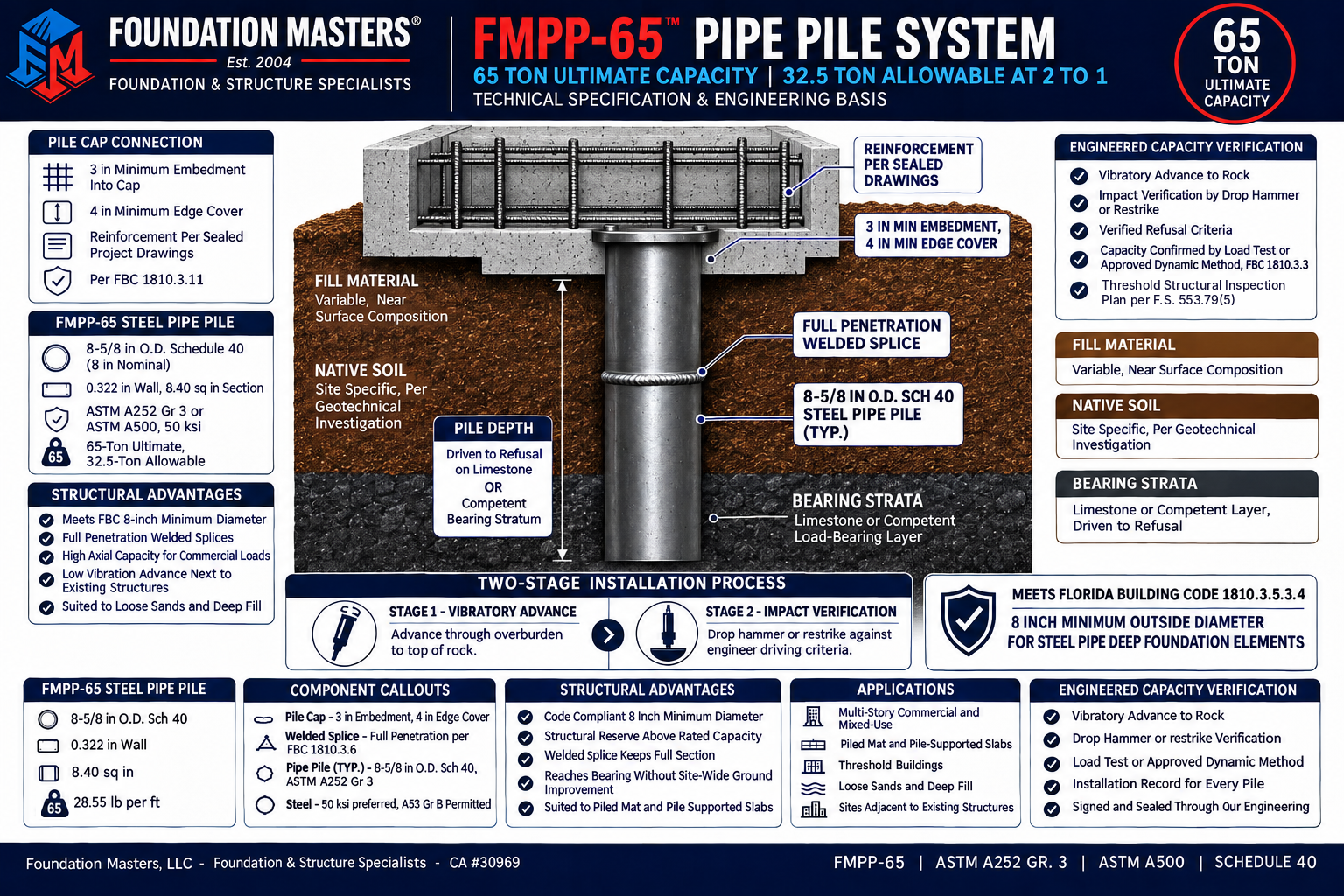
Where the pipe pile code requirements live in Chapter 18
This is the working list. Each row is the requirement as written, then what it costs you in practice.
| Section | What it requires | What that means on a real job |
|---|---|---|
| 1810.3.5.3.4 | Steel pipes and tubes used as deep foundation elements shall have a nominal outside diameter of not less than 8 inches. | A 4 inch or 6 inch driven pipe is not a compliant deep foundation element. It is fine for residential underpinning work that is not classified that way, but it will not pass as a deep foundation element on a commercial set. |
| 1810.3.5.3.4 second clause | Open ended driving requires 0.34 square inches of steel per 1,000 foot-pounds of hammer energy, or a wave equation analysis instead. | This sizes your hammer, not your pile. An 8.40 square inch section permits roughly 24,700 foot-pounds before you need the wave equation route. |
| Table 1810.3.2.6 | Allowable compressive stress on pipes and tubes is 0.35 Fy capped at 24,000 psi. 0.5 Fy capped at 32,000 psi applies only where justified under 1810.3.2.8. | Most published pile capacities quietly assume the 0.5 Fy number. If you have not filed the justification, your real limit is lower. |
| 1810.3.2.8 | Higher stress requires a geotechnical investigation, load tests regardless of the load carried, and a report to the building official from the supervising design professional. | This is a paperwork package, not a checkbox. Decide early whether the project needs it. |
| 1810.3.3 | Allowable loads determined by an approved formula, load tests or method of analysis. | Three routes, and the building official decides what is approved. |
| 1810.3.3.1.1 | A load set by an approved driving formula shall not exceed 40 tons. Above 40 tons the wave equation method shall be used, and loads verified by load test. | This is the hinge point in the whole chapter. Design at or below 40 tons allowable and the acceptance path is simple. Go above it and you have bought wave equation analysis and load testing. |
| 1810.3.6 | Splices shall maintain alignment and resist the forces at the splice, and develop not less than 50 percent of the bending strength of the weaker section. | The code does not mandate a full penetration weld. It mandates performance. A welded splice is the usual way to meet it on pipe. |
| 1810.3.11 | Tops embedded not less than 3 inches into the cap or grade beam, caps extending not less than 4 inches beyond the element. | Small numbers that get missed on tight cap layouts, and they are easy for a reviewer to scale off your drawing. |
Section text read from the 2023 Florida Building Code, Building, Eighth Edition, Chapter 18. Confirm the governing edition and any local amendments with your building department and engineer of record.
The 8-inch minimum, in the code words
Nominal is the operative word. An 8-5/8 inch outside diameter pipe is 8 inch nominal and satisfies the section on its face. There is nothing to argue and nothing to justify.
The section carries a second requirement that is almost never quoted. Where the pipe is driven open ended, it must have at least 0.34 square inches of steel in cross section for every 1,000 foot-pounds of hammer energy, or the engineer may use a wave equation analysis instead to assess driving stress and whether the section suits the hammer. Where the wall is thinner than 0.179 inches and the pipe is driven open ended, a cutting shoe is required.
Steel pipes and tubes used as deep foundation elements shall have a nominal outside diameter of not less than 8 inches (203 mm).
Florida Building Code 2023, Eighth Edition, Section 1810.3.5.3.4
Why these pipe pile code requirements catch people
Small diameter driven pipe is common, well understood and performs. It is also not a compliant deep foundation element under this section. Projects discover that at plan review, after the foundation is designed.
What these pipe pile code requirements do not cover
Helical piles, micropiles, precast concrete and drilled elements each have their own dimensional sections. The 8-inch pipe rule applies to steel pipes and tubes used as deep foundation elements, nothing else.
The allowable stress trap
Table 1810.3.2.6 lists allowable stresses for deep foundation materials. For steel in compression it gives four different numbers depending on condition, and the two that matter for pipe are easy to mix up.
Pipes, tubes or H-piles where justified in accordance with Section 1810.3.2.8 get 0.5 Fy, capped at 32,000 psi. Other pipes, tubes or H-piles get 0.35 Fy, capped at 24,000 psi. The 0.35 value is the default. The 0.5 value has to be earned.
Worked example on an 8.40 square inch section: at 0.35 Fy the limit is about 51 tons in a 35 ksi steel and about 73 tons in a 50 ksi steel. At 0.5 Fy the same section reaches about 73 tons and about 105 tons. If a capacity table quotes you the higher pair without mentioning a filing, ask which one it assumed.
The 40-ton line in Section 1810.3.3.1.1
This is the sentence that quietly shapes most driven pile design in Florida, and it is worth reading twice.
The allowable compressive load on any driven deep foundation element where determined by the application of an approved driving formula shall not exceed 40 tons (356 kN). For allowable loads above 40 tons, the wave equation method of analysis shall be used to estimate driveability for both driving stresses and net displacement per blow at the ultimate load.
Florida Building Code 2023, Eighth Edition, Section 1810.3.3.1.1
Pipe pile code requirements at or below 40 tons allowable
An approved driving formula can establish the load, subject to the engineer of record and the building official. The acceptance path is short.
Pipe pile code requirements above 40 tons allowable
Wave equation analysis becomes mandatory, and allowable loads are verified by load tests under 1810.3.3.1.2. That is schedule and budget, and it needs to be in the number you quote.
This is why a pile rated at 32.5 tons allowable and a pile rated at 50 tons allowable are not simply two sizes of the same thing. They sit on opposite sides of this sentence.
Special inspection: there is no FBC 1705.7 in Florida
This one catches working engineers, and it has found its way into published specifications.
In the International Building Code, Section 1705.7 covers special inspection of driven deep foundation elements. Florida did not adopt it. In the 2023 Florida Building Code, Chapter 17, Section 1704 is marked RESERVED and Section 1705 is marked RESERVED. The entire IBC special inspection framework is deleted. Citing FBC 1705.7 on a Florida project points at a section that does not exist.
What governs instead is statute. Florida Statutes 553.79(5)(a) requires the enforcing agency to have a special inspector perform structural inspections on a threshold building, under a structural inspection plan prepared by the engineer or architect of record, and that plan must be approved before the building permit is issued. Florida Statutes 553.71(12) defines a threshold building as one greater than three stories or 50 feet in height, or with an assembly occupancy exceeding 5,000 square feet and an occupant content greater than 500 persons.
If your project is a threshold building
The structural inspection plan comes from the engineer or architect of record and is approved before permit. Pile installation records need to drop into that plan, not into a Chapter 17 checklist.
If it is not
A fee simple owner may still designate a building as a threshold building voluntarily under 553.79(5). Some do it on complex foundations to get the inspection regime.
Writing the pipe pile code requirements on the drawings
Cite Florida Statutes 553.79(5)(a) and the approved structural inspection plan. Do not cite FBC 1705.7.
Pipe Pile Code Requirements Questions Engineers and Plan Reviewers Ask
What is the minimum diameter for a steel pipe pile in Florida?
Section 1810.3.5.3.4 of the 2023 Florida Building Code requires steel pipes and tubes used as deep foundation elements to have a nominal outside diameter of not less than 8 inches. An 8-5/8 inch outside diameter pipe is 8 inch nominal and meets it outright.
Is there an exception to the 8-inch minimum?
Not within 1810.3.5.3.4 itself. Micropiles are a separate element type under Section 1810.3.10 with their own requirements, and the code does not state a minimum diameter for them, but it does require that they be grouted. Whether a given small grouted element qualifies as a micropile is a determination for the engineer of record and the building official.
What allowable stress can I use on a steel pipe pile?
Table 1810.3.2.6 gives 0.35 Fy capped at 24,000 psi as the default for pipes and tubes. A higher value of 0.5 Fy capped at 32,000 psi applies only where it is justified under Section 1810.3.2.8, which requires a geotechnical investigation, load tests regardless of the load supported, and a report to the building official from the supervising registered design professional.
Why does 40 tons keep coming up?
Section 1810.3.3.1.1 states that an allowable compressive load determined by an approved driving formula shall not exceed 40 tons. Above that, wave equation analysis is required and allowable loads are verified by load test. It is the practical dividing line between a simple acceptance path and a more involved one.
Does the Florida Building Code require a full penetration welded splice?
No. Section 1810.3.6 sets performance requirements: a splice must maintain alignment and position, resist the axial and shear forces and moments at the splice, and where elements of the same type are spliced it must develop not less than 50 percent of the bending strength of the weaker section. A full penetration weld is a common way to satisfy that on steel pipe, not a code mandate.
How far does a pile have to go into the cap?
Section 1810.3.11 requires the tops of vertical deep foundation elements to be embedded not less than 3 inches into the pile cap or grade beam, and the cap to extend not less than 4 inches beyond the edges of the element. Tops are cut or chipped back to sound material before capping.
Is FBC 1705.7 the special inspection requirement in Florida?
No. In the 2023 Florida Building Code, Chapter 17 Sections 1704 and 1705 are both marked RESERVED, so there is no FBC 1705.7. Special inspection of a threshold building comes from Florida Statutes 553.79(5)(a) and the structural inspection plan prepared by the engineer or architect of record.
Working Through a Pipe Pile Code Requirements Question?
Send us the geotechnical report and the loads. We will come back with a pile schedule, driving criteria and a sealed layout that answers the code sections above before a plan reviewer has to ask.
(813) 614-1718