
Minimum Pipe Pile Diameter in Florida
The 8-inch minimum outside diameter for steel pipe piles used as deep foundation elements, the second clause of the same section that almost nobody quotes, and what to do when the pile you want is smaller.
The Short Answer
Eight inches. The minimum pipe pile diameter in Florida is set by Section 1810.3.5.3.4 of the 2023 Florida Building Code, which requires steel pipes and tubes used as deep foundation elements to have a nominal outside diameter of not less than 8 inches.
Nominal is the operative word. An 8-5/8 inch outside diameter schedule 40 pipe is 8 inch nominal and satisfies the section on its face, with nothing to justify and nothing for a plan reviewer to question.
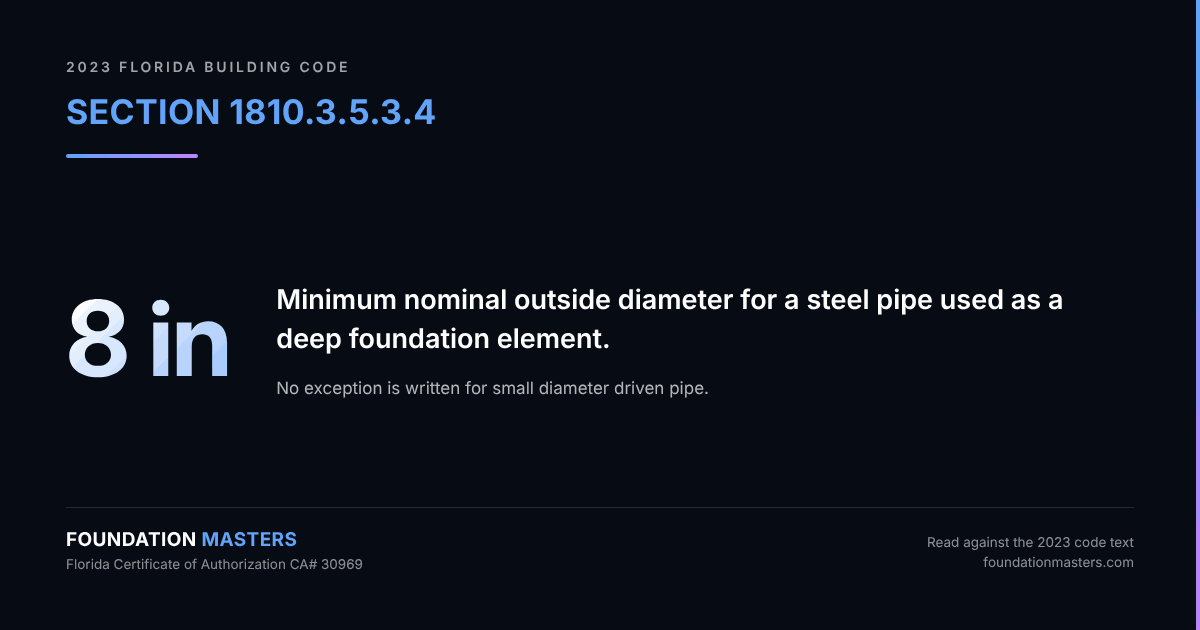
The minimum pipe pile diameter, in the code words
There is no small-project exception written into the section, no residential carve-out, and no provision for a smaller pipe where the loads are light. If the element is a steel pipe or tube acting as a deep foundation element, the 8-inch floor applies.
Steel pipes and tubes used as deep foundation elements shall have a nominal outside diameter of not less than 8 inches (203 mm).
Florida Building Code 2023, Eighth Edition, Section 1810.3.5.3.4
The clause underneath the minimum pipe pile diameter rule
The same section carries a second requirement that rarely appears in specifications. Where the pipe or tube is driven open ended, it must have at least 0.34 square inches of steel in cross section to resist each 1,000 foot-pounds of pile hammer energy, with equivalent strength permitted for steels with a yield greater than 35,000 psi. A wave equation analysis is permitted instead, to assess the driving-induced compressive stress and whether the section suits the hammer.
Where a pipe or tube with a wall thickness less than 0.179 inches is driven open ended, a suitable cutting shoe is required.
This is the arithmetic that decides whether the rig on site is the right rig. It is worth running before mobilisation rather than after a cracked pile head.
What the minimum pipe pile diameter rule does not cover
The section applies to steel pipes and tubes. Other element types have their own dimensional requirements in the same part of the code, and they are different numbers.
| Element type | Dimensional requirement | Section |
|---|---|---|
| Steel pipes and tubes | Nominal outside diameter not less than 8 in | 1810.3.5.3.4 |
| Precast concrete | Minimum lateral dimension 8 in, corners of square elements chamfered | 1810.3.5.1 |
| Cased cast-in-place or grouted-in-place | Nominal outside diameter not less than 8 in | 1810.3.5.2.1 |
| Uncased cast-in-place or grouted-in-place | Specified diameter not less than 12 in, length not more than 30 times the diameter | 1810.3.5.2.2 |
| Structural steel H-piles | HP shapes per ASTM A6, or flange projections not exceeding 14 times the minimum metal thickness | 1810.3.5.3.1 |
| Micropiles | No minimum diameter stated, but the element must be grouted | 1810.3.10 |
If your pile is smaller than the minimum pipe pile diameter
This is where most people arrive at this page, usually at plan review, with the design finished and the minimum pipe pile diameter rule sitting on top of it. There are three honest routes and one that is not.
Go to 8 inch nominal
The simplest answer. An 8-5/8 inch outside diameter schedule 40 pipe clears the section outright, and the extra section area usually clears the allowable stress check in Table 1810.3.2.6 without a filing as well.
Use a micropile
Micropiles are a separate element type under Section 1810.3.10 with no stated minimum diameter. The code does require that they be grouted and reinforced along the full length. Whether a given small element qualifies as a micropile is a determination for the engineer of record and the building official, not a label you can simply apply.
Use a different element type
Helical piles, drilled shafts and precast concrete each have their own sections. If the ground and the loads suit one of them, the 8-inch pipe rule stops being the governing constraint.
What does not meet the minimum pipe pile diameter
Describing a small diameter driven pipe as something else on the drawings. The classification follows what the element is and how it carries load, and a reviewer who knows Chapter 18 will see it.
Where small pipe is still the right answer
None of this makes smaller driven pipe a bad system. It is the right choice for residential underpinning and light structural repair work across Florida, and it has decades of performance behind it.
The distinction is classification. A pile supporting a new commercial structure as a deep foundation element is governed by the minimum pipe pile diameter rule in Section 1810.3.5.3.4. Remedial underpinning of an existing residential footing is a different situation, and the engineer of record and the building official decide which one applies.
Minimum Pipe Pile Diameter Questions
What is the minimum diameter for a steel pipe pile in Florida?
Eight inches nominal. Section 1810.3.5.3.4 of the 2023 Florida Building Code requires steel pipes and tubes used as deep foundation elements to have a nominal outside diameter of not less than 8 inches.
Does an 8-5/8 inch pipe meet the 8-inch minimum?
Yes. An 8-5/8 inch outside diameter schedule 40 pipe is 8 inch nominal, which satisfies the section directly.
Is there an exception for small residential piles?
Not within the section. There is no residential carve-out and no light-load exception. Micropiles are a separate element type under Section 1810.3.10 with their own requirements, including that they must be grouted, and the code states no minimum diameter for them.
What is the 0.34 square inch rule?
The second clause of Section 1810.3.5.3.4. Where a steel pipe or tube is driven open ended, it must have at least 0.34 square inches of steel in cross section for each 1,000 foot-pounds of pile hammer energy, with equivalent strength allowed for steels above 35,000 psi yield. A wave equation analysis is permitted instead.
When is a cutting shoe required?
Where a pipe or tube with a wall thickness less than 0.179 inches is driven open ended, Section 1810.3.5.3.4 requires a suitable cutting shoe.
Does the minimum diameter apply to helical piles?
No. Helical piles are a different element type with their own provisions. Section 1810.3.5.3.4 applies to steel pipes and tubes used as deep foundation elements.
Caught by the Minimum Pipe Pile Diameter Rule?
Send us the loads and the geotechnical report. We drive an 8-5/8 inch pile that meets Section 1810.3.5.3.4 outright, and we will tell you straight if a different element type suits your site better.
(813) 614-1718