
Structural Engineer Apollo Beach
Apollo Beach has roughly fifty five miles of canals leading to Tampa Bay, and almost all of that frontage is held by a seawall. That single fact reorders the engineering here. On a canal lot the wall at the water line is not landscaping and it is not a marine accessory. It is the structure holding up the ground your house is standing on, and when it moves, the house is what tells you.
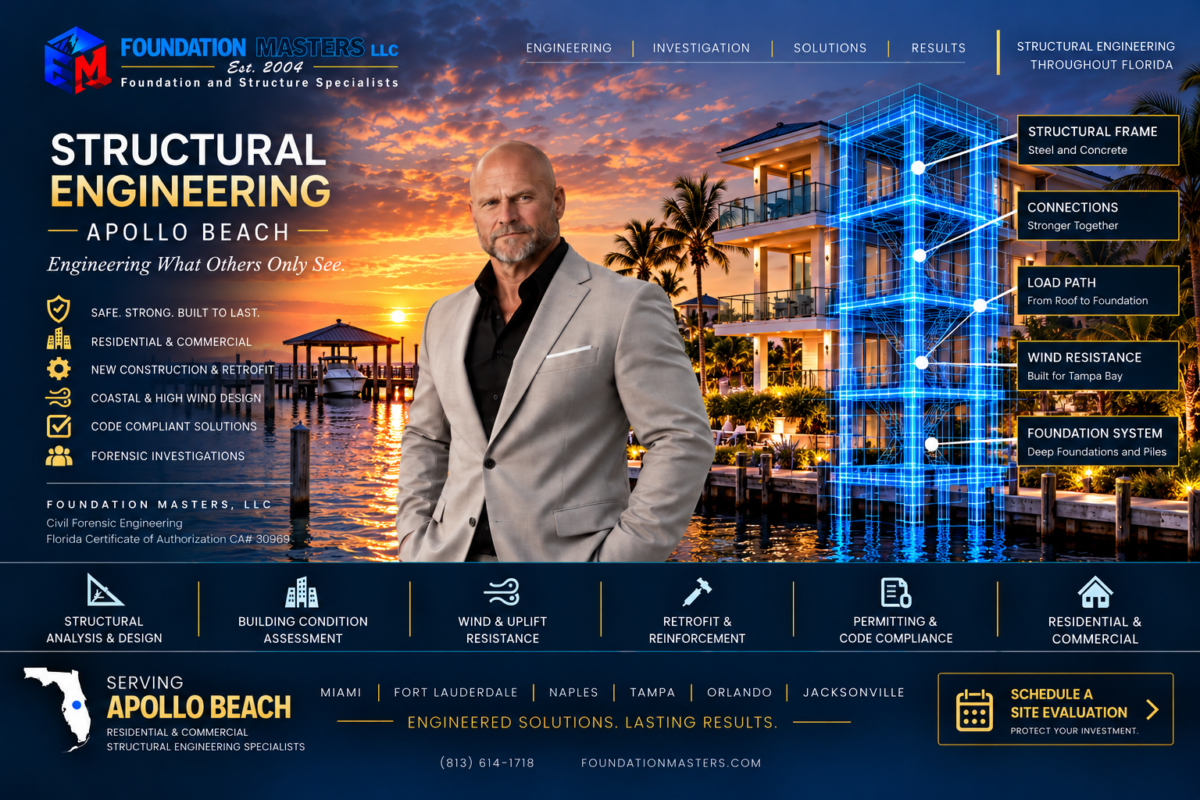
Those canals were dredged. This community was laid out and cut by developers starting in the nineteen fifties, which means fill history is a real question on a great many of these lots and not a theoretical one. We design the structure, the foundation and the earth retention as one problem, and we install the deep foundations and the sheet piling ourselves.

Explore Florida Structural Engineering Pages
Foundation Masters is headquartered in Tampa and Apollo Beach, so this is home ground for us, and we provide structural engineering throughout Florida. The design criteria change more across this state than most owners expect, so each page covers what actually governs in that market rather than repeating the same material. Explore our statewide hub, or jump to another market below.
Every Lot Has a Seawall, and the Seawall Is Structural
Most structural firms treat a seawall as somebody else scope of work. On a canal lot that is the mistake that produces a repair which comes back.
A seawall is a retaining structure. It holds a height of soil against water, and it does that through the wall, the embedment below the mudline, and usually a tieback anchored back into the ground behind it. That anchor zone is frequently the same ground the house foundation is bearing on. When the wall rotates or deflects, the soil behind it loses support and moves toward the water, and the first place anyone notices is a crack pattern in the structure.
Which means the diagnosis has to include both. A firm that looks only at the house will design an underpinning repair that stabilizes the building while the wall keeps failing. A firm that looks only at the wall will replace it without accounting for the structure sitting inside its influence zone.
Where We Come In
- Seawall and bulkhead design, permitting and construction on canal lots
- Foundation and load-path design with the retention accounted for
- Settlement investigation where the wall and the structure are both involved
- Elevated flood zone construction and new waterfront homes
- Deep foundation design and installation on filled and dredged ground
- Structural evaluation of cracking, movement and storm damage
- Forensic investigation, threshold inspections and expert witness support
What Is Actually Happening When a Seawall Starts to Go
A seawall fails in a small number of recognizable ways, and each one has a different consequence for the structure behind it. Reading which mode is in play is the whole diagnosis, because the repair for one is wrong for another.
The most common is loss of fill through the wall. Joints open, panels separate, a weep system clogs or was never adequate, and soil migrates out into the canal a little at a time. Nothing dramatic happens at the wall. What happens is a void grows behind it, and the ground surface over that void eventually settles. If the house is close enough, that settlement reaches the foundation.
The second is rotation. The wall leans outward because the embedment below the mudline is inadequate, the tieback has corroded or pulled, or the passive resistance in front of the toe was lost to scour. Rotation moves the soil wedge behind the wall, and that wedge is often the same soil carrying part of the house.
What We Look At on a Canal Lot
- Wall alignment and plumbness along its full length, not just where the owner noticed something.
- Joint condition and evidence of soil loss, including depressions, sinking pavers and voids under slabs near the wall.
- Tieback presence, spacing and condition, since a corroded anchor rod gives no warning before it lets go.
- Scour and mudline elevation in front of the toe, which sets the passive resistance the wall depends on.
- Cap condition, because cracking there is often the first visible symptom of movement below.
- Distance from the wall to the structure, and whether the foundation sits inside the wall influence zone.
- The crack pattern in the house itself, read for direction and rotation rather than just width.
Why the Two Repairs Have to Be Designed Together
Underpin the house and leave the wall, and the building stops moving while the ground around it keeps going. The patio, the pool deck and the utilities continue to settle, and eventually the wall fails outright and takes the yard with it.
Replace the wall and ignore the house, and the construction itself becomes the risk. Driving new sheet piling, excavating behind a wall, or dewatering next to a structure that is already sensitive to movement is how a modest problem becomes a claim.
The Six Variables, Filled In for Apollo Beach
Every structural engineering problem in Florida is the same six variables holding different values. Here is what they hold on this side of Tampa Bay.
Wind, Exposure, and the Zone This Is Not In
- Ultimate design wind speed. Moderate by Florida standards for Hillsborough County. We pull the value for the actual parcel and risk category from the current code maps rather than using a regional figure, because design pressure rises with the square of speed.
- High Velocity Hurricane Zone. Not applicable here. That zone covers Miami-Dade and Broward counties only, so projects here run the general statewide code path, which changes the product approval route and the testing evidence a submittal has to carry.
- Exposure category. This is the variable that changes across a single street in Apollo Beach. A lot fronting open bay water is in the open water exposure category. A lot three rows back on a narrow canal inside a built up subdivision is not. Two houses a few hundred feet apart can carry different design pressures.
Water, Age, and What Is Under the Slab
- Flood zone. A protected bay rather than open Gulf front, so the surge geometry is different from a barrier island, but flood zone and design flood elevation still govern the ground floor and the substantial improvement threshold still decides whether a renovation becomes a full code upgrade.
- Milestone inspection. Under section 553.899, Florida Statutes, residential condominium and cooperative buildings of three habitable stories or more get a first milestone inspection at thirty years of age, which a local enforcement agency may pull forward to twenty five years where conditions such as proximity to salt water warrant it, then every ten years. One to four family dwellings with three or fewer habitable stories are exempt, which covers most of the stock here.
- Soil and foundation type. This is the governing variable in Apollo Beach. Sand with a high groundwater table, canal lots created by dredging, and fill whose placement and compaction history is often undocumented. What is under a given slab is a borings question, not a neighborhood assumption.
Structural Engineering Services in Apollo Beach
Foundation Masters, LLC provides structural, civil, geotechnical, forensic, and construction-integrated services for residential, commercial, and municipal projects throughout Apollo Beach and Hillsborough County.
Structural Design and PE Sealed Drawings
Signed and sealed structural engineering drawings, calculations and details for new construction, additions and remodels, built to the criteria for the specific parcel.
Seawalls, Bulkheads and Earth Retention
Design, permitting and construction of seawalls and sheet piling, engineered together with the structure the wall is holding up.
Deep Foundation Design and Installation
Deep foundation systems designed and driven by the same company, including helical piers, pipe pile, and push piers.
Geotechnical Investigation
Soil borings, SPT testing, groundwater evaluation and bearing analysis, which on filled and dredged ground is the only way to know what is actually down there.
Foundation Repair and Underpinning
Settlement diagnosis and repair design, executed by our Apollo Beach foundation repair team, with the seawall assessed in the same visit where one is involved.
Elevated and Waterfront Construction
Flood zone compliant design for new waterfront homes, including the load path from roof to foundation and the ground floor treatment the flood ordinance requires.
Structural Evaluation and Retrofit
Investigation of cracking, movement, deflection and storm damage, with reinforcement and repair design that addresses the cause rather than the symptom.
Forensic Engineering and Expert Witness
Structural distress investigations, foundation movement analysis, water intrusion evaluations, construction defect and storm damage assessments, repair scope development, and litigation support.
Threshold Inspections and Code Compliance
Threshold inspection programs, construction phase inspections, structural observation reports, and coordination with Hillsborough County review and inspection.
Ground With a Construction History
Apollo Beach is a planned waterfront community that was cut out of the shoreline. Development on the land goes back to the nineteen twenties, a canal was started near U.S. 41 in the early nineteen fifties and abandoned in 1956, the property changed hands in 1957 and took the Apollo Beach name in 1958, and the dredging of the canal network continued from there. Today that network runs an estimated fifty five miles out to Tampa Bay.
For a foundation engineer, that history is the important part. Where a canal was dredged, the upland next to it was shaped at the same time, by whoever was building at the time, to whatever standard applied then. Some of that ground is perfectly serviceable. Some of it is fill that was never documented, never tested, and never compacted to anything a modern engineer would accept.
Add a high groundwater table on a bay front community and you get the two failure modes we investigate most often here. Differential settlement, where one part of a footprint is on competent material and another part is on fill, and buoyancy problems, where shallow groundwater reduces effective stress and lifts slabs, pools and pits that were designed as though the ground were dry.
What the Borings Have to Answer
- Whether the site is on natural ground or on fill, and if it is fill, how deep it goes.
- Density of that material, because uncontrolled fill is the most common cause of settlement we investigate in this community.
- Depth to competent bearing material, and how much it varies across the building footprint.
- Groundwater depth at the time of work and seasonally, since both drive the construction sequence and the buoyancy check.
- Organic or compressible layers, which are common on ground that was originally near the waterline.
- Soil properties behind any seawall, since those set the earth pressure the wall and its tieback have to carry.
One Jurisdiction, and That Is Genuinely Simpler
Apollo Beach is an unincorporated census designated place in Hillsborough County. There is no city government and no municipal building department, which means Hillsborough County is the authority having jurisdiction for the whole community. After working markets with three city departments on one island and thirty nine municipalities in one county, we can say plainly that this is the easier end of the spectrum.
The simplicity has one exception, and it is the one that matters here. Seawall and shoreline work brings in more than the building department. Depending on the scope and the location, that can mean county environmental review and state agency involvement, and the sequencing of those reviews against the building permit is where the schedule risk lives on waterfront work.
We handle seawall permitting as part of the engineering rather than as a separate errand, because the permit path and the design decisions shape each other. A wall detail that is easy to permit and hard to build is not a good answer, and neither is the reverse.
Working Next to a Wall You Cannot Take Out
Most canal lots here are narrow, the houses sit close to the water, and the neighbors are close on both sides. That means new foundation work frequently has to happen within the influence zone of a seawall that has to keep doing its job throughout construction.
Driving pile next to an existing wall transmits vibration into it. Excavating behind it removes the soil that is providing part of its stability. Dewatering changes the pressure balance on both sides. None of those are reasons not to do the work. They are reasons the work has to be sequenced by someone who understands the wall as a structure.
Because we design and install, the construction sequence is part of the design rather than something a contractor discovers afterward. Helical piers install with smaller equipment and less vibration where that matters. Driven pipe pile develops more capacity where there is room for it. Which one belongs on a lot is an access and vibration answer as much as a capacity answer.
Aging Stock and Storm Work
A large share of Apollo Beach was built decades ago, which puts a lot of original seawalls at or past the age where the tieback rods and the joints become the limiting element rather than the panels. Those walls were built to the standards of their day and they have been holding back soil and salt water ever since.
After a storm event the questions get sharper. Whether the wall moved, whether fill was lost behind it, whether the structure took differential movement, and whether any of it crosses the substantial improvement threshold that converts a repair into a full code upgrade. Those are engineering determinations with real money attached, and they are worth getting right before a scope is priced.
We provide the forensic evaluation, the repair scope, and where it is needed, the expert witness work for claims and litigation.
Structural Engineer Apollo Beach: Frequently Asked Questions
When should I hire a structural engineer in Apollo Beach?
Hire a structural engineer when planning renovations, removing load bearing walls, building or replacing a seawall, constructing an elevated or waterfront home, addressing settlement or cracking, or when PE sealed drawings are required for permitting. On a canal lot, any settlement question is also a seawall question and worth an engineering opinion rather than a contractor guess.
Why does my seawall matter to my house foundation?
Because a seawall is a retaining structure holding up the ground your house is standing on. It works through the wall, the embedment below the mudline, and usually a tieback anchored into the soil behind it, and that anchor zone is often the same soil the foundation bears on. When the wall rotates or loses fill through its joints, the ground behind it settles, and the first symptom is usually a crack pattern in the structure rather than anything visible at the wall.
My seawall looks fine but my patio is sinking. What is happening?
Most likely fill loss through the wall. Joints open or a weep system clogs, soil migrates out into the canal a little at a time, and a void grows behind the wall. Nothing looks wrong at the face of the wall because the panels have not moved. What has happened is that the ground behind them has less material in it than it used to, and the surface over that void eventually drops. If the house is close enough, the settlement reaches the foundation next.
Can you just underpin the house and leave the seawall alone?
Sometimes, but usually that is the wrong answer. Underpinning stops the building from moving while the ground around it keeps going, so the patio, pool deck and utilities continue to settle and the wall eventually fails outright. Where the wall is the cause, both get designed together and sequenced so the construction of one does not damage the other.
Which building department reviews my Apollo Beach project?
Hillsborough County. Apollo Beach is an unincorporated census designated place with no city government and no municipal building department, so the county is the authority having jurisdiction for the whole community. Shoreline and seawall work can bring additional environmental and state agency review depending on scope and location, and sequencing that against the building permit is where the schedule risk sits.
Is Apollo Beach in the High Velocity Hurricane Zone?
No. That zone covers Miami-Dade and Broward counties only, so projects here follow the general statewide provisions of the Florida Building Code. That changes the product approval path and the testing documentation a submittal needs. The wind criteria in Hillsborough County are moderate by Florida standards, which is part of why the governing risk here sits at the water line and under the slab rather than over the roof.
Is my lot built on fill?
It may well be, and that is a borings question rather than a neighborhood assumption. Apollo Beach was laid out and its canal network dredged by developers starting in the nineteen fifties, and that network now runs an estimated fifty five miles to Tampa Bay. Where a canal was cut, the upland beside it was shaped at the same time. Some of that ground is serviceable and some is fill that was never documented or compacted to any standard a modern engineer would accept.
Why do slabs and pools sometimes lift here rather than settle?
Buoyancy. On a bay front community with a shallow groundwater table, water below the structure reduces effective stress and applies uplift pressure on anything set into the ground. A slab, tank or pool shell designed as though the ground were dry can float, and the movement shows up as heaving rather than settlement. It is a different failure mode with a different fix, and diagnosing which one you have is the first step.
Do you provide PE sealed drawings and calculations?
Yes. Plans and calculations on our projects are prepared and sealed by licensed Florida professional engineers, and we handle the structural details and the responses to county review comments for residential, commercial and municipal projects throughout Hillsborough County and Tampa Bay.
Can you design and install the deep foundations?
Yes. Foundation Masters is an engineering firm and a deep foundation contractor in the same company. We design the structure and the foundation, and our own crews drive the pipe pile, install the helical piers and push piers, and set the sheet piling. On a tight canal lot next to a wall that has to keep working during construction, having the designer and the installer be the same company is what makes the sequence work.
Do you offer geotechnical engineering with the structural design?
Yes. We coordinate soil borings, SPT testing, groundwater evaluation and bearing analysis, then integrate those findings into the structural design and the foundation selection. On ground with a construction history, that investigation is not an optional line item.
Do you handle forensic engineering and storm damage claims?
Yes. We perform forensic evaluations for structural failures, storm damage, settlement, water intrusion, construction defects and insurance related claims, including structural distress investigations, foundation movement analysis, repair scope development and expert witness consulting.
Apollo Beach and Tampa Bay
The rest of what we do in Apollo Beach and across the bay region.
Foundation Repair Apollo Beach
Settlement diagnosis and repair on canal lots, where the seawall gets assessed in the same visit as the structure.
Apollo Beach foundation repairSeawall Design and Construction
Seawalls and bulkheads designed, permitted and built as structural elements rather than as marine accessories.
Seawall contractorSeawall Permitting in Florida
The permit path for shoreline work, handled as part of the engineering rather than as a separate errand.
Seawall permits FloridaSheet Piling Contractors
Earth retention driven by our own crews, for new walls and for shoring next to structures that cannot move.
Sheet piling contractorsStructural Engineer Tampa
The wider Tampa Bay market, where limestone and karst activity drive the foundation question inland.
Tampa structural engineeringGeotechnical Engineer Tampa
Subsurface investigation across Hillsborough County, including fill history on dredged and filled lots.
Tampa geotechnical engineeringRetaining Wall Contractor Tampa
Earth retention design and construction beyond the shoreline, for grade changes and site walls.
Retaining wall contractor TampaHelical Piers and Pipe Pile
The two deep foundation systems that do most of the work on tight canal lots, designed and installed by our crews.
Helical pier systemsStatewide Structural Engineering
The Florida hub page, with the full service list and every market we cover across the state.
Structural engineering FloridaSchedule a Structural Engineering Consultation
If you are planning a project in Apollo Beach that needs structural engineering, seawall design, foundation repair, forensic evaluation or PE sealed plans, tell us the address and the scope. On a canal lot we will look at the structure and the retention together, because that is the only way to get the diagnosis right.
Jeff Earl, CEO
Foundation Masters, LLC · Construction & Engineering Management
Florida CA #30969
Phone: 813-614-1718
Service area: Apollo Beach, Ruskin, Riverview, Gibsonton, Sun City Center, Brandon, Tampa and Hillsborough County.