
Drainage and Waterproofing Bradenton
Foundation Masters provides homeowners, condominium boards and commercial property managers in Bradenton with engineer designed solutions to stop flooding, water intrusion, hydrostatic pressure and soil erosion.
There is a line in Bradenton where fresh water stops and salt water starts. It is not the coast, it is miles up the river, and it moves. The USGS monitors it because it moves. Which side of it your property sits on this season is not fixed.
We are a licensed Florida engineering firm and a repair contractor in the same company, and we were the first engineering firm to pioneer the waterproofing industry in Florida. Qualifying work carries a lifetime transferable warranty.

Contractor Execution With Engineering Behind It
Foundation Masters is a licensed Florida engineering firm, CA# 30969, and a structural repair contractor. We work throughout Bradenton and Manatee County on single family homes from the historic neighborhoods to the newer subdivisions east of town, townhomes and villas, condominium and association owned buildings, and commercial property from Manatee Avenue and Cortez Road out to the industrial corridor.
The work is usually standing water that will not leave, moisture coming up through a slab, hydrostatic pressure against below grade concrete, a lower level or garage deck that takes water every wet season, soil disappearing rather than pooling, salt staining and spalling on concrete near grade, or the water half of a problem somebody has already been told is a foundation problem.
The difference is not the trench or the membrane. The difference is deciding what is actually wrong before anything is installed, and establishing whether the water has anywhere to go at the hour it needs to go there. We pair contractor work with in house civil engineering, geotechnical engineering and soil borings, so the design and the installation answer to the same firm.
A licensed Florida professional engineer signs and seals the drawings. Inspections are free.
Signs You Need Drainage and Waterproofing in Bradenton
- Standing water or soggy yards after storms
- Buckled wood floors or tile popping from slab moisture
- Water stains or efflorescence along baseboards and walls
- Mildew odor or visible mold near slab edges
- Driveway or parking lot flooding that drains slowly
- A yard that stays wet for days after the rain has stopped
- A lower level or garage deck that takes water on a schedule
- Rust staining, cracking or spalling on concrete near grade
- Efflorescence that comes back a few months after somebody cleaned it off
That last one is worth paying attention to. Efflorescence is dissolved salts left behind by water that has passed through concrete and evaporated. Cleaning it treats the deposit. It coming back tells you the water is still moving through.
A City Built Where a River Meets the Tide
Bradenton was incorporated on 19 May 1903 and sits on the south bank of the Manatee River near the point where it opens into Tampa Bay. It is the Manatee County seat, about 14.34 square miles of land with another 3.16 square miles of water inside the city limits, at an elevation of roughly 16 feet.
That water area is the point. A fifth of the incorporated city is water, and the rest of it is arranged around two tidal rivers. This is not a coastal town that happens to have a river. It is an estuary with a city built on the edges of it.
The USGS description of the watershed is blunt about the relief. Land surface elevations run from about 100 feet above sea level at the headwaters down to sea level at the coast, across a watershed characterized as having low topographic relief. Bradenton sits at the bottom end of that, where there is very little fall left to work with.
So the ordinary drainage problem here is the one every flat coastal city has. A drain is a path to somewhere lower, the somewhere lower is tidal, and on the days the tide is up there is not much lower left. What makes Bradenton different is what is in that water, and it is not the same thing every year.
Surface Water
Grade, collection and conveyance. The Florida Building Code requires the ground to fall six inches within the first ten feet from the foundation, and two percent on impervious surfaces. On low relief ground that is often impossible without a drain, which the code anticipates and allows.
Water Already Under the Slab
Hydrostatic pressure and capillary movement through porous concrete. The USGS puts the water table in the dominant soils here at 10 to 40 inches below the surface, so it does not have far to rise before it is in contact with a slab.
What Is Dissolved in It
The variable most quotes ignore entirely. Fresh water and brackish water do very different things to reinforced concrete over twenty years, and near an estuary the answer changes with the season.
The Salt Line Is Not Where the Map Says the Coast Is
In an estuary, fresh water and salt water do not mix on contact. Salt water is denser, so it slides underneath as a wedge along the channel bottom while lighter fresh water runs out over the top of it. The tip of that wedge is a real, physical boundary, and its position depends on how hard the river is flowing against how hard the tide is pushing.
On the Braden River there is a structure that makes this visible. The Ward Lake weir, an 838 foot broad crested weir built in 1936 and reconstructed in 1985, holds back the reservoir that supplies most of Bradenton with drinking water. Below it runs a tidally dominated channel roughly six miles long, with tidal flats, oyster beds, seagrass, salt marsh and mangroves.
And the USGS installed conductivity monitoring on that reach specifically to track, in their words, the movement of brackish water, the saline wedge, from the estuary toward the weir. They monitor it because it does not stay put. In a wet year the river pushes it downstream. In a dry year, or a dry season, or on a strong tide, it climbs back up.
Now bring that to your property. Groundwater near a tidal reach is in communication with it. So the water sitting against your footings is not reliably fresh just because you are not on the bay, and it is not reliably brackish either. It changes. Chlorides do not need to be present all the time to reach reinforcement. They only need to arrive often enough.
That is why we treat waterproofing near either river as a corrosion question and not only a moisture question. Keeping water off the concrete is the same job in both cases. The difference is what it costs you if you skip it, and near an estuary the answer is a great deal more than a damp floor.
Poorly Drained, and Permeable at the Same Time
The USGS names the dominant soil associations in this watershed as Myakka and Cassia, and EauGallie and Floridana. The characterization is worth quoting because it sounds contradictory until you think about it: nearly level, poorly drained soils of moderate to rapid permeability, with the water table typically 10 to 40 inches below land surface.
Poorly drained and rapidly permeable at the same time is not a mistake. Permeability describes how fast water moves through the soil. Drainage class describes whether it has anywhere to go. Here water passes through the profile easily and then stops, because the ground is nearly level and there is no gradient to carry it away. It arrives quickly and it leaves slowly.
For an owner that produces two symptoms that seem unrelated. A yard that floods fast in a storm, and a yard that is still soft three days later. They are the same condition seen at two different points in time.
It also means a shallow perimeter trench fills up quickly and then has nowhere to empty to. The fix is not a bigger trench. It is establishing a discharge point that works, and where there is not one, lifting the water rather than hoping it runs.
What Actually Falls Here
The Bradenton normal for 1991 to 2020 is 56.28 inches a year. Just over 35 inches of that, close to two thirds, falls between June and September, and August alone normals at 10.07 inches. February and November are the driest months at under two inches each.
So the honest figure is higher than the 50 that gets quoted and the season is more concentrated than most people expect. A system sized against an annual average is being sized against a number that describes no actual month.
You will also see three inches of rain in an hour described locally as an ordinary summer storm. It is not ordinary. That is close to the peak rate in events the National Weather Service treats as extremely rare. Designing to a figure that severe and calling it routine produces numbers that sound authoritative and are not.
The binding constraint is still not how much falls. On low relief ground draining to a tidal river, it is whether the receiving water will accept it at the moment it arrives.
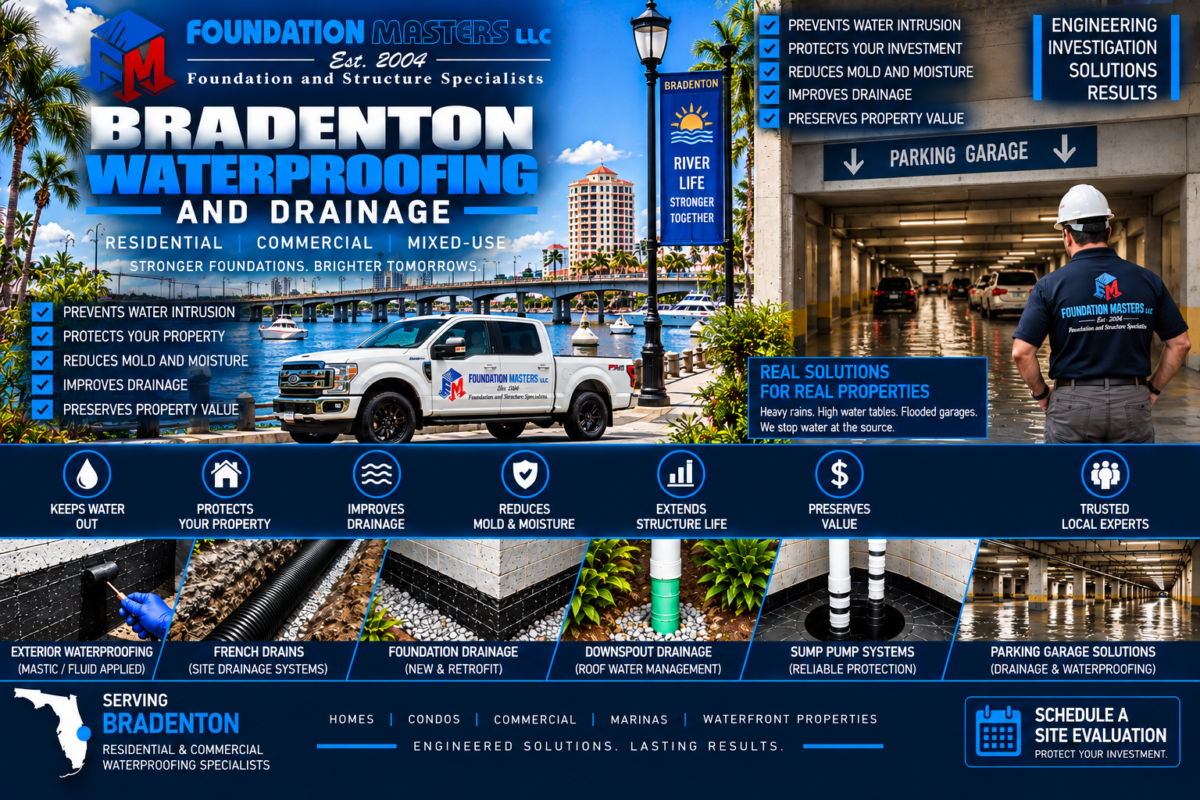
Parking Garage Waterproofing in Bradenton
A below grade or partially below grade parking level is the hardest waterproofing problem in any coastal city, and it is the one most often handled backwards. The structure sits in the groundwater rather than above it, so it behaves less like a building and more like the hull of a boat. Water is pressing against it continuously, and the only question is whether the assembly that was supposed to hold that pressure is still doing it.
Water gets in through a short list of places. Cracks in walls and floor slabs. Grouted tie back penetrations left from the original excavation. Cold joints where the deck meets the wall. Breaches at the termination, where the above grade wall meets the top edge of the waterproofing. And it is made worse from above by the ordinary things nobody looks at, roof leaders discharging to grade beside the structure and back pitched paving that ponds against the wall instead of running away from it.
Along the Manatee and Braden river corridors the second mechanism applies with force. When the saline wedge is up, the groundwater reaching a below grade wall carries chlorides. Chlorides reach the reinforcement, corroding steel occupies more volume than the steel it replaced, and that cracks and spalls the concrete from the inside. That is how a drainage problem becomes a structural one, and it is exactly what a milestone inspector is looking for. The corrosion is always the expensive end of a sequence that started with water.
A lower level that takes water a few times each wet season is describing its future, not its worst case. A pipe invert does not move, and the receiving water it discharges to is not going down.
Two Things Nobody Tells the Owner
The first is that where the water appears inside the garage is frequently not where it got through the assembly. Water travels laterally between the membrane and the concrete before it finds a way in, so the wet column and the actual breach can be a considerable distance apart. Chasing the wet spot is how an owner pays three times for the wrong repair.
The second is that the standard fix treats the symptom rather than the defect. Because excavating to reach the original exterior waterproofing gets called cost prohibitive, the work is done from the dry side instead: epoxy or urethane injected into the cracks, or a crystalline coating brushed onto the inside face. Forensic practice is candid that this addresses where the moisture shows up and leaves the waterproofing deficiency exactly as it was. Water then migrates to the next available path, and the injection gets repeated.
That is why nobody warranties an injection for the life of the structure. You cannot warranty a symptom. If a garage has been repaired repeatedly and still takes water, the repairs were probably not wrong so much as aimed at the wrong side of the wall.
Fix It From the Water Side
We work the positive side, the face groundwater actually touches. Excavate to expose the wall and the footer, establish where the assembly has failed rather than where the stain is, treat that surface with the Seal Tight Waterproofing System, and then engineer the discharge so the structure is not asked to hold back a standing head of water indefinitely. Near a tidal river that usually means a designed sump and pumped discharge rather than a gravity line, because a gravity line here has hours in the day when it does not work.
Alongside it, the things a wet garage usually also needs: catch basin and trench drain repair, subgrade stabilization, sheet piling cutoff walls where groundwater control demands them, and concrete repair where chlorides have already reached the steel.
There is also a compliance clock. Under Florida Statute 553.899, condominium and cooperative buildings of three or more habitable stories face milestone inspections at 30 years from the certificate of occupancy and every 10 years after, and a garage that is part of such a building sits inside that scope. Waterproofing is separately a named item in the structural integrity reserve study requirements, and for budgets adopted after 31 December 2024 reserves for named items cannot be waived or reduced. Confirm how both apply to your building with your association counsel.
Corrected properly from the water side, the work carries a lifetime transferable warranty. If you want the structure assessed rather than the water stopped, that is a different service and it lives on our parking garage inspection and high rise building inspection pages.
Bradenton and Manatee County
The useful question here is not which neighborhood you are in. It is how close you are to a tidal reach, and how old the structure is.
Downtown and the Historic Neighborhoods
Downtown on the south bank, the Village of the Arts, Point Pleasant, Ware Creek and the older streets between Manatee Avenue and the river. Older housing stock, slabs and footings built to the standards of their day, and the closest thing in the city to a tidal boundary running past the end of the street.
The Braden River Corridor
East and southeast toward Ward Lake and the weir. This is the reach the USGS instrumented, and the properties along it are the ones where the position of the saline wedge is not an abstraction. Fresh above the weir, tidal below it, and a boundary in between that moves with the season.
West Bradenton and Cortez
Out toward the mouth of the river and the bridges to the beaches. Fully tidal, low relief, and the part of the city where a discharge design has to be checked against tide rather than slope. This is also where a lot of the association owned property sits.
Across the County
We work the whole of Manatee and the keys off it: Anna Maria Island, Holmes Beach, Longboat Key, and south into Sarasota.
Bradenton Is a City, and That Matters
Bradenton has been incorporated since 1903 and runs its own building department and its own floodplain administration. Unincorporated Manatee County next door is a separate authority, and so are Palmetto, Holmes Beach, Bradenton Beach and Anna Maria.
That matters when a project runs up against a flood threshold. In a mapped flood hazard area the lowest floor has to be at or above base flood elevation plus one foot, with certification at lowest floor placement and again at final inspection. And whether an older structure gets pulled into that requirement turns on a substantial improvement or substantial damage determination, which is made by the floodplain official with jurisdiction over your parcel rather than by you or your contractor.
The threshold is 50 percent of the market value of the structure alone. Not the land, not the pool, not the dock. On an older Bradenton house the denominator is often a good deal smaller than the number on the tax bill, which is how owners get surprised.
Check your zone through the FEMA Flood Map Service Center or Manatee County Floodplain Management, and confirm anything that turns on a determination with the authority that actually has your parcel, and with counsel.
What the Work Actually Is
Foundation Masters developed the first true engineered waterproofing system in Florida to solve these issues. The process is four steps and it does not vary much.
- Excavating a trench to roughly 12 inches below the slab edge to expose the footer and wall
- Applying the Seal Tight Waterproofing System to protect below grade concrete and footings
- Designing engineered drainage piping or sump discharge to safely redirect water away from the structure and the underlying soils
- Installing gutters and grading corrections to control surface runoff
This stops moisture intrusion, prevents soil erosion, and helps reduce settlement risk under Bradenton properties. Alongside it we handle catch basin and trench drain repair, subgrade stabilization, vapor retarder work under new slabs, and seawall repair in Bradenton where a riverfront edge is part of the problem.
What we do not do here is install a French drain and call it solved. A French drain moves water by gravity to a lower point. On ground where the water table sits 10 to 40 inches down and the receiving water is tidal, the pipe is in the water table and there is no reliable lower point. It has to daylight or be pumped, and if it is being pumped then the gravel trench is not the part doing the work.
Bradenton Drainage and Waterproofing
Why does my yard flood even with drains installed?
Flat coastal terrain and shallow groundwater mean that after heavy rain or high tide, soils saturate and drains cannot empty because groundwater is already near the surface. A drain is a path to somewhere lower, and on low relief ground draining to a tidal river there are hours in the day when nowhere lower exists.
Why is my slab letting moisture through?
Many older homes were built with slabs at or near grade. When storms drop several inches of rain quickly, the water table can rise and contact the slab, degrading vapor barriers and wicking moisture through concrete. With the water table already 10 to 40 inches down in the soils here, it does not have to rise far.
Can you waterproof an existing home in Bradenton?
Yes. Our Seal Tight System is engineered for coastal hydrostatic pressure to keep slabs dry. It is applied to the positive side, the face the groundwater actually touches, which is why it works on a structure that is already built rather than only on new construction.
Do tides and storm surge affect my property in Bradenton?
High tides and coastal surges can raise nearby groundwater and reduce infiltration. Properly engineered drainage and waterproofing decouple the slab from groundwater pressure and route water to safe discharge. Bradenton is built around two tidal rivers, so tidal influence reaches well inland of anything most people would call the coast.
Do you handle commercial parking lot drainage problems?
Absolutely. We repair and retrofit catch basins, storm pipes, and subgrade failures for retail centers, HOAs, and industrial facilities across Bradenton and Manatee County. Details on parking lot drainage systems.
Where can I check my property flood risk?
Use the FEMA Flood Map Service Center or Manatee County Floodplain Management. If your parcel is inside the Bradenton city limits, the city administers it rather than the county.
I am not on the bay. Can my groundwater still be salty?
Yes, and this is the thing worth knowing about Bradenton. In an estuary the denser salt water intrudes upstream along the channel bottom as a wedge under the fresh water running out on top. On the Braden River the USGS monitors conductivity specifically to track that saline wedge moving from the estuary toward the Ward Lake weir. Where the boundary sits depends on river flow against tide, so it moves with the season and with the year.
Why does the efflorescence keep coming back after I clean it?
Because cleaning removes the deposit and not the cause. Efflorescence is dissolved salt carried through concrete by water and left behind when that water evaporates at the surface. If it returns, water is still moving through the wall or slab. It is a useful diagnostic, and it is covered on our efflorescence page.
My yard floods fast and then stays soft for days. Are those two problems?
One problem seen twice. The USGS describes the dominant soils here as nearly level and poorly drained but of moderate to rapid permeability. Water passes through the profile quickly, which is why it floods fast, and then has nowhere to go, which is why it stays. A bigger trench does not solve that. A working discharge point does.
Do you install French drains in Bradenton?
No. A French drain moves water by gravity to a lower point. With the water table at 10 to 40 inches and a tidal receiving water, the pipe sits in the water table and the lower point is not reliably lower. It has to daylight or be pumped. If it is being pumped, the gravel trench is not the part doing the work, and you should be paying for the pump and the discharge design instead.
Why is the concrete near grade rusting and flaking?
Chlorides reaching the reinforcing steel. Corroding steel takes up more volume than the steel it replaced, so it cracks concrete from the inside and pushes the surface off. Near an estuary the chlorides can come from groundwater that is brackish only part of the year, which is why the damage can appear on a building nobody thinks of as waterfront. More on our steel corrosion page.
Does drainage and waterproofing work carry the lifetime warranty?
Qualifying drainage and waterproofing work carries a lifetime transferable warranty, which means it passes to the next owner of the property. Transferability is the part that matters, because a warranty that dies at closing is worth very little on a house you may sell. The scopes and the exclusions are on our warranties page.
Drainage and Waterproofing Services
- Seal Tight Waterproofing System on the positive side of below grade concrete
- Engineered perimeter drainage with a verified discharge point
- Designed sump and pumped discharge where gravity is not available
- Catch basin, trench drain and storm pipe repair and replacement
- Parking lot drainage systems and subgrade stabilization
- Below grade and lower level parking structure waterproofing
- Grading corrections and gutter and leader discharge
- Vapor retarder detailing under new slabs
- Seawall repair and replacement in Bradenton and seawall permitting
- Sheet piling groundwater cutoff
When the Water Has Already Done Damage
Water that has been under a structure long enough stops being a drainage question. If soil has been carried away rather than compressed, or if chlorides have reached reinforcement, the repair is structural and the drainage work is what stops it happening again.
- Foundation repair in Bradenton and house leveling in Bradenton
- Structural engineer, Bradenton
- Steel corrosion in coastal and below grade concrete
- Helical piers, push piers and pipe pile underpinning
- Weathered cracks and how to read what a crack is telling you
- Foundation settlement repair, which explains tilt, sagging and hogging
- High rise building inspection and parking garage inspection
Statewide context sits on foundation repair in Florida and drainage and waterproofing in Florida.
Where Else We Work
Drainage and Waterproofing Florida · All Locations · Anna Maria Island · Holmes Beach · Longboat Key · Sarasota · Lido Key · St. Armands Key · Siesta Key · Casey Key · Venice · Apollo Beach · St. Petersburg · Tampa · Flood Asset Protection · Efflorescence · Geotechnical Engineering Sarasota · Foundation Inspection Florida · Warranties
Get a Drainage and Waterproofing Inspection in Bradenton
Because Florida has no statewide waterproofing code, you need people who understand local soils, fluctuating water tables and coastal pressures. What the code does require is narrower than most owners think. The Florida Building Code requires grading that falls six inches within the first ten feet of the foundation, and two percent on impervious surfaces within that distance. It requires a real foundation drain only where a foundation both retains earth and encloses habitable or usable space below grade, which a Florida slab on grade house never does. And outside a mapped flood hazard area there is no minimum finished floor elevation above adjacent grade and no elevation certification.
Put plainly, on a typical Bradenton house the detail that would actually keep water out is not required and is therefore usually not there. We build it anyway, because the absence of a requirement is not the same as the absence of a problem.
Under new slabs we detail vapor retarders to ASTM E1745, which caps water vapor permeance at 0.1 perms across all classes and requires 45 pounds per inch tensile and 2,200 grams puncture resistance for Class A. The 2021 IRC raised the residential requirement to a minimum 10 mil Class A sheet with 6 inch lapped joints.
Inspections are free. We would rather tell you the repair is drainage than sell you a waterproofing scheme you did not need, and on a fair number of Bradenton properties the honest answer is that the discharge point is the whole problem.
Find Out Where Your Water Is Going
Call for direct help with flooding, moisture intrusion, hydrostatic pressure or drainage system failure. We will tell you what is wrong before we tell you what it costs.