
House Leveling in Cape Coral, FL
Foundation Masters, LLC. Florida licensed engineering firm, CA# 30969.

Every page below is already part of this service area. Jump straight to the one you need.
Foundation Masters, LLC is the trusted house leveling specialist in Cape Coral. Our Florida licensed engineering team brings decades of structural and geotechnical experience to lift, level and stabilize homes across Cape Coral and Lee County.
We correct uneven floors, settlement, crawl space deterioration and structural movement using engineered methods designed for Southwest Florida coastal weather, high groundwater and sandy or limestone soils. From a simple floor lift to deep underpinning or a complete house relocation, our engineers design a code compliant plan and handle the local permitting.
Cape Coral is one of the most unusual places in Florida to work on a foundation. The city is enormous, it is built around one of the largest canal networks anywhere, and the ground under the houses was made rather than found. Those three facts drive almost everything on this page.
House Leveling and Foundation Services in Cape Coral
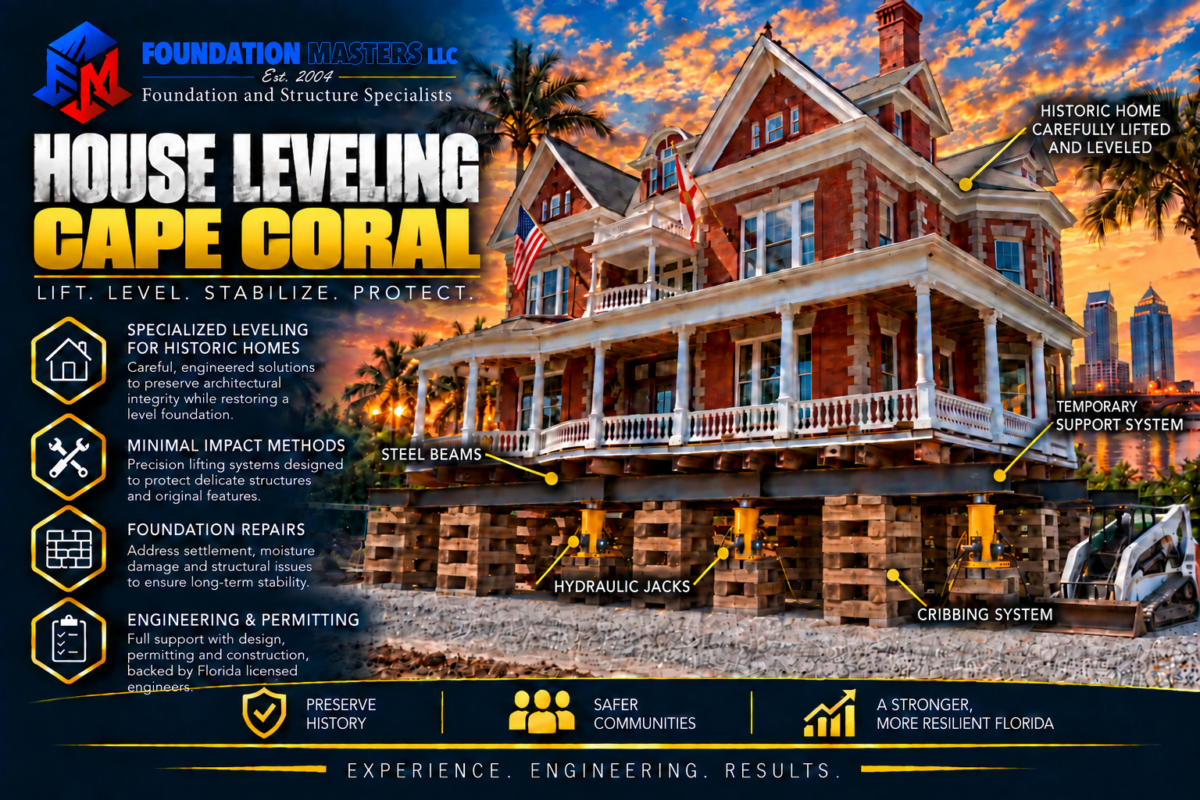
House Leveling and Floor Lifting
Correct uneven floors, sinking piers and settlement related damage to restore safety and value. See smart jacks for adjustable support under a settled floor system.
Underpinning and Structural Stabilization
Engineered solutions including helical piers, push piers and deep foundation support designed for Florida soils.
Structural Shoring and Temporary Support
Emergency stabilization to secure your home during repairs or renovations. See statewide code resources at the Florida Building Commission.
Home and Building Moving
Safe relocation of houses and light commercial structures with full engineering oversight and local permitting. Verify contractor licensing via the Florida DBPR.
Crawl Space Repair and Encapsulation
Moisture control, wood rot replacement and mold remediation for coastal Florida homes. Health guidance is available through EPA Mold Resources.
Engineering Inspections and Preliminary Plans
Free initial inspection and preliminary drawings. Verify Florida engineers via the Florida Board of Professional Engineers License Search.
Financing Options
Flexible programs to help homeowners afford necessary foundation and leveling work. Consumer information is available through the Florida Department of Financial Services.
Pressure Grouting and Void Filling
Where the problem is a void, a collapsed trench or loose material near the surface rather than the depth of bearing, grouting treats that zone directly.
Soil Borings and Geotechnical Data
On a made ground lot the depth of the fill is the design question. Where it governs we take soil borings rather than guessing at it.
Seawall and Canal Bank Work
A tired seawall lets the fill behind it leave. On a canal lot the bank belongs in the same scope as the house.
Drainage and Water Management
Collection, discharge and grade correction so the structural repair holds. See drainage and waterproofing.
Warranty Coverage
Our engineered repairs carry written coverage. Review the foundation repair warranties before you sign with anyone.
For structural repair details, see our Foundation Repair Cape Coral page.
Two Canal Systems, Two Different Foundation Problems
Cape Coral has something almost no other city has: two separate canal systems inside the same street grid. The southern and southwestern canals are saltwater and connect to the river and the Gulf. A large part of the north and central Cape is on a freshwater system that is not tidally connected and is managed with weirs and control structures. Most homeowners know which one they live on. Very few realize it changes the engineering.
On a Saltwater Canal
- The water table under the lot rises and falls with the tide, every day, for decades
- That cycling keeps fines moving and keeps the fill working
- Salt reaches reinforcement, anchors and hardware through cracks and thin cover
- Surge exposure is real, and surge scours loose fill from under a slab edge
- Spalling concrete with rust staining is common and it is structural, not cosmetic
On a Freshwater Canal
- The water level is governed by rainfall and control structures rather than tides
- Big seasonal swings instead of daily ones, which loads and unloads the bank differently
- Far less corrosion pressure on reinforcement and connectors
- Bank slumping and seepage paths matter more than salt attack
- A long dry season followed by a heavy wet one is when movement usually shows up
This is why we ask which canal you are on before we even schedule. On a saltwater lot the structural assessment has to include the condition of the reinforcement, because a repair that stabilizes the soil and ignores corroding steel has only fixed half the problem. On a freshwater lot the question is usually the bank and the seasonal water path, and the concrete is in far better shape than its age would suggest.
New Houses on Seventy Year Old Ground
The other thing that makes Cape Coral unusual is the gap between when the lots were made and when the houses were built. The canal network was dredged and the lots platted starting in the late 1950s, with the material from the canals placed on the lots to raise them. Many of those lots sat empty for decades. Some are still being built on now.
So a house finished last year can be sitting on fill that was placed before anyone alive on the street was born, and was never compaction tested because nobody required it at the time. That is not a reason to panic. It is a reason to find out what is down there rather than assume a new house means new ground.
Old Uncompacted Fill
Canal spoil placed to raise a lot settles for a very long time, and it settles unevenly. A new slab on that material can start moving within a few years.
Buried Organics Below
The original ground here was low flatwoods and wetland. Peat and root mat left in place under the fill compress whenever the load or the water table changes.
Utility Trench Backfill
Water and sewer were extended through established neighborhoods over many years. A trench that was backfilled without proper compaction becomes a settlement path and a water path, often right along a front yard.
Abandoned Septic Tanks and Wells
Much of the Cape was on septic and well for decades. A tank that was not properly crushed and filled when sewer arrived can collapse years later, and it sits directly under a yard, a walk or a driveway.
Loose Sand Densifying
Clean sand carries a house well when it is dense and poorly when it is loose. Under load it tightens up, and the footing goes down with it.
Limestone at Variable Depth
Below the sand the depth to competent limestone changes over short distances. Two lots on the same street can need two different pier depths.
Plumbing Leaks Under the Slab
A leaking supply or drain line washes material out of loose fill continuously. We rule it out before designing anything.
Stormwater Aimed at the Slab
A downspout dumping at a corner or runoff directed at the foundation will empty the ground under a footing edge. Follow the crack and you generally find the water.
Lanais, Cages and Additions
A pool cage, lanai or addition poured later rarely bears the same way as the house, so the two move independently and the joint opens.
If your home is newer and the builder warranty has recently run out, that timing is not a coincidence. Fill settlement very often shows up in exactly that window.
Signs a Cape Coral Home Needs Leveling
One crack tells you almost nothing. A group of them along one wall, one corner or the canal side of the house tells you plenty. Get an engineering inspection before any cosmetic repair, because patching a structure that is still moving buys you one season at most.
Inside the House
- A floor running downhill across a room, or a soft spot that gives underfoot
- Diagonal cracking out of the upper corners of doors and windows
- Doors and sliders that drag, rack or will not latch
- Gaps opening at the baseboard or along the ceiling line
- Grout failing in a straight run across a tile floor
Outside and Underneath
- Stair step cracking through the mortar joints of block or stucco
- A dip in the slab edge, or grade falling away toward the canal
- A pool cage, lanai or Florida room separating from the structure
- A leaning or bulging seawall, or soil pulling away behind it
- A depression following a line across the yard where a utility trench runs
- A hole or soft spot opening where an old septic tank or well used to be
Choosing the Right Method in Cape Coral
There is no single best method. There is a best method for your soil profile, your structure, your canal and the load the repair has to carry. On a made ground lot the question is almost always whether the load needs to go below the fill, or whether the problem is a void and a water path close to the surface. Those two answers lead to very different work.
Helical Piers
Shafts with helix plates turned through the fill to competent material, where the installing torque confirms capacity. No reaction weight needed, which suits lanais, cages, additions and tight canal lots.
Push Piers
Steel sections driven below the footing using the weight of the house as the reaction. A strong fit for a heavier block home with room alongside to work.
Smart Jacks
Adjustable steel supports on new engineered footings, set under the girders of a crawl space or pier and beam structure so the floor levels without touching the perimeter.
Pressure Grouting
Fills and densifies where a collapsed trench, an old tank, a washout or loose fill is the problem rather than the depth of bearing. On this ground it is often the correct first move.
FM PP25 Push Pier
Our own push pier system, engineered and specified in house so the bracket, the pipe and the connection to your footing are designed as one assembly.
FM PP30 Pipe Pile
A heavier pipe pile for larger loads and deeper bearing, which is what the bigger river front and Gulf access homes need.
Concrete and Masonry Repair
Spalled concrete cut back to sound material, reinforcement treated, section restored. On a saltwater canal this is part of most structural scopes.
Structural Shoring
Temporary shoring makes the structure safe while the permanent repair is designed, permitted and built. On anything unsafe it is the first move.
House Lifting and Relocation
Raising a structure above the flood elevation, or moving it outright, with the engineering, the permitting and the field work under one roof.
If a company quotes you one method before anyone has looked at the soil, they are selling a product rather than solving your problem.
How a Cape Coral House Leveling Project Runs
1. Free Inspection
We walk the house inside and out, read the cracking and the drainage, and shoot floor elevations so the movement is recorded as measurements instead of impressions.
2. The Site History
Which canal system, when the house was built, where the utility trenches run, and whether there was ever a septic tank or well on the lot. All of that changes where we look.
3. Soil and Load Data
Where the design turns on how deep the fill goes and what sits under it, we take soil borings and work out what the footings carry.
4. Engineered Design
Our licensed engineers select the system, set pier or jack locations and depths, and issue signed and sealed plans with calculations.
5. City of Cape Coral Permitting
Inside the city limits permits go through Cape Coral rather than Lee County. North Fort Myers, Lehigh Acres and the unincorporated areas go to the county. We confirm it from the parcel and carry the submittal.
6. Install, Lift and Documentation
Crews install the system, then lift in controlled increments with elevations monitored across the structure. You finish with sealed plans, the install record, closing readings and written warranty coverage.
Drainage and bank correction are part of the repair, not an upsell. Carrying the load below the fill fixes the structure. Keeping water and soil where they belong is what stops the next problem opening further along the same wall.
Serving Cape Coral and Lee County
We proudly serve Cape Coral, Fort Myers, North Fort Myers, Lehigh Acres, Bonita Springs, Estero, Sanibel, Captiva, Pine Island and Matlacha. For statewide service, visit our House Leveling Florida hub.
Nearest House Leveling Pages
Why Choose Foundation Masters in Cape Coral
Licensed Florida engineering firm, CA# 30969, with decades of combined experience
Owner operated by Jeff Earl with Ken Sands, P.E. as Chief Engineer
Free on site inspections and preliminary engineering drawings
Fast permitting and code compliant documentation
Trusted by homeowners, builders and real estate professionals throughout Lee County
We design the repair, seal the plans, pull the permit and do the work, all from one office
On made ground a job can change on you. A boring comes back with fill deeper than anyone expected, or the excavation finds an old tank nobody knew about. A crew can only install what was sold. An engineering firm can stop, re measure, revise the design and carry the revision through plan review without handing the problem back to you.
We are also willing to tell you to leave it alone. If the elevations show your floor is within tolerance and the cracking is cosmetic, we will say so and tell you what to watch for. A written opinion that you do not need foundation work is worth exactly as much as one that says you do, and on a house you may be about to sell it is worth more.
Schedule a House Leveling Inspection in Cape Coral
Call us today to schedule your free inspection and receive preliminary plans for your house leveling or structural stabilization project. You are also welcome to send photographs, plans or a written description of what the house is doing for a preliminary review before anyone comes out.
Call Now
Main Office: 813-614-1718
Direct, emergency or temporary shoring: Jeff Earl 656-233-7089
Need help paying for your project? Ask about our financing programs when you call.
Statewide Engineering
House Leveling Florida · Foundation Repair Florida
Structural Engineering · Geotechnical Engineering
Soil Borings · Warranties
House Leveling Cape Coral FAQs
These come up on nearly every first call from a Cape Coral homeowner. If yours is not here, call the office and ask it directly.
What causes a house to need leveling in Cape Coral?
High groundwater, coastal storms, sandy and limestone soils, plumbing leaks, and crawl space wood deterioration can lead to settlement and uneven floors in Lee County homes.
How do you level a house in Cape Coral?
Depending on loads and soils, we use helical or push piers, pressure grouting, and structural shoring to lift and stabilize the structure while meeting Florida Building Code and local permitting requirements.
Can you level and also move my house?
Yes. Foundation Masters is one of the leading house and building movers in Florida, providing engineering plans, permitting, and safe relocation.
How much does house leveling cost in Cape Coral?
Costs vary by home size, access, and settlement severity. Simple floor lifts may cost a few thousand dollars, while deep underpinning or relocation projects require larger structural budgets. We provide free inspections and detailed proposals.
Will I need to leave my home during leveling?
Many projects allow homeowners to remain in place, while major lifts or structural replacement projects may require temporary relocation. We discuss this before work begins.
Do you handle permitting and code compliance?
Yes. As a licensed engineering firm, we prepare plans, manage permitting, and coordinate with the City of Cape Coral and Lee County building departments to ensure compliance.
Does it matter whether I am on a saltwater or a freshwater canal?
It matters a great deal. On a saltwater canal the water table cycles with the tide every day and salt reaches reinforcement through cracks and thin cover, so the condition of the steel is part of the assessment. On a freshwater canal the swings are seasonal rather than daily and corrosion pressure is far lower, so the questions are usually the bank and the water path instead.
My house is almost new. Why would it be settling already?
Because the house is new and the ground is not. The lots here were made in the late 1950s with material dredged out of the canals, and many sat empty for decades before anyone built on them. That fill was never compaction tested, so a recently finished slab can be sitting on seventy year old uncontrolled fill. Settlement showing up right after the builder warranty expires is a very common pattern.
There is a depression running in a line across my yard. What is that?
That line usually marks a utility trench. Water and sewer were extended through established Cape Coral neighborhoods over many years, and a trench backfilled without proper compaction becomes both a settlement path and a water path. Where it runs close to the house it can take material out from under a footing edge.
We used to be on septic. Could the old tank be a problem?
Yes, and it is worth knowing where it was. A tank that was not properly crushed and filled when sewer arrived can collapse years later, and it is sitting under a yard, a walk or a driveway. The same goes for an abandoned well. If a soft spot or a hole has opened near where the old system was, that is the first thing we look at.
Do I need soil borings for a Cape Coral house leveling job?
Often, yes. On a made ground lot the design depends on how deep the fill goes and what sits beneath it, and that changes from one lot to the next on the same street. Where the repair turns on that depth, borings are the only way to design from measured data rather than assumption.
Looking for other areas? Visit our Florida House Leveling hub for statewide service.
Free Cape Coral House Leveling Inspection
Uneven floors, a settling slab edge, a line opening across the yard, or a leaning seawall. We measure it, we engineer it, and we stand behind the lift.
Call 813-614-1718