
Structural Engineer Sarasota
Sarasota is two engineering markets that happen to share a county name. On the keys the governing documents are coastal lines, and there are three of them. On the mainland the water table sits within a few feet of the surface and the governing problem is what the ground does under load. The same set of drawings will not serve both.

The Keys and the Mainland Are Two Different Engineering Problems
Most Florida markets have one governing variable. Sarasota County has two, and which one applies depends on whether you cross a bridge.
On Siesta, Lido, Longboat and Casey Key the project is governed by lines drawn on a map. Construction seaward of them is prohibited outright unless a variance is granted, and where the state line applies the building code fixes the foundation type before an engineer opens a calculation. On the mainland there is no line. There is a shallow water table, a carbonate formation below it, and a settlement problem that shows up years after the certificate of occupancy.
Where We Come In
- New residential and commercial construction across Sarasota County
- Coastal setback and control line design, with engineer certification
- Elevated pile supported foundations on Siesta, Lido, Longboat and Casey Key
- Foundation and load-path design for bayfront and canal lots with seawalls
- Settlement and sinkhole investigation on the mainland and the inland county
- Milestone inspection support on aging bayfront and beachfront mid rise stock
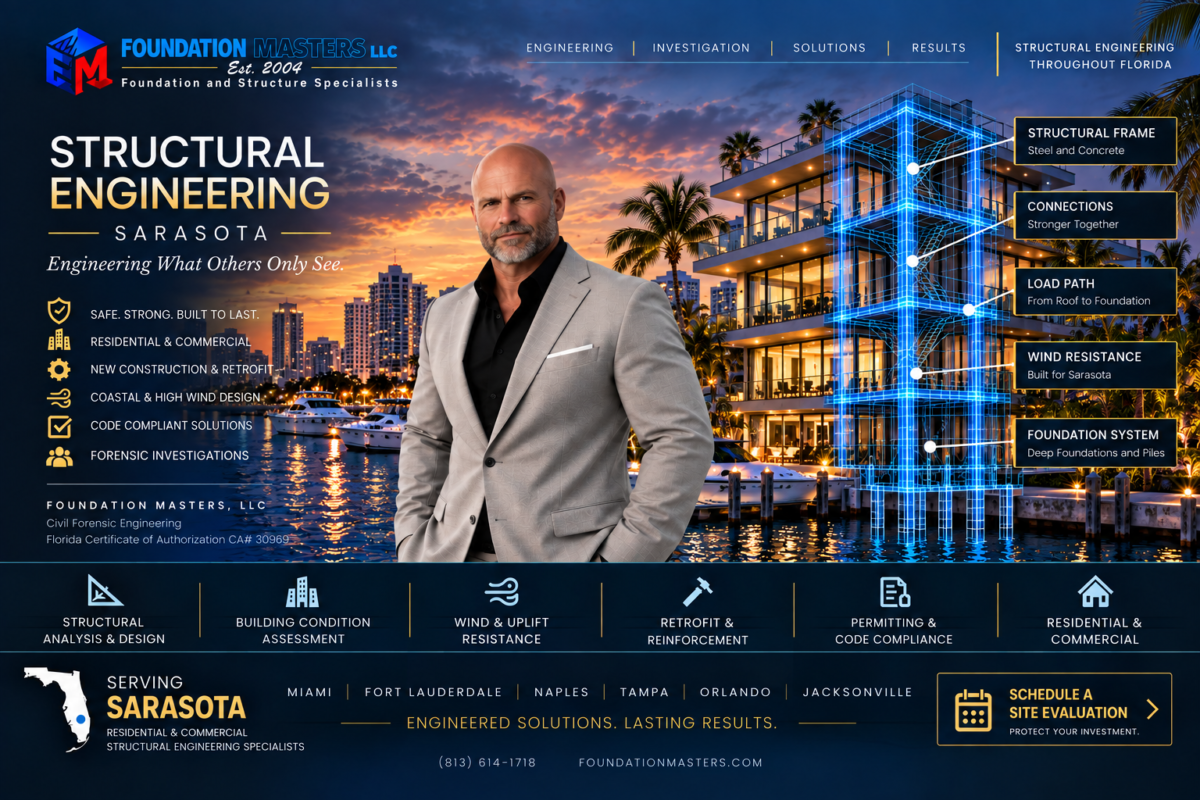
Sarasota County Draws Its Own Coastal Lines, and Seaward of Them Construction Is Prohibited
Every Gulf front county in Florida has the state coastal construction control line, established under section 161.053, Florida Statutes. Sarasota County adds two of its own on top of it, under Chapter 54, Article XXII of the Sarasota County Code, known as the Coastal Setback Code.
The first is the Gulf Beach Setback Line. The second is the Barrier Island Pass Twenty-Year Hazard Line. The county Environmental Protection Division reviews requests for variances to the prohibition of construction and excavation seaward of the Gulf Beach Setback Line or waterward of the Barrier Island Pass Twenty-Year Hazard Line. Note the word prohibition. This is not a setback you design around with a smaller footprint. It is a bar on building there at all without relief from the county.
The county describes the areas those lines protect as coastal high hazard areas where development would be subjected to erosion, flooding and storm damage caused by wind, wave and surge impacts. Certain activities are exempt, and a limited number can be approved by county staff through a Written Conditioned Exception. Everything else goes to the County Commission as a variance request at a public hearing, on the record, with an engineering case behind it or without one.
What Each Line Actually Governs
- The state control line. Where it applies, Section 3109 of the Florida Building Code takes over the foundation. The structure has to be elevated and supported on piles or columns. Shallow foundations and stemwalls are not permitted. The design ratio of pile spacing to pile diameter is not to be less than eight to one for individual piles.
- The Gulf Beach Setback Line. A county line along the Gulf front. Construction and excavation seaward of it are prohibited absent a variance or an exception, regardless of what the building code would otherwise allow.
- The Barrier Island Pass Twenty-Year Hazard Line. A county line drawn around the passes, where the shoreline moves fastest. The same prohibition applies waterward of it. It is the line most often missed, because a lot near a pass can be well back from the Gulf and still be inside it.
- The state design event. Seaward of the control line, all major structures are required to be designed to resist the predicted forces associated with a one hundred year storm event, and a Florida registered engineer or architect certifies to the building official that the design follows Section 3109.
Why This Order of Operations Matters
A variance request that goes to the County Commission without an engineering basis is a request to be told no in public. The county is weighing erosion, flooding and storm damage exposure. The answer to that is not a rendering. It is a foundation and a structure that demonstrably handle the hazard the line was drawn to describe.
So on a Sarasota County barrier island lot the sequence runs the other way from how most owners expect. Establish where all three lines fall on the parcel. Establish which prohibitions and which exemptions are in play. Then design, and build the case alongside the drawings rather than after the first denial.
The Six Variables, Filled In for Sarasota County
Every structural engineering problem in Florida is the same six variables holding different values. This is what they hold here, and it is why the keys and the mainland cannot share a template.
Wind, Exposure, and the Zone Sarasota Is Not In
- Ultimate design wind speed. Sarasota County sits in the middle of the Gulf coast range, lower than Collier County to the south and higher than the inland counties to the east. We pull the value for the actual parcel and risk category from the current code maps rather than using a regional figure, because design pressure rises with the square of speed.
- High Velocity Hurricane Zone. Sarasota County is not in it. That zone covers Miami-Dade and Broward counties only. Sarasota runs the general statewide code path, which changes the product approval route and the testing evidence a submittal has to carry.
- Exposure category. This is where the county splits hardest. Gulf frontage on Siesta, Lido, Longboat and Casey Key is open water exposure. Two miles inland behind the bay and a built up street grid, the exposure drops a category and the design pressures fall with it. Same county, same wind speed, different loads.
Water, Age, and What Is Under the Slab
- Flood zone. The barrier islands are coastal high hazard, which means elevated construction on piles with breakaway enclosures below. The mainland bayfront and the inland county are a different flood problem, and the substantial improvement threshold decides whether a renovation stays a renovation.
- Milestone inspection. Under section 553.899, Florida Statutes, residential condominium and cooperative buildings of three habitable stories or more get a first milestone inspection at thirty years of age, which a local enforcement agency may pull forward to twenty five years where conditions such as proximity to salt water warrant it, then every ten years after. One to four family dwellings with three or fewer habitable stories are exempt.
- Soil and foundation type. A surficial aquifer with a water table typically within five feet of land surface, over the Hawthorn Group. It decides shallow versus deep everywhere the coastal lines have not already decided it for you.
Structural Engineering Services in Sarasota
The same six services we provide across Florida, described in the terms a Sarasota County project actually runs into.
Structural Design and Drawings
Signed and sealed structural engineering drawings for new construction, additions and remodels, built to the criteria for the specific parcel rather than a county wide default.
Coastal Setback and Control Line Work
Elevated pile supported design for barrier island projects, and the engineering case that goes with a coastal setback variance request rather than behind it.
Foundation Design and Installation
Deep foundation systems designed and driven by the same company, so the pile that arrives on site is the pile that was engineered for the soil under it.
Geotechnical Investigation
Soil borings and geotechnical engineering to establish the depth to competent material and whether the confining unit below is intact at this site.
Structural Evaluation
Investigation of cracking, settlement, storm damage and distress, with a written engineering opinion on cause and a repair scope that addresses the cause.
Civil and Site Engineering
Civil engineering for grading, drainage and site work. With a water table this shallow, site drainage in Sarasota County is a structural question in civil clothing.
A Water Table Five Feet Down and Carbonate Below It
The published hydrogeology of central Sarasota County is unusually specific and unusually useful to a foundation engineer. The surficial aquifer has a saturated thickness of roughly forty to seventy five feet, and the water table sits typically within five feet of the ground surface. That single number governs more construction decisions in this county than the wind speed does.
Below the surficial aquifer the sequence runs through the intermediate aquifers. The Tamiami and upper Hawthorn unit begins roughly fifty to seventy five feet below sea level and averages about one hundred feet thick. The lower Hawthorn and upper Tampa unit tops out around one hundred ninety to two hundred twenty feet below sea level and runs two hundred to two hundred fifty feet thick. Confining units separate them.
The Hawthorn Group Arcadia Formation, mapped in Manatee and Sarasota counties, is described as predominantly a carbonate unit with a variable siliciclastic component. In practice that means variably sandy, clayey and phosphatic fossiliferous limestones and dolostones, with thin beds of sand and clay and pockets of silicified carbonate. Carbonate that variable is carbonate that dissolves unevenly, which is the mechanism behind the inland sinkhole risk in eastern Sarasota County.
On the Keys
- Pile embedment is governed by design storm erosion, not just by bearing capacity. The tip has to land below the sand a storm is expected to take.
- Loose beach and dune sand near the surface contributes almost nothing, so capacity comes from depth.
- Salt in the soil and the air makes corrosion protection on reinforcing and pile material a design decision, not a coatings decision.
- Access is the constraint nobody budgets for. Bridges, causeways, narrow lots and tight setbacks all limit what equipment can reach the work.
On the Mainland
- A water table within five feet of grade puts dewatering on the critical path for any below grade work and shortens the open excavation window.
- Buoyancy matters. Shallow groundwater reduces effective stress and can uplift slabs, tanks and pits that were designed as if the ground were dry.
- Variable carbonate and clay in the Hawthorn Group means bearing that can be adequate at one corner of a footprint and marginal at another.
- Where the confining unit thins, inland sinkhole risk rises, and that is a borings question rather than an assumption question.
Five Building Departments, and One Town That Sits in Two Counties
Sarasota County has four incorporated municipalities inside it: the City of Sarasota, the City of Venice, the City of North Port, and the Town of Longboat Key. Everything else is unincorporated Sarasota County. That is five separate building departments, each with its own submittal package, review sequence, inspection schedule and local amendments.
Longboat Key is the one worth knowing about in advance. The town lies in both Sarasota and Manatee counties and is almost equally divided between them, a split that dates to 1921. One town, one building department, two county code layers underneath it. A project on the north end of the island and a project on the south end can answer to different county requirements even though the same town issues both permits.
Add the coastal lines and the count goes up again. On a barrier island parcel the Florida Department of Environmental Protection is in the review where the state control line applies, and the Sarasota County Environmental Protection Division is in it where the Gulf Beach Setback Line or the pass hazard line applies. Sequencing those reviews so they do not each sit waiting on the other is most of the schedule risk on island work here.
Milestone Inspections on the Sarasota Mid Rise Stock
Section 553.899, Florida Statutes, requires a milestone inspection of residential condominium and cooperative buildings three habitable stories or more. The first inspection comes at thirty years of age. A local enforcement agency may pull it forward to twenty five years where conditions such as proximity to salt water warrant it. After that the cycle is every ten years.
Buildings of one to four dwelling units with three or fewer habitable stories are exempt. That exemption covers most of the single family stock on Siesta Key and Bird Key and almost none of the beachfront and bayfront condominium inventory on Longboat Key, Lido Key and along the downtown Sarasota bayfront.
Much of that inventory went up during the decades Sarasota grew fastest, which puts a meaningful share of it at or past the age the statute keys on. Proximity to salt water is precisely the condition the twenty five year provision exists for, and a Gulf front building on a barrier island is about as proximate as Florida gets.
The Bayfront and the Canal Lots
Not every waterfront lot in Sarasota County faces the Gulf. Bird Key, Harbor Acres, the Nokomis and Casey Key canals and much of the mainland bayfront are seawall and basin systems, and on those lots the retaining structure at the water line is part of the structural problem whether it was drawn that way or not.
A seawall holds the ground the house sits on. When it rotates, deflects or loses fill behind it, the first symptom is usually a settlement pattern in the structure rather than a visible defect at the wall. We look at both together, because separating them produces a repair that treats the crack and not the reason for it.
We design and install sheet piling and handle seawall permitting, so the retention, the foundation and the structure above are engineered as one system by one company. With the water table this close to the surface, that integration matters more here than it does in most of the state.
Sarasota County, Island by Island and Inland
Nine areas, and the governing variable changes between most of them. This is the county where the phrase local conditions earns its keep.
Siesta Key
Open water exposure, coastal high hazard flood zone, and the county setback lines running through a market of high value single family and older condominium stock.
Longboat Key
One town, two counties, almost equally divided. The town issues the permit and the county code layer underneath depends on which end of the island the parcel sits on.
Lido Key and St Armands
Narrow island geometry with the Gulf on one side and the bay on the other, plus pass proximity that can put a lot inside the twenty year hazard line.
Casey Key and Nokomis
A long thin key with canal frontage behind it. Seawalls, tight access, and some of the most erosion exposed frontage in the county.
Downtown Sarasota and the Rosemary District
Mid rise and high rise construction on the mainland, where the shallow water table governs excavation and the flood zone governs the ground floor.
Bird Key, Harbor Acres and the Bayfront
Seawall and basin lots on filled ground. Settlement behind the wall and settlement under the house are usually one story told twice.
Venice and the Island
A separate city building department inside the same county, higher ground than most of the coast, and a heavy renovation and addition market.
North Port and the Inland Corridor
A separate city department again, inland platted lots on former agricultural and ranch ground, and the part of the county where karst becomes the primary risk.
Osprey, Palmer Ranch and Eastern Sarasota County
Managed fill, master planned development and large acreage. No coastal layer, a seasonally high water table, and settlement as the governing concern.
What We Establish Before Drawing
- Which of the five building departments has jurisdiction, and on Longboat Key which county the parcel falls in.
- Where the state control line, the Gulf Beach Setback Line and the pass hazard line fall relative to the property boundary.
- Flood zone, base flood elevation, and the design flood elevation the governing ordinance actually requires.
- Exposure category from the upwind terrain in every direction, which on a narrow key is open water in two of them.
What the Borings Have to Answer
- Depth to competent bearing material, and how much it varies across the building footprint.
- Water table depth at the time of work and seasonally, since both drive the construction sequence here.
- Whether the confining unit below is intact at this site or thinning, which is the inland sinkhole question.
- Fill history on dredged and filled bayfront lots, where uncontrolled fill may be carrying a slab never designed for it.
When a Remodel Stops Being a Remodel
A large share of the structural work in this county is renovation, addition and rebuild rather than new construction on raw land. The barrier islands were built out decades ago and the mainland close to the bay was built out before that. The structural question on that work is rarely how to fix the damage. It is whether the code still lets the building stay what it is.
Federal floodplain management rules define a substantial improvement as work whose cost equals or exceeds fifty percent of the market value of the structure before the work began, and they define substantial damage the same way against the value before the damage. Cross that threshold and the building is treated as new construction, which on a Sarasota barrier island lot can mean elevating the entire structure and putting it on piles.
Local ordinances may set a stricter threshold than the federal minimum, and the number that governs is the one in the ordinance for the jurisdiction the parcel sits in. With five departments in this county that is not a footnote. It is the first question worth answering, because it decides whether the project is a permit or a redesign.
Criteria First, Then Drawings
The failures we get called to look at in Sarasota County are rarely calculation errors. They are criteria errors. A building designed to a mainland exposure category on an open water lot, a slab designed as if the ground were dry, a variance request that reached the County Commission without an engineering case behind it.
So we settle the criteria before we draw. Jurisdiction and county. The three coastal lines. Wind speed for the parcel and risk category. Exposure. Flood zone and design flood elevation. Soil and water table at the site. Those answers, confirmed against the governing sources, and only then does the structure get designed.
Then we install what we designed. We drive the pipe pile, install the micropiles, build the drilled shafts and set the sheet piling with our own crews and our own equipment. Nothing gets value engineered out of the foundation between the seal on the drawing and the work in the ground, because one company answers for both.
Structural Engineering in Sarasota: Common Questions
Do I need a structural engineer for a project on Siesta Key or Longboat Key?
On barrier island work in Sarasota County, yes, and usually for more than one reason. Where the state coastal construction control line applies, a Florida registered engineer or architect has to certify to the building official that the design follows Section 3109 of the Florida Building Code. Separately, a coastal setback variance request to the county is an engineering argument, and it is far better made with engineering behind it than after a denial.
What is the Gulf Beach Setback Line?
It is a Sarasota County line along the Gulf front, established under Chapter 54, Article XXII of the Sarasota County Code, the Coastal Setback Code. Construction and excavation seaward of it are prohibited unless the county grants a variance or the work qualifies as exempt or for a Written Conditioned Exception. It sits on top of the state control line, not instead of it.
What is the Barrier Island Pass Twenty-Year Hazard Line?
It is the second Sarasota County coastal line, drawn around the barrier island passes where the shoreline moves fastest. The same prohibition on construction and excavation applies waterward of it. It is the line owners miss most often, because a parcel can sit well back from the Gulf and still fall inside the pass hazard line.
Can I build seaward of the Gulf Beach Setback Line?
Only with relief from the county. The Environmental Protection Division reviews requests for variances to the prohibition on construction and excavation seaward of that line, certain activities are exempt, and a limited number can be approved by staff through a Written Conditioned Exception. Anything else is a variance request heard by the County Commission at a public hearing.
Is Sarasota in the High Velocity Hurricane Zone?
No. That zone covers Miami-Dade and Broward counties only. Sarasota County follows the general statewide provisions of the Florida Building Code, which changes the product approval path and the testing documentation a submittal needs. It does not make the criteria on a Sarasota barrier island lot forgiving, because exposure and flood zone do most of the work here anyway.
Why can I not use a conventional footing on a barrier island lot?
Where the state coastal construction control line applies, the code decides for you. Section 3109 requires the structure to be elevated and supported on piles or columns, and shallow foundations and stemwalls are not permitted. The design ratio of pile spacing to pile diameter is not to be less than eight to one for individual piles, which links pile diameter to layout and sets the pile count early.
Which building department reviews my Sarasota project?
One of five. Sarasota County has four incorporated municipalities, the City of Sarasota, the City of Venice, the City of North Port and the Town of Longboat Key, plus unincorporated Sarasota County. Each sets its own submittal package, review sequence and local amendments, so a Sarasota mailing address does not settle the question.
Which county is my Longboat Key property in?
It depends which part of the island you are on. The Town of Longboat Key lies in both Sarasota and Manatee counties and is almost equally divided between them, a split dating to 1921. The town issues the building permit either way, but the county code layer underneath differs, so we establish it at the start rather than assuming from the address.
How deep is the water table in Sarasota County?
Shallow. Published hydrogeology for central Sarasota County puts the water table typically within five feet of land surface, with the surficial aquifer carrying a saturated thickness of roughly forty to seventy five feet. That single fact governs excavation sequencing, dewatering, slab and below grade design, and buoyancy on anything set into the ground.
Are there sinkholes in Sarasota County?
The mechanism is present inland. Below the surficial aquifer sits the Hawthorn Group Arcadia Formation, described as predominantly a carbonate unit with a variable siliciclastic component, meaning sandy, clayey and phosphatic limestones and dolostones. Carbonate that variable dissolves unevenly, and where the confining unit above thins the risk rises. It is a borings question at a specific site, not a county wide assumption.
Does my Sarasota condominium need a milestone inspection?
If it is a residential condominium or cooperative building of three habitable stories or more, yes. Section 553.899, Florida Statutes, sets the first milestone inspection at thirty years of age, and a local enforcement agency may require it at twenty five years where conditions such as proximity to salt water warrant it. After the first, the cycle is every ten years. One to four unit buildings with three or fewer habitable stories are exempt.
Do you install the foundations you design?
Yes. Foundation Masters is an engineering firm and a deep foundation contractor in the same company. We design the structure and the foundation, and our own crews drive the pipe pile, install the micropiles, build the drilled shafts and set the sheet piling. It closes the gap between what was engineered and what got installed, which is where a large share of foundation problems start.
Sarasota County and the Gulf Coast
The rest of what we do in Sarasota County and along the surrounding coast.
Foundation Repair in Sarasota
Investigation and repair of settlement, cracking and foundation distress on existing Sarasota County structures.
Sarasota foundation repairGeotechnical Engineering in Sarasota
Borings, subsurface investigation and geotechnical recommendations for Sarasota County sites, including the confining unit question inland.
Sarasota geotechnical engineeringDrainage and Waterproofing in Sarasota
Site drainage and below grade waterproofing, which with a water table five feet down is a structural problem as much as a moisture one.
Sarasota drainage and waterproofingLongboat Key Foundation Repair
Foundation work on the island that sits in two counties, where access and salt exposure shape the repair as much as the distress does.
Longboat Key foundation repairSiesta Key Foundation Repair
Settlement and foundation repair on Siesta Key, inside the coastal high hazard zone and the county setback lines.
Siesta Key foundation repairStructural Engineer Venice
The other coastal city inside Sarasota County, on higher ground than most of the coast, with its own building department.
Venice structural engineeringSeawalls and Marine Structures
Design, permitting and installation of seawalls and bulkheads on bayfront, canal and basin lots in Sarasota County.
Seawall contractorPile Driving and Deep Foundations
The installation side of the business, including pipe pile, micropiles, drilled shafts and sheet piling driven by our own crews.
Pile driving contractorsStatewide Structural Engineering
The Florida hub page, with the full service list and every market we cover across the state.
Structural engineering FloridaTalk to a Structural Engineer About Your Sarasota Project
Tell us the address and the scope. We will establish the jurisdiction, the county, where the coastal lines fall and what criteria govern the parcel, and tell you what the project actually requires before you spend money designing the wrong thing.
Foundation Masters, LLC
Structural engineering, geotechnical engineering and deep foundation installation in Sarasota, Siesta Key, Longboat Key and Sarasota County.
Phone: 813-614-1718
Service area: Sarasota, Siesta Key, Lido Key, Longboat Key, Casey Key, Nokomis, Osprey, Venice, North Port and all of Sarasota County.