
Structural Engineer Venice
Venice is famous for the fossil shark teeth that wash up on its beaches, and there is a geological reason for it that almost nobody connects to construction. Those teeth come out of the Peace River Formation, which outcrops on the sea floor just off this stretch of coast. The same formation runs under the town.
The published description of it is worth reading as an engineer rather than as a collector. Fine grained sandy, clayey and phosphatic sediments. Roughly twenty five feet of surface sand sits over it, and the formation itself is thirty to sixty feet thick. So Venice looks like the most solid ground on this coast, and about twenty five feet down it changes character completely.

Explore Florida Structural Engineering Pages
Foundation Masters is headquartered in Tampa and Apollo Beach and we provide structural engineering throughout Florida. The design criteria change more across this state than most owners expect, so each page covers what actually governs in that market rather than repeating the same material. Explore our statewide hub, or jump to another market below.
A Dry Looking Town on a Wet Coastline
Venice reads as the safest Gulf front address in Sarasota County. It sits a little higher than the ground around it, the core feels established and inland, and it is not a barrier island. Every one of those impressions is only partly true.
A few feet of relief on a coastal plain is a real advantage and it is not flood protection. Gulf frontage is Gulf frontage. And the part that matters most to a foundation is not visible at all: the profile under this town changes character at a depth a shallow footing never sees but a building absolutely feels.
That is what makes Venice a different engineering problem from the barrier islands to the north and south of it. On Anna Maria Island or St Pete Beach the code tells you what to do because the flood zone decides it. Here the flood rules are gentler in most of the city, nothing is prescribed, and the question becomes what the ground will actually do over thirty years.
Where We Come In
- Subsurface investigation deep enough to reach the fine grained beds under the surface sand
- Long term settlement analysis where compressible material sits below the foundation
- Foundation design and deep foundation installation on mixed profiles
- Settlement and cracking investigation on the older slab on grade stock
- Waterfront foundation and seawall engineering on the Gulf, the Intracoastal and the keys
- Renovation and addition design, including the substantial improvement question
- Forensic investigation, construction vibration claims and expert witness support
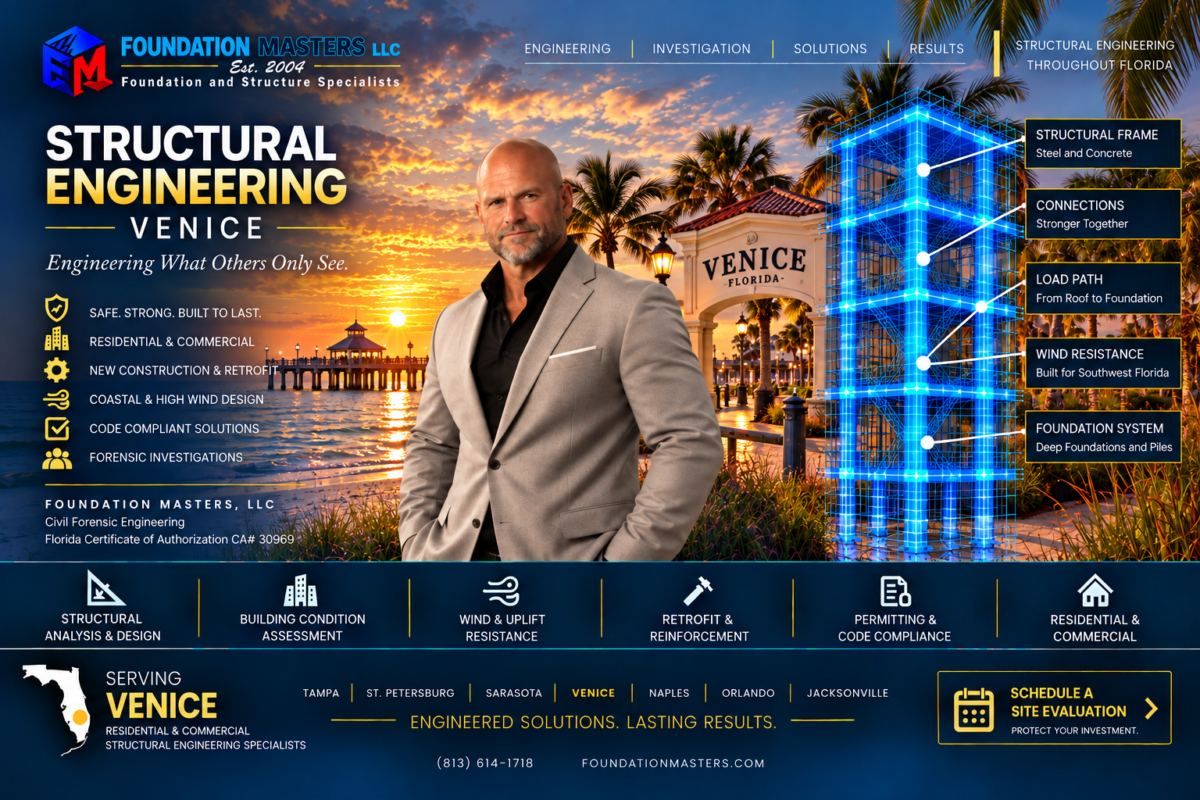
Why Venice Beach Is Famous, and Why It Matters to Your Foundation
The Sarasota County water atlas explains the shark teeth in one sentence: the Miocene aged Peace River Formation is exposed just offshore of Venice, where it outcrops beneath the surface of the Gulf of Mexico, and erosion of the shoreline exposes the fossils, which accumulate along the beaches. Currents erode the deposits and the teeth wash up.
It also explains where the phosphate came from. During the Miocene, large deposits of phosphorite accumulated as cool, nutrient laden ocean water bathed Florida, and those are the deposits that are mined today. The same beds that make Bartow a mining district reach the coast here, and at Venice they come near enough to the surface to put fossils in a bucket.
A published study of the Venice nearshore puts numbers on the profile, and those numbers are the reason this page exists.
What Is Actually Under Venice
The study reports the subsurface in the Venice area as roughly twenty five feet of Quaternary and Pleistocene surficial sediments blanketing the Peace River Formation, which runs about thirty to sixty feet thick, over the Early to Middle Miocene Arcadia Formation at about sixty feet below ground. The figures are published in metres and converted here.
It describes the Peace River Formation itself as fine grained sandy, clayey and phosphatic sediments, and the contact with the formation above it as erosional, generally identified as a dark coloured carbonate mud containing concentrations of reworked phosphate.
Read that as a foundation profile rather than as stratigraphy. Sand at the top, in the depth range a footing occupies. Then several tens of feet of fine grained clayey material. Then carbonate. Three materials, three completely different behaviours, stacked inside the depth a building influences.
Why Clay Behaves Nothing Like Sand
This is the part that decides the design, and it is a timing problem rather than a strength problem. Sand under load settles almost immediately and then stops, because water moves out of it fast. Fine grained clayey material does not. Water leaves it slowly, so it consolidates over months and years, and it keeps going long after the building is finished and everyone has gone home.
Which produces a very particular kind of complaint, and it is common in this market. A house that was fine for years starts showing movement. Nothing changed, no storm, no leak, no new load. What is happening is that a compressible layer below the foundation is still doing what it started doing when the building was built.
It also breaks a lot of routine practice. A boring program that stops at twenty feet sits entirely in the sand and reports good news. A settlement calculation that only considers the bearing layer misses the mechanism. And a pile driven to refusal in a clayey layer does not behave like a pile in sand, because its capacity and its long term movement come from different places.
The Six Variables, Filled In for Venice
Every structural engineering problem in Florida is the same six variables holding different values. Venice has moderate values across five of them and a genuinely unusual sixth.
Wind, Exposure, and the Zone This Is Not In
- Ultimate design wind speed. Mid range for the Gulf coast, lower than Collier County to the south and higher than the inland counties. We pull the value for the actual parcel and risk category from the current code maps rather than using a regional figure, because design pressure rises with the square of speed.
- High Velocity Hurricane Zone. Not applicable. That zone covers Miami-Dade and Broward counties only, so projects here run the general statewide code path, which changes the product approval route and the testing evidence a submittal has to carry.
- Exposure category. A real variable, because this city has water in several directions. A Gulf front parcel and a key parcel have open water upwind. A parcel inside the built up core does not. A parcel on the Intracoastal has a narrower fetch than the Gulf but more than a street. It gets decided from the upwind terrain rather than from the address.
Water, Age, and What Is Under the Slab
- Flood zone. Gentler across much of the city than on the barrier islands either side of it, which is exactly why the comfort here is misleading rather than wrong. The Gulf front, the keys and the low ground still carry real flood zone and design flood elevation requirements, and the substantial improvement threshold still decides whether a renovation becomes a full code upgrade.
- Milestone inspection. Under section 553.899, Florida Statutes, residential condominium and cooperative buildings of three habitable stories or more get a first milestone inspection at thirty years of age, which a local enforcement agency may pull forward to twenty five years where conditions such as proximity to salt water warrant it, then every ten years. One to four family dwellings with three or fewer habitable stories are exempt, which covers most of the stock here.
- Soil and foundation type. The governing variable and the unusual one. Surface sand over several tens of feet of fine grained clayey phosphatic sediments over carbonate. Everywhere else in this cluster the profile is sand over sand, sand over rock, or made ground. Venice is the one market where compressible fine grained material sits inside the depth a building influences.
Structural Engineering Services in Venice
Foundation Masters, LLC provides structural, civil, geotechnical, forensic, and construction-integrated services for residential, commercial, municipal and waterfront projects throughout Venice and Sarasota County.
Structural Design and PE Sealed Drawings
Signed and sealed structural engineering drawings, calculations and details for new construction, additions and remodels, built to the criteria for the specific parcel.
Geotechnical Investigation
Soil borings, SPT testing, groundwater evaluation and bearing analysis, taken deep enough to reach and characterise the fine grained beds under the surface sand.
Settlement Analysis and Diagnosis
Long term consolidation analysis where compressible material sits below the foundation, and diagnosis of movement in structures that were stable for years.
Deep Foundation Design and Installation
Deep foundation systems engineered and installed by our own crews, including pipe pile, drilled shafts and micropiles.
Foundation Repair and Underpinning
Push piers, helical piers and FM PP30 pipe pile for structures already moving, designed from a diagnosis rather than sold from a symptom.
Waterfront and Elevated Construction
Foundation and flood zone design on Gulf front, Intracoastal and key parcels, including elevation where the zone requires it.
Seawalls, Bulkheads and Earth Retention
Seawalls and bulkheads designed, permitted and built as structural elements, with the sheet piling driven by our own crews.
Building Envelope and Waterproofing
Envelope evaluation, leak investigation and drainage and waterproofing design, which on a mixed profile is also a settlement control measure.
Forensic Engineering and Expert Witness
Investigation of structural failures, settlement, construction defects, water intrusion, storm damage and construction vibration damage, with expert witness support for claims and litigation.
Four Kinds of Waterfront Inside One City
Waterfront in Venice is not one condition, and the differences are structural rather than cosmetic. Establishing which one a parcel actually has is the first thing that happens on a project here, because it changes the flood criteria, the exposure category, the retention question and sometimes the permit path.
Gulf front. Open water upwind, the highest flood exposure in the city, and the stretch of coast where the Peace River Formation is outcropping offshore. This is where the state and county coastal lines reach, and where a project is most likely to need elevation.
The Intracoastal Waterway. A channel rather than open Gulf, so the fetch is shorter and the surge geometry is different, but the bank is still a slope with tidal water at the toe. That makes it a stability question as much as a bearing question, and many of these banks carry a wall somebody built without engineering.
The keys. Casey Key to the north and the barrier islands to the south are genuine coastal high hazard barrier island conditions, with the prescriptive pile requirements and the access constraints that go with them. A key parcel and a mainland Venice parcel are not the same project.
Inland canals and the low ground. Water on the parcel, groundwater close to the surface, and drainage that has to be designed rather than assumed, which on a profile with clay below matters more than it would on clean sand.
What We Look For on a Venice Site
- Depth to the fine grained beds, and their thickness and compressibility
- Density and consistency of the surface sand across the whole footprint
- Whether movement in an existing structure is recent or long running, because the rate points at the mechanism
- Load history: when the structure was built, and whether anything has been added since
- Groundwater level and whether it is tidally influenced at this distance from the water
- Which of the four waterfront conditions applies, confirmed rather than assumed
- Flood zone, design flood elevation and the current lowest floor
- Whether a renovation scope approaches the substantial improvement threshold
- Condition and influence zone of any seawall, bulkhead or bank retention
- Whether the reviewing authority is the City of Venice or unincorporated Sarasota County
Two Jurisdictions, and a Stock That Is Old Enough to Have Told You
Sarasota County has four incorporated municipalities in it: Sarasota, Venice, North Port and Longboat Key. Venice is one of them, which means a parcel inside the city limits and a parcel just outside them are reviewed by different authorities, and coastal work can bring county and state agency review alongside the building permit. We confirm the jurisdiction and the agency path before drawings are assembled rather than after.
The Renovation Market, and Why Timing Matters
A large share of the Venice stock is single family slab on grade from the decades when this coast filled in, much of it owned by people who bought it to enjoy rather than to develop. That produces a steady stream of kitchens, additions, lanai enclosures, second bathrooms and whole house remodels.
Two things are worth establishing before any of that is priced. First, whether the scope approaches the substantial improvement threshold, because crossing it converts a renovation into a full code upgrade. Second, whether the structure has a settlement history, because adding load to a building that is already moving on a compressible layer is how a nice project becomes a repair project.
Construction Vibration, and the Neighbour Problem
Venice is dense in places and much of the stock is older masonry and slab on grade, which makes it sensitive to construction alongside it. Driving pile, excavating or dewatering next to a structure that is already carrying distress is how a straightforward job turns into a claim, and on a profile with fine grained material the effects can travel further than people expect.
The way to handle it is to design for it. Account for the influence zone and the construction loads, specify shoring where it is needed, and document the pre-existing condition of the neighbouring structure before work starts rather than arguing about it afterward.
Where a dispute has already developed, we provide the construction vibration damage investigation, the crack documentation, the forensic evaluation and the expert witness work.
Structural Engineer Venice: Frequently Asked Questions
When should I hire a structural engineer in Venice?
Hire a structural engineer when removing load bearing walls, adding stories, planning an addition on an older slab on grade house, seeing foundation settlement or cracking, building on a Gulf front or key parcel, building or replacing a seawall, or when PE sealed drawings are required for permitting. In Venice there is one more trigger worth knowing: if a house that was stable for years has started moving, that pattern is worth a proper diagnosis rather than a repair quote.
Why are there fossil shark teeth on Venice beach?
Because of the formation that runs under the town. The Sarasota County water atlas explains that the Miocene aged Peace River Formation is exposed just offshore of Venice, where it outcrops beneath the surface of the Gulf of Mexico, and that erosion of the shoreline exposes the fossils, which accumulate along the beaches as currents erode the deposits. It also notes that during the Miocene large deposits of phosphorite accumulated as cool, nutrient laden ocean water bathed Florida, and that those are the deposits mined today. The same beds that make Polk County a mining district reach the coast at Venice.
What does that have to do with my foundation?
Everything, because the formation that puts fossils on the beach is also what sits under the building. A published study of the Venice nearshore reports the subsurface as roughly twenty five feet of Quaternary and Pleistocene surficial sediments blanketing the Peace River Formation, which runs about thirty to sixty feet thick, over the Arcadia Formation at about sixty feet below ground. The study describes the Peace River Formation as fine grained sandy, clayey and phosphatic sediments. So the profile is sand at the top, where a footing sits, then several tens of feet of fine grained clayey material.
Why does clay below the sand matter if my footing is in sand?
Because a footing loads the ground well below its own bearing depth. The stress from a foundation spreads downward, so a compressible layer twenty five or thirty feet down is carrying part of the building even though nothing touches it. Sand settles quickly and stops, because water moves out of it fast. Fine grained clayey material consolidates slowly, over months and years, and keeps going long after construction finishes. That is why the mechanism here is a timing problem rather than a strength problem.
My house was fine for years and has just started cracking. Why now?
That pattern is common in this market and it is the signature of consolidation. Nothing has to change for it to appear. A compressible layer below the foundation can still be doing what it started doing when the building was built, and the movement only becomes visible once it accumulates past what the structure can absorb. It is worth distinguishing from the other causes, because drainage, a leak, root activity, added load and framing problems all produce cracking too, and the repairs are not interchangeable.
How deep should soil borings go in Venice?
Deeper than a routine program, and this is the most practical thing on the page. A boring that stops at twenty feet sits entirely inside the surface sand and reports good news, because the surface sand is usually fine. The investigation has to get through the sand and into the fine grained beds and characterise them, since that is where the long term settlement comes from. On anything that matters, a program designed to confirm the bearing layer is not the same as a program designed to find the mechanism.
Does the clay layer change what kind of pile I need?
It can change it substantially. A pile in clean sand develops capacity in a way that is reasonably predictable and stops settling early. A pile that ends in or passes through fine grained material behaves differently, because its capacity and its long term movement come from different places, and driving to refusal in a clayey layer does not mean what it means in sand. That is an analysis question rather than a rule of thumb, and it comes out of the boring logs and the loads.
Is Venice safer than the barrier islands nearby?
In flood terms much of the city is genuinely gentler than Casey Key or the islands to the south, and that is a real advantage. It is also why the comfort here can mislead. A few feet of relief on a coastal plain is not flood protection, the Gulf front and the low ground still carry real flood requirements, and the ground condition that matters most in Venice is not related to flood at all. The honest summary is that Venice trades a prescriptive problem for a judgment problem.
Which building department reviews my Venice project?
It depends on whether the parcel is inside the city limits. Sarasota County has four incorporated municipalities, Sarasota, Venice, North Port and Longboat Key, so a Venice address inside the city and a parcel just outside it go to different authorities. Coastal work can also bring county and state agency review alongside the building permit. We confirm the jurisdiction and the agency path before drawings are assembled rather than after a submittal has been prepared for the wrong one.
Is Venice in the High Velocity Hurricane Zone?
No. That zone covers Miami-Dade and Broward counties only, so projects here follow the general statewide provisions of the Florida Building Code, which changes the product approval path and the testing documentation a submittal needs. Wind criteria on this part of the Gulf coast are mid range, lower than Collier County to the south and higher than the inland counties, and we pull the value for the actual parcel and risk category rather than using a regional figure.
Can you handle a construction vibration or neighbour damage dispute?
Yes, and Venice produces them because the city is dense in places and much of the stock is older masonry and slab on grade. Driving pile, excavating or dewatering next to a structure already carrying distress sends effects past the property line. We provide the vibration damage investigation, the crack documentation, the forensic evaluation and the expert witness work, and on our own projects we design the shoring and document the pre-existing condition of the neighbouring structure before work starts.
Do you provide PE sealed drawings and install the foundations?
Yes to both. Plans and calculations on our projects are prepared and sealed by licensed Florida professional engineers, and we handle the structural details and the responses to review comments. We are also a deep foundation contractor in the same company, so our own crews install the pipe pile, the drilled shafts, the micropiles, the helical and push pier systems and the sheet piling. On a mixed profile where field conditions frequently differ from what a log predicted, having the designer and the installer be the same company keeps a change in conditions from becoming a change order argument.
Venice and Sarasota County
The rest of what we do in Venice, across Sarasota County, and along this stretch of the Gulf coast.
Foundation Repair Venice
Settlement diagnosis and repair in Venice, starting with whether the movement is recent or long running.
Venice foundation repairHouse Leveling Venice
Releveling and structural correction for homes that have already taken differential movement.
Venice house levelingDrainage and Waterproofing Venice
Water management on a mixed profile, where drainage is also a settlement control measure.
Venice drainage and waterproofingCasey Key Drainage and Waterproofing
The barrier island immediately north, with genuine coastal high hazard conditions and island access constraints.
Casey Key drainage and waterproofingStructural Engineer Sarasota
The county seat to the north, where two county coastal setback lines sit on top of the state control line.
Sarasota structural engineeringGeotechnical Engineering Sarasota
Subsurface investigation across Sarasota County, taken deep enough to find what sits below the surface sand.
Sarasota geotechnical engineeringConstruction Vibration Damage
Investigation and documentation where work on one site has damaged the structure next to it.
Construction vibration damageStructural Engineer Bartow
Inland Polk County, where the same Miocene phosphate beds are mined rather than washed onto a beach.
Bartow structural engineeringStatewide Structural Engineering
The Florida hub page, with the full service list and every market we cover across the state.
Structural engineering FloridaSchedule a Structural Engineering Consultation
If you are planning a project in Venice or anywhere in Sarasota County that needs structural engineering, a subsurface investigation, settlement diagnosis, foundation repair, seawall design, forensic evaluation or PE sealed plans, tell us the address and the scope. If a structure is already moving, the first thing we will establish is whether it is still moving, because that decides everything that follows.
Jeff Earl, CEO
Foundation Masters, LLC · Construction & Engineering Management
Florida CA #30969
Phone: 813-614-1718
Service area: Venice, Nokomis, Osprey, Casey Key, Englewood, North Port, Sarasota and Sarasota County.