
Structural Engineering for Clearwater and Pinellas County Projects
Structural Engineer Clearwater. Foundation Masters, LLC proudly offers Structural Engineering, Civil Engineering, and Geotechnical Engineering services across Clearwater and the Tampa Bay / Pinellas County area. We specialize in a fully integrated design-build approach, managing every phase from initial engineering and estimating through physical construction, providing a streamlined, cost-efficient experience for our clients.
Whether your project involves new construction, structural repairs, forensic evaluations, or complex foundation designs, Foundation Masters, LLC brings the expertise and in-house capabilities to deliver outstanding results. Our commitment to technical excellence, innovation, and superior client service has made us a trusted engineering and construction partner throughout the Clearwater and Pinellas County region.

Engineering and Construction Services
Foundation Masters, LLC provides comprehensive engineering and construction solutions designed specifically for the needs of residential, commercial, and municipal projects in Clearwater.
We deliver custom-tailored solutions for developers, contractors, property owners, municipalities, and public agencies across Pinellas County and the Tampa Bay area.
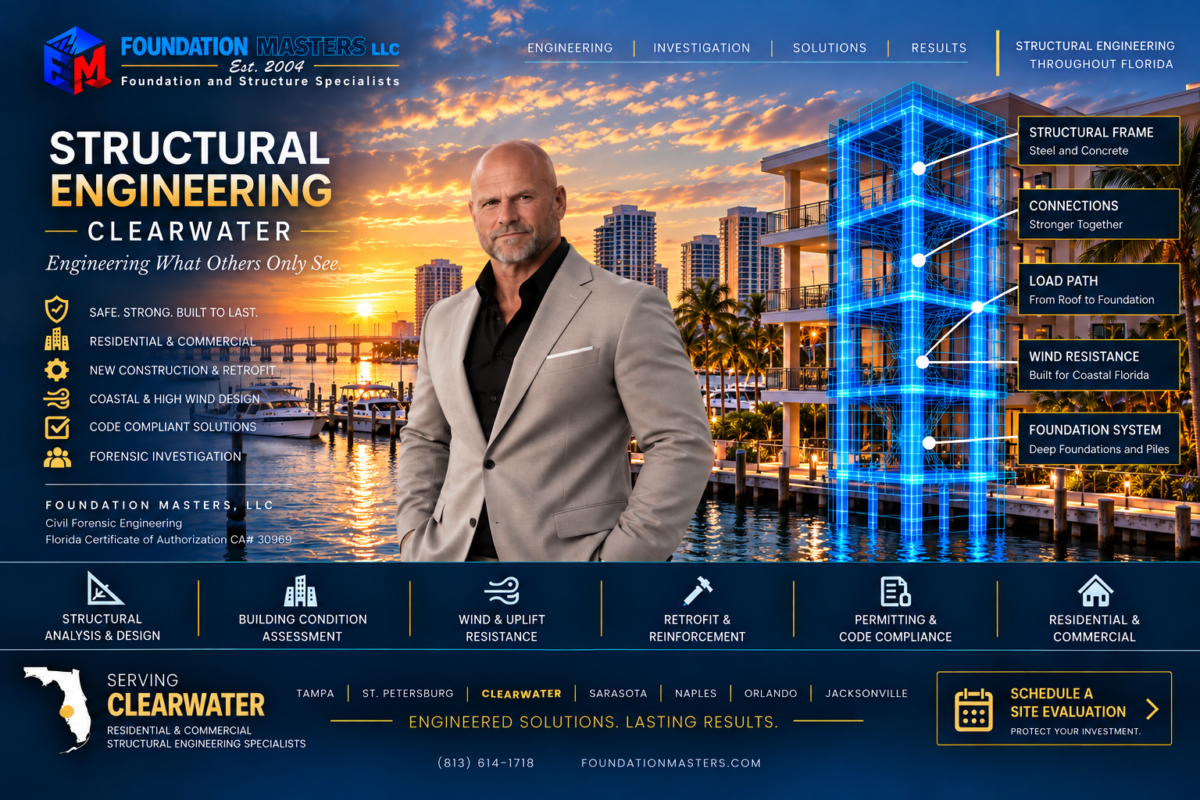
Engineering & Construction Services • Tampa Bay / Pinellas County
One City, Two Completely Different Structural Problems
Clearwater is unusual among Florida cities in that it contains two separate foundation code paths inside one municipality. A parcel on the beach side and a parcel on the mainland can be a few minutes apart, get reviewed by the same building department, and still be governed by entirely different rules about what the structure is allowed to sit on.
That is not a technicality. It is the first thing to settle on any Clearwater project, because it decides the foundation type before a single beam gets sized.
The Beach Side, Where the Control Line Runs
Rule 62B-26.011, Florida Administrative Code, establishes the Pinellas County coastal construction control line under section 161.053, Florida Statutes. It runs the length of the barrier island chain, from Honeymoon Island at the north end, down past Caladesi Island and through Dunedin Pass, Little Pass, Johns Pass, Blind Pass and Pass-A-Grille Channel, to its terminus at Tampa Bay via Bunces Pass on Mullet Key. Clearwater Beach and Sand Key sit inside that chain.
Seaward of that line, a permit to alter, excavate or construct is required from the Department of Environmental Protection, and Florida Building Code Section 3109 takes over the foundation. Structures must be elevated on piles or columns, shallow foundations and stemwalls are not permitted, and for individual piles the spacing to diameter ratio cannot be less than eight to one.
The Mainland, Where Nothing Is Prescribed
Landward of the control line there is no Section 3109 mandate, which means the foundation decision belongs entirely to the engineer. Sometimes that decision is an ordinary shallow foundation and the owner should not be paying for piles. Sometimes the load has to reach deeper. What settles it is the soil profile, the groundwater, the loads and the site, not the absence of a rule.
And the mainland has its own condition, which the beach side does not: limestone at depth, sinkhole activity in the northern part of the county, and a long developed landscape where older lots can carry placed fill near the surface. The beach side problem is water and elevation. The mainland problem is what is underneath.
The Design Criteria That Actually Change in Clearwater
Every structural engineering problem in Florida is built from the same handful of variables holding different values. In Clearwater two of them split the city in half and the rest follow from there.
Wind, Exposure, and the Zone This Is Not In
- Ultimate design wind speed. Moderate by Florida standards for Pinellas County, well below the southeast coast. We pull the value for the actual parcel and risk category from the current code maps rather than using a regional figure, because design pressure rises with the square of speed.
- High Velocity Hurricane Zone. Not applicable. That zone covers Miami-Dade and Broward counties only, so projects here run the general statewide code path, which changes the product approval route and the testing evidence a submittal has to carry.
- Exposure category. This is the second variable that splits the city. A beach side parcel facing the Gulf has open water upwind and falls in the open water exposure category. A mainland parcel inside a built up neighborhood does not. Two structures a short drive apart carry materially different design pressures, and the difference is decided by upwind terrain rather than by the municipal boundary.
Water, Age, and What Is Under the Slab
- Flood zone. Coastal high hazard on the beach side, where the design flood elevation and the lowest horizontal structural member govern the ground floor, versus conventional exposure inland. The substantial improvement threshold applies on both sides, and it is what decides whether a renovation stays a renovation or becomes a full code upgrade with an elevation requirement attached.
- Milestone inspection. Under section 553.899, Florida Statutes, residential condominium and cooperative buildings of three habitable stories or more get a first milestone inspection at thirty years of age, which a local enforcement agency may pull forward to twenty five years where conditions such as proximity to salt water warrant it, then every ten years. Clearwater has a substantial older coastal mid rise stock, so that exception is a live question here. One to four family dwellings with three or fewer habitable stories are exempt.
- Soil and foundation type. Recent barrier island sand on the beach side over a high water table, and on the mainland a sequence of limestone formations at depth with sinkhole activity concentrated in the northern part of the county. Two different subsurface problems requiring two different investigations.
Comprehensive Structural Engineering Services in Clearwater
- Structural design for new residential, commercial, and industrial construction
- Restoration, retrofitting, and rehabilitation of existing structures
- Soil sampling, geotechnical analysis, and site investigation services
- Building envelope evaluations, waterproofing, and leak investigations
- Deep foundation systems, earth retention structures, and pile foundation design
- Roof consulting, structural inspections, and load evaluations
- Foundation stabilization, underpinning, and soil improvement services
- Engineering analysis, forensic investigations, and expert witness consulting
- Threshold inspections for high-rise and essential structures
- Coastal high hazard and elevated pile supported construction on the beach side
- Seawall, bulkhead and shoreline retaining structure design and construction
- Sinkhole and subsidence evaluation with remediation design where warranted
The Rock Under Pinellas County Dips, and That Changes Everything
Pinellas County publishes an unusually clear description of its own geology, and it explains a lot of what engineers actually run into here. The county comprehensive plan states that the county lies on the southwestern flank of the Ocala platform and is underlain by a series of limestone formations, all of which dip toward the south.
That single sentence is the whole story. Depth to rock is not a county wide number, it is a gradient. The plan puts the Suwannee Formation at about one hundred feet in the Tarpon Springs area and dipping to over two hundred fifty feet under St. Petersburg. The Tampa Formation, which sits above it, nearly reaches the surface north of a line from Palm Harbor to Safety Harbor and dips to over one hundred feet in St. Petersburg.
Clearwater sits on that transition. Go north and the rock comes up toward you. Go south and it drops away. Which means a boring log from a project in northern Pinellas and a boring log from a project in St. Petersburg describe genuinely different subsurface conditions, and neither one tells you what is under a parcel in between.
The county also notes that sinkholes are found primarily in the northern one third of the county, inland of the Tarpon Springs area, and that geologists have described the Tampa Formation as the most prone to sinkhole development. Those two statements belong together: the karst risk concentrates where that formation is shallowest.
What We Look For on a Clearwater Site
- Whether the parcel is seaward or landward of the coastal construction control line, confirmed from the map of record
- Flood zone, design flood elevation, and on the beach side the lowest horizontal structural member requirement
- Upwind terrain, because exposure category is a real variable across this city
- Depth to competent bearing material, which on the mainland changes with position in the county
- Density and consistency of the sand profile across the whole footprint rather than at one location
- Groundwater depth, and whether it is tidally influenced near the water
- Indications of karst activity, weighted by where the parcel sits relative to the shallow formation to the north
- Placed fill near the surface on older lots in a long developed part of the state
- For an existing structure, whether the crack pattern points at settlement, subsidence or framing
- Equipment access, which on a barrier island or a tight infill lot is a design constraint and not a detail
On the Beach Side, Access Is a Design Input
A foundation design that cannot be built with the equipment that can physically reach the site is not a design, it is a drawing. On a Pinellas barrier island that is a live constraint rather than a theoretical one, because the beach side is reached by causeways and bridges, the lots are narrow, the setbacks are tight, and the neighbors are close on both sides.
Why This Decides the Pile Type
Section 3109 requires elevation on piles or columns seaward of the control line, but it does not tell you which pile system. That choice comes down to the loads, the soil, and what can be mobilized to the site and operated in the space available.
Large driven pile rigs, drill rigs and cranes each have their own footprint, headroom and access requirements. On a constrained island lot the honest answer is sometimes a smaller high capacity system such as micropiles or helical piers, chosen because they can actually be installed there, and engineered to carry the load with more elements rather than bigger ones.
Working Next to Something That Cannot Move
Pinellas is a long developed and largely built out county, which means very little work here happens on an empty site. New construction, additions and underpinning all tend to happen within a few feet of an existing structure, a seawall, a pool or a neighbor.
That makes construction induced movement a design problem in its own right. Driving pile, excavating, or dewatering next to a structure that is already sensitive to movement is how a modest project turns into a claim, and the way to prevent it is to account for the influence zone and the construction loads in the design rather than discover them in the field.
Where shoring is needed we design it and our own crews install the sheet piling, so the protection of the neighboring structure is part of one sequence rather than a handoff between two companies.
Structural Engineer Clearwater: Frequently Asked Questions
When should I hire a structural engineer in Clearwater?
Hire a structural engineer when you are removing load-bearing walls, adding stories, seeing foundation settlement or cracking, planning coastal/wind-zone construction, or you need stamped drawings for permitting. We serve homeowners, contractors, HOAs, and municipalities across Pinellas County and the Tampa Bay area.
Do you provide PE-sealed drawings and calculations for permits in Pinellas County?
Yes. Our Florida-licensed engineers prepare PE-sealed plans, structural calculations, details, and responses to AHJ comments to streamline permitting for residential, commercial, and municipal projects in Clearwater and surrounding areas.
Can you investigate cracks, sagging floors, or settlement in my home or building?
Absolutely. We diagnose causes (soil, drainage, framing, or foundation issues) and design repairs such as underpinning, shoring, and framing reinforcement. See deep foundation options like helical piers and pipe piles.
Do you offer geotechnical services with structural design in Clearwater?
Yes. We coordinate soil sampling, site investigations, and geotechnical analysis to inform bearing capacity, settlement, and drainage requirements, then integrate those findings into the structural design and foundation selection.
Can you design and inspect deep foundations and earth retention systems?
Yes. We design/install helical piers and pipe piles. We also design and install micropiles, drilled shafts, push piers and sheet piling earth retention, and because the installation crews are ours, the system gets selected partly on what can actually be mobilized to the site.
Is my Clearwater Beach property seaward of the coastal construction control line?
That has to be confirmed from the official map of record for the parcel rather than estimated from how close the water looks. Rule 62B-26.011, Florida Administrative Code, establishes the Pinellas County coastal construction control line under section 161.053, Florida Statutes, and runs it the length of the barrier island chain from Honeymoon Island down to Bunces Pass on Mullet Key. Clearwater Beach and Sand Key sit inside that chain, so it is a real question on any beach side project and it is the first thing we check.
Why do the rules change between Clearwater Beach and the mainland?
Because the coastal construction control line is a code line, and Clearwater has parcels on both sides of it. Seaward of the line a permit from the Department of Environmental Protection is required and Florida Building Code Section 3109 governs the foundation: elevated on piles or columns, no shallow foundations or stemwalls, and a pile spacing to diameter ratio of not less than eight to one. Landward of the line none of that is prescribed and the foundation becomes an engineering judgment based on the actual soil, groundwater and loads.
How deep is bedrock in Clearwater?
There is no single county wide answer, and that is the useful thing to know. The Pinellas County comprehensive plan states that the county is underlain by a series of limestone formations, all of which dip toward the south. It puts the Suwannee Formation at about one hundred feet near Tarpon Springs and over two hundred fifty feet under St. Petersburg, and the Tampa Formation nearly at the surface north of a line from Palm Harbor to Safety Harbor and over one hundred feet down in St. Petersburg. Clearwater sits on that transition, so depth to bearing comes from borings on the parcel.
Is Clearwater in a sinkhole area?
Pinellas County reports that sinkholes are found primarily in the northern one third of the county, inland of the Tarpon Springs area, and that geologists have described the Tampa Formation as the most prone to sinkhole development. Those two facts belong together, because that formation is shallowest in the north. So karst risk here is a question of where in the county a parcel sits rather than a blanket condition, and distinguishing subsidence from ordinary settlement or framing movement is an engineering determination worth making before a repair is designed.
Is Clearwater in the High Velocity Hurricane Zone?
No. That zone covers Miami-Dade and Broward counties only, so projects here follow the general statewide provisions of the Florida Building Code, which changes the product approval path and the testing documentation a submittal needs. Wind criteria in Pinellas County are moderate by Florida standards, and we pull the value for the actual parcel and risk category rather than using a regional figure. Exposure category matters more here than most owners expect, because a Gulf facing beach parcel and a mainland parcel are not in the same category.
Does my Clearwater condominium building need a milestone inspection?
If it is a residential condominium or cooperative of three habitable stories or more, then yes, under section 553.899, Florida Statutes. The first inspection comes at thirty years of age, and a local enforcement agency may pull that forward to twenty five years where conditions such as proximity to salt water warrant it, then every ten years after that. Clearwater has a substantial older coastal mid rise stock, so that exception is a live question here. One to four family dwellings with three or fewer habitable stories are exempt.
Can you work on a narrow beach lot with limited access?
Yes, and that constraint frequently decides the design. Section 3109 requires elevation on piles or columns seaward of the control line but does not specify which pile system, and the choice comes down to loads, soil and what can be mobilized to the site and operated in the space available. On a constrained island lot the right answer is often a smaller high capacity system carrying the load with more elements rather than bigger ones. Because we are the engineer and the installer in one company, we know what our own crews and equipment can get onto a site, so the design is buildable when it leaves the office.
Local Engineering Experience Backed by Statewide Depth
Over the last decade, Foundation Masters, LLC has built a team of engineers, project managers, and licensed contractors offering over 125 years of combined experience in structural, civil, and geotechnical engineering.
Headquartered in Tampa and Apollo Beach, we proudly serve Clearwater and surrounding Pinellas County communities, providing technical expertise tailored to the local climate, soil challenges, and construction codes.
Our Areas of Expertise Include
- Structural engineering for residential, commercial, and industrial buildings
- Coastal engineering and flood mitigation for waterfront and flood-prone areas
- Foundation engineering, soil stabilization, and deep foundation systems
- Waterproofing systems and building envelope assessments
- Structural retrofitting and renovations for aging properties
- Forensic engineering services and expert witness support
- Load-bearing analysis and property condition evaluations
Built to Perform in the Field, Not Just on Paper
Clearwater and Pinellas County
The rest of what we do in Clearwater, along the Pinellas barrier islands, and around Tampa Bay.
Foundation Repair Clearwater
Settlement diagnosis and repair across Clearwater, on the beach side and on the mainland.
Clearwater foundation repairDrainage and Waterproofing Clearwater
Envelope and drainage work, which near the water is structural rather than a finish trade.
Clearwater drainage and waterproofingHouse Leveling Clearwater
Releveling and structural correction for homes that have already taken differential movement.
Clearwater house levelingStructural Engineer St. Petersburg
The south end of the county, where the limestone has dipped away and corrosion drives the long term problem.
St. Petersburg structural engineeringStructural Engineer St. Pete Beach
Further down the same barrier island chain, entirely inside the coastal high hazard area.
St. Pete Beach structural engineeringIndian Rocks Beach Foundation Repair
The island immediately south of Sand Key, with the same access and elevation constraints.
Indian Rocks Beach foundation repairStructural Engineer Tampa
Across the bay, where limestone and karst activity drive the foundation question inland.
Tampa structural engineeringSoil Borings and Geotechnical Testing
The investigation that answers the depth to bearing question, which in this county changes with position.
Soil boringsStatewide Structural Engineering
The Florida hub page, with the full service list and every market we cover across the state.
Structural engineering FloridaExplore Florida Structural Engineering Pages
Foundation Masters provides structural engineering across Clearwater and Tampa Bay and throughout the state. The design criteria change more across Florida than most owners expect, so each page covers what actually governs in that market. Explore our statewide structural engineering hub, or jump to another market below.
Start Your Clearwater Project with an Engineering Team Built for Performance
Foundation Masters, LLC delivers engineering, inspections, forensic evaluations, repair design, and construction-integrated solutions for demanding projects throughout Clearwater, Pinellas County, and the Tampa Bay area.
Jeff Earl, CEO
Foundation Masters, LLC · Construction & Engineering Management
Florida CA #30969
Phone: 813-614-1718
Service area: Clearwater, Clearwater Beach, Sand Key, Dunedin, Largo, Safety Harbor, Belleair, Indian Rocks Beach, St. Petersburg and Pinellas County.