
Structural Engineer Sebring
Sebring sits at the southern end of the Lake Wales Ridge, which Florida State Parks describes as the highest and oldest ridge in Florida, running about one hundred miles from Clermont in Lake County south to Sebring and terminating in Venus, Highlands County. The ridge is made of ancient dunes that were once islands, and the habitat on it is described as relatively dry and desert-like.
High ground and sandy well drained soil sounds like the easiest foundation conditions in the state. It is not, and the reason is what that same sand is doing to the rock underneath it. The United States Geological Survey describes the Lake Wales Ridge as an uplands recharge area containing many sinkhole lakes. Those lakes are the visible part. The rest is under the sand.

Explore Florida Structural Engineering Pages
Foundation Masters is headquartered in Tampa and Apollo Beach and we provide structural engineering throughout Florida. The design criteria change more across this state than most owners expect, so each page covers what actually governs in that market rather than repeating the same material. Explore our statewide hub, or jump to another market below.
High and Dry Is Not the Same as Stable
On the coast an owner knows there is a problem, because the water is right there. On the ridge the ground looks like the safest in Florida, and that is precisely what hides the two mechanisms that actually cause damage here.
Elevation protects you from surge. It does nothing about what is happening two hundred feet down. The USGS describes the generalized groundwater flow of the Lake Wales Ridge as water moving downward from the surficial aquifer into the intermediate aquifer and the Upper Floridan aquifer, primarily under the ridges. The ridge is where the water goes in.
Water moving down through a thick sand column into carbonate rock is the engine of dissolution. It is why the same agency describes this ridge as containing many sinkhole lakes. Those lakes are dissolution features that reached the surface. The ones that have not reached the surface are the engineering problem.
Where We Come In
- Distinguishing sand settlement from karst related subsidence, which is the whole diagnosis here
- Subsurface investigation through deep sand to competent bearing
- Foundation design where the sand is thick, loose or variable across a footprint
- Deep foundation design and installation, including drilled shafts and pipe pile
- Sinkhole and subsidence evaluation with remediation design where warranted
- Lakefront and lake adjacent foundation engineering
- Forensic investigation, insurance claim support and expert witness work
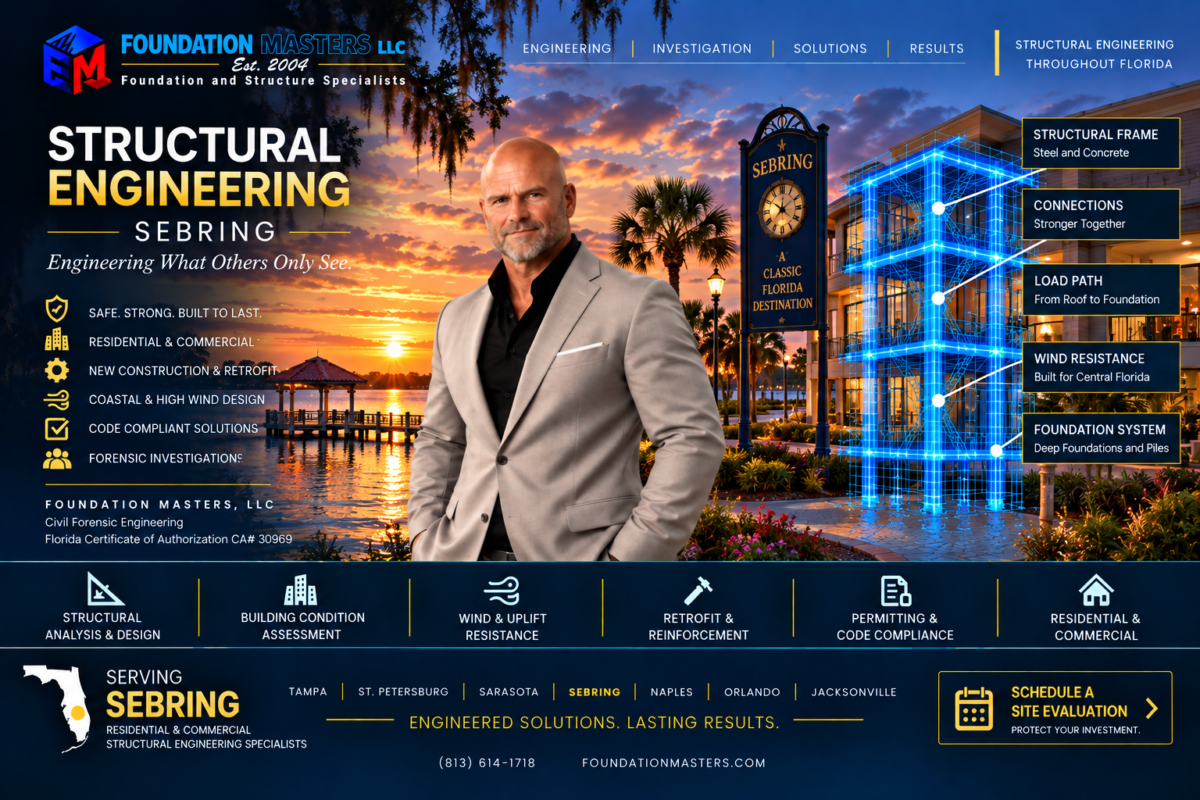
What Is Actually Under a Sebring Lot
The profile on the ridge has a shape that matters more than any single number in it. At the top is sand, and it can be thick. Below that the USGS describes the surficial aquifer as generally unconfined and composed primarily of clastic deposits, underlain by the confined intermediate aquifer and confining units, which consist of up to three water bearing units composed of interbedded clastics and carbonate rocks.
Below all of it is the Upper Floridan aquifer, described as a thick, hydraulically connected sequence of carbonate rocks about twelve hundred to fourteen hundred feet thick. That is the rock that dissolves, and on the ridge it is a long way down.
Which produces the defining characteristic of this market. Where carbonate is shallow, a dissolution feature announces itself: a hole opens. Where carbonate is deep under a thick sand cap, it does not announce anything. Sand migrates downward into the void a little at a time and the surface settles slowly and broadly instead of collapsing.
A slow, broad settlement is exactly what ordinary foundation settlement looks like. That is the trap in Sebring, and it runs in both directions. Karst related subsidence gets written off as normal settlement and repaired with a scope that cannot work, or ordinary settlement gets called a sinkhole and an owner spends money on remediation they never needed.
Mechanism One: The Sand Itself
Ridge sand is clean, uniform and fine, because it is relict dune and shoreline material. Clean uniform sand has no cohesion and no fines to bridge anything, so its behavior under load depends almost entirely on how dense it is, and it can be loose to significant depth without anything at the surface suggesting it.
Loose sand settles when loaded, and it can settle again when its moisture condition changes. A parcel that is dry, above the water table and well drained by nature is also a parcel where a leaking service line, a redirected downspout or a new irrigation system introduces water into a soil column that has not had it. That is a recognized settlement mechanism and it is worth evaluating rather than assuming.
Mechanism Two: Subsidence From Below
The second mechanism starts in the carbonate and travels up. It is driven by the same downward moving recharge water that makes the ridge valuable as an aquifer recharge area, and it is slow by nature because the sand column above it has to give way gradually.
The USGS also notes that below normal rainfall and increased groundwater pumping have produced declines in groundwater levels and in the water levels of many of the ridge lakes. Changing groundwater levels are a recognized factor in subsidence activity, because the support the water provides inside a soil column is part of what holds it in place.
None of that makes a given parcel unsafe. It makes the question worth asking properly, with borings placed to find a boundary rather than to confirm a hope.
Lakefront on the Ridge Means Something Specific
Sebring is built around water, and lakefront is the premium product in this market. It is also the condition that most deserves an engineer before a purchase rather than after.
The reason is the USGS description of this ridge as an uplands recharge area that contains many sinkhole lakes. On the ridge, a lake is frequently not a low spot that filled with rain. It is a dissolution feature that intersected the water table. Buying on the shore of one means buying next to the visible expression of the exact process that concerns an engineer.
That is not a reason to avoid lakefront, and plenty of it performs perfectly well. It is a reason to know the profile under the specific parcel, the depth and consistency of the sand, the groundwater condition, and whether there is any indication of activity, before a foundation is designed or a price is agreed.
Lake adjacent lots bring a second, more ordinary set of issues as well: a bank with a slope, groundwater close to the surface at the shore, seasonal stage changes in a basin that may not drain quickly, and in many cases a retaining structure or a seawall that somebody built without engineering.
What We Look For on a Sebring Site
- Thickness and density of the sand column, measured with depth rather than assumed
- Consistency of that profile across the whole building footprint, not at one location
- Whether the damage pattern is broad and bowl shaped or localized and linear
- Depth to competent bearing, and whether it is continuous under the structure
- Groundwater level, and how far it sits below the foundation
- Any indication of downward soil migration or loss of ground
- Proximity to a lake, a closed depression or a mapped feature
- Drainage, irrigation and plumbing, because introduced water is a real trigger in dry sand
- Whether prior repairs treated a symptom rather than a mechanism
- For an existing structure, the rate of movement, which separates the two mechanisms better than anything else
The Six Variables, Filled In for Sebring
Every structural engineering problem in Florida is the same six variables holding different values. Sebring has the mildest set of above ground criteria of any market we cover, and the most interesting below ground question in the state.
Wind, Exposure, and the Zone This Is Not In
- Ultimate design wind speed. Among the lowest in Florida. Highlands County sits inland, well away from both coasts, and the criteria reflect it. We still pull the value for the actual parcel and risk category from the current code maps rather than using a regional figure, because design pressure rises with the square of speed and the difference between a guess and a value is money in both directions.
- High Velocity Hurricane Zone. Not applicable. That zone covers Miami-Dade and Broward counties only, so projects here run the general statewide code path, which changes the product approval route and the testing evidence a submittal has to carry.
- Exposure category. Mostly inland terrain, with one real exception that catches people out. Highlands County has large lakes, and a parcel fronting a wide one has open water upwind. A lakefront house and a house four streets inland are not in the same exposure category, and the difference is decided by upwind terrain rather than by the zip code.
Water, Age, and What Is Under the Slab
- Flood zone. No storm surge this far inland, which removes the variable that dominates every coastal page in this cluster. What replaces it is lake stage and local drainage. Basins here do not always drain quickly, so flood exposure is about where water collects and how long it stays. Flood zone and design flood elevation still govern the lowest floor where they apply, and the substantial improvement threshold still decides whether a renovation becomes a full code upgrade.
- Milestone inspection. Under section 553.899, Florida Statutes, residential condominium and cooperative buildings of three habitable stories or more get a first milestone inspection at thirty years of age, which a local enforcement agency may pull forward to twenty five years where conditions warrant it, then every ten years. One to four family dwellings with three or fewer habitable stories are exempt, which covers most of the stock here.
- Soil and foundation type. The governing variable and the reason this page exists. Deep relict dune sand over a sequence of interbedded clastics and carbonate, with the dissolving rock a long way down. Two settlement mechanisms with similar symptoms and different cures, and no way to tell them apart from the surface.
Structural Engineering Services in Sebring
Foundation Masters, LLC provides structural, civil, geotechnical, forensic, and construction-integrated services for residential, commercial, industrial, agricultural and municipal projects throughout Sebring and Highlands County.
Structural Design and PE Sealed Drawings
Signed and sealed structural engineering drawings, calculations and details for new construction, additions and remodels, built to the criteria for the specific parcel.
Sinkhole and Subsidence Evaluation
Separating karst related subsidence from ordinary sand settlement, with the investigation, the determination and the remediation design where one is warranted.
Geotechnical Investigation
Soil borings, SPT testing, groundwater evaluation and bearing analysis, taken deep enough and at enough locations to measure a thick sand column rather than sample it once.
Deep Foundation Design and Installation
Deep foundation systems engineered and installed by our own crews, including drilled shafts, micropiles and pipe pile.
Foundation Repair and Underpinning
Push piers, helical piers and FM PP30 pipe pile for structures already moving, designed from a diagnosis rather than sold from a symptom.
Civil and Site Engineering
Civil engineering for grading, drainage and site development, which on dry ridge sand is a settlement control measure and not only a water problem.
Earth Retention and Site Walls
Retaining structures for the grade changes that ridge topography and lake banks produce, designed as structural elements and built by our crews.
Forensic Engineering and Expert Witness
Investigation of structural failures, settlement, subsidence, construction defects, water intrusion and storm damage, with repair scope development and expert witness support for claims and litigation.
Threshold Inspections and Code Compliance
Threshold inspection services, structural observation and code compliance review for larger structures, with plan review responses handled as part of the engineering.
Telling the Two Mechanisms Apart Is the Service
Because the symptoms overlap, the diagnosis here is a process of elimination rather than an inspection. These are the discriminators that actually do the work, in roughly the order they matter.
Shape, Rate and Extent
Ordinary sand settlement under a structure tends to follow the load. It concentrates where the loads are heaviest, it slows down as the soil consolidates, and it usually stops. Subsidence from below follows the feature rather than the building, so it can be centered on a part of the structure that carries almost no load, it does not respect the footprint, and it does not necessarily slow down.
Rate is the best single discriminator, which is why monitoring over time is worth more than one more opinion. A pattern that has been stable for years is telling you something a photograph cannot.
What the Borings Have to Be Designed to Find
On thick sand the investigation has to answer two different questions with one program. First, the density of the sand with depth, which decides whether ordinary settlement explains what is happening. Second, whether there is any evidence of loss of ground: a zone of unusually low resistance, material out of sequence, or a soft interval where the profile should be consistent.
Spacing matters as much as depth, because the entire question is variability across the footprint and a single boring at the middle of a building cannot see an edge. A program designed to confirm that everything is fine will usually succeed at confirming it.
We design the program to find the boundary if there is one, then read the logs against the structure we are evaluating rather than receiving a report from a third party and interpreting it at arm length.
Highlands County Practice, and the Stock We See
Sebring is an incorporated city and Highlands County has other municipalities in it along with a great deal of unincorporated land, so the reviewing authority depends on which side of a city limit a parcel sits on. We confirm the jurisdiction before a submittal is assembled rather than after a set of drawings has been prepared for the wrong one. For reference on Florida engineering licensure and professional standards, the Florida Board of Professional Engineers publishes the governing requirements.
Older Homes and a Long Build History
Sebring has a genuine historic core and decades of residential development around the lakes, much of it built before anyone documented what was under it or how the fill was placed. When one of those comes in for a renovation, an addition, a change of use or a commercial conversion, the foundation question arrives with it whether the owner wanted it or not.
The useful move on an older Sebring house is to establish the subsurface condition and the movement history at the start of the project, while the scope can still be adjusted, instead of discovering it once the walls are open.
Agricultural, Industrial and Municipal Work
Highlands County carries a large share of agricultural and light industrial structure, and those buildings are less tolerant of movement than houses are. Long span roofs, heavy point loads on slabs, tanks, equipment pads and racking systems all concentrate load in ways that deep loose sand notices.
Municipal and infrastructure work in the county runs into the same ground, with the added requirement that it be documented and defensible. We provide the structural design, the geotechnical investigation, the threshold inspection services and the construction phase observation as one scope.
Where a claim or a dispute develops, we provide the forensic evaluation, the repair scope and the expert witness work.
Structural Engineer Sebring: Frequently Asked Questions
When should I hire a structural engineer in Sebring?
Hire a structural engineer when planning renovations, removing load bearing walls, building new on the ridge, buying a lakefront or lake adjacent parcel, when a structure is cracking or settling, when subsidence is suspected, or when PE sealed drawings are required for permitting. In Highlands County there is one trigger that matters more than the others: any movement in a structure is worth a proper diagnosis here, because two different mechanisms produce similar damage and they have different cures.
Why is high ground not automatically good ground?
Because elevation protects against surge and nothing else. Sebring sits on the Lake Wales Ridge, which Florida State Parks describes as the highest and oldest ridge in Florida, running about one hundred miles from Clermont south to Sebring and terminating in Venus. The United States Geological Survey describes the generalized groundwater flow there as water moving downward from the surficial aquifer into the intermediate aquifer and the Upper Floridan aquifer, primarily under the ridges. Water moving down through sand into carbonate rock is what dissolves the rock, so the same feature that makes the ground high and dry is what drives the process underneath it.
Is Sebring a sinkhole area?
The USGS describes the Lake Wales Ridge as an uplands recharge area in central Florida that contains many sinkhole lakes. So the process is documented and it is regional rather than hypothetical. What that does not mean is that a given parcel has a problem. Most of this county is built on and performing fine. It means the question deserves a real answer from borings rather than a reassurance, particularly before a purchase or before a foundation is designed.
Why do sinkholes here look like ordinary settlement?
Because of how deep the rock is. The USGS describes the Upper Floridan aquifer as a thick, hydraulically connected sequence of carbonate rocks about twelve hundred to fourteen hundred feet thick, sitting below the surficial aquifer and a confined intermediate aquifer and confining units of interbedded clastics and carbonate. Where carbonate is shallow a dissolution feature opens a hole. Where it is deep under a thick sand cap, sand migrates downward into the void gradually and the surface settles slowly and broadly instead of collapsing. A slow broad settlement is exactly what normal foundation settlement looks like, which is why it gets misread in both directions.
How do you tell the two mechanisms apart?
Shape, rate and extent first, then borings. Ordinary sand settlement follows the load, so it concentrates where the structure is heaviest and it slows as the soil consolidates. Subsidence from below follows the feature rather than the building, so it can center on a lightly loaded part of the structure, it ignores the footprint, and it does not necessarily slow down. Rate is the best single discriminator, which is why monitoring over time beats another opinion. Extent matters too: if the driveway, pool deck, fence line and the neighboring yard are all involved, the building is a bystander rather than the cause.
What is wrong with the sand itself?
Nothing is wrong with it, but it has to be measured rather than assumed. Ridge sand is relict dune and shoreline material, so it is clean, uniform and fine. Clean uniform sand has no cohesion and no fines to bridge anything, which means its behavior under load depends almost entirely on density, and it can be loose to significant depth with nothing at the surface to suggest it. Loose sand settles when loaded, so the answer is to measure density with depth and design for what is actually there.
Can new landscaping or a leaking pipe really cause settlement?
In dry sand it can, and it is worth knowing on a parcel that is naturally well drained and above the water table. Florida State Parks describes the habitat on this ridge as relatively dry and desert-like, and the sandy soils as allowing water to seep down into the deep Floridan aquifer. Introducing water into a soil column that has not had much of it, through a leaking service line, a redirected downspout or a new irrigation system, is a recognized settlement mechanism. It is one of the first things we look at when movement shows up without an obvious cause.
Is lakefront property on the ridge a problem?
It is a condition to understand rather than a problem to avoid, and plenty of lakefront here performs perfectly well. The reason to look carefully is the USGS description of this ridge as containing many sinkhole lakes. On the ridge a lake is frequently not a low spot that filled with rain, it is a dissolution feature that intersected the water table. Buying on the shore of one means buying beside the visible expression of the process an engineer cares about, so knowing the profile under the specific parcel before a price is agreed is worth the cost of the investigation.
Does the falling water level in the lakes matter to my foundation?
It is a factor worth accounting for rather than a cause on its own. The USGS notes that below normal rainfall and increased groundwater pumping have produced declines in groundwater levels and in the water levels of many of the ridge lakes. Changing groundwater levels are a recognized factor in subsidence activity, because the support water provides inside a soil column is part of what holds that column in place. We treat it as context for the investigation, not as a diagnosis.
Is Sebring in the High Velocity Hurricane Zone?
No. That zone covers Miami-Dade and Broward counties only, so projects here follow the general statewide provisions of the Florida Building Code, which changes the product approval path and the testing documentation a submittal needs. Wind criteria in Highlands County are among the lowest in Florida because the county sits inland, well away from both coasts. Exposure category is the one wind variable that still needs attention here, because a parcel fronting one of the large lakes has open water upwind and a parcel a few streets inland does not.
Do you provide PE sealed drawings and calculations?
Yes. Plans and calculations on our projects are prepared and sealed by licensed Florida professional engineers, and we handle the structural details and the responses to review comments for residential, commercial, industrial, agricultural and municipal projects throughout Highlands County and central Florida.
Can you design and install the deep foundations?
Yes. Foundation Masters is an engineering firm and a deep foundation contractor in the same company. We design the structure and the foundation, and our own crews install the drilled shafts, the micropiles, the driven pipe pile and the helical and push pier systems. On a deep sand profile, where the length required is a function of what the borings actually show rather than a standard detail, having the designer and the installer be the same company keeps a change in field conditions from becoming a change order argument.
Sebring and the Central Florida Ridge
The rest of what we do in Sebring, across Highlands County, and up the ridge through central Florida.
Foundation Repair Sebring
Settlement diagnosis and repair in Sebring, starting with which of the two mechanisms is actually in play.
Sebring foundation repairHouse Leveling Sebring
Releveling and structural correction for homes that have already taken differential movement.
Sebring house levelingStructural Engineer Bartow
Polk County to the north, where the question is whether the ground was placed by a dragline rather than deposited.
Bartow structural engineeringWinter Haven Foundation Repair
The lake country of eastern Polk County, on the same ridge system with the same karst behavior below.
Winter Haven foundation repairFoundation Repair Lakeland
Central Polk County, where the transition from ridge sand to phosphate country runs through the market.
Lakeland foundation repairSoil Borings and Geotechnical Testing
The investigation a deep sand profile requires, designed to find a boundary rather than to confirm a hope.
Soil boringsDrilled Shafts
Cast in place deep foundations for carrying load through a thick sand column into competent bearing.
Drilled shaftsStructural Engineer Orlando
The other major inland market, where karst sits under a confining unit rather than under deep ridge sand.
Orlando structural engineeringStatewide Structural Engineering
The Florida hub page, with the full service list and every market we cover across the state.
Structural engineering FloridaSchedule a Structural Engineering Consultation
If you are planning a project in Sebring or anywhere in Highlands County that needs structural engineering, a subsurface investigation, a subsidence opinion, foundation repair, forensic evaluation or PE sealed plans, tell us the address and the scope. If a structure is already moving, the first thing we will establish is which mechanism is causing it, because that decides everything that follows.
Jeff Earl, CEO
Foundation Masters, LLC · Construction & Engineering Management
Florida CA #30969
Phone: 813-614-1718
Service area: Sebring, Avon Park, Lake Placid, Lorida, Venus, Wauchula, Lake Wales and Highlands County.